

When an AI acts on your behalf, whose interests is it actually serving?
Three major AI releases landed this week. On the surface: new models, new markets, new products. Look closer and they're all answering the same foundational design question — just very differently. Here's what each answer means for practitioners and financial services teams.
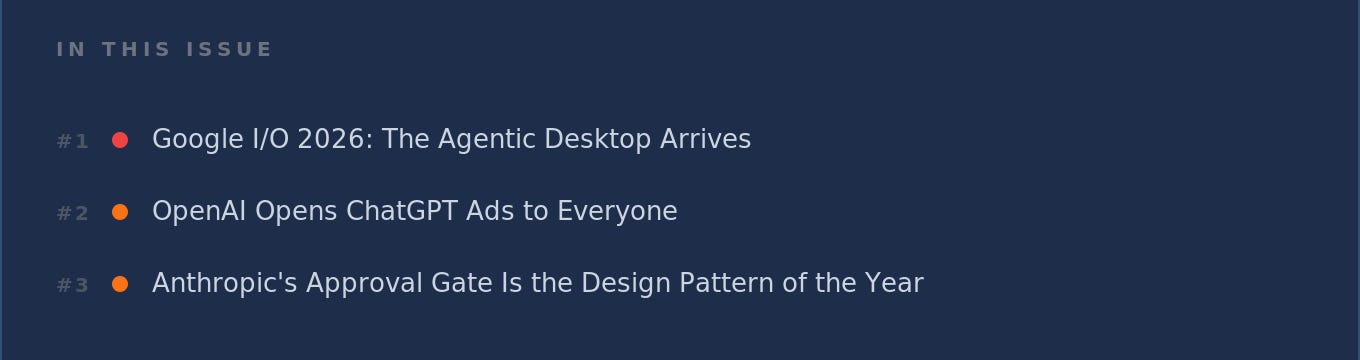
#1Google I/O 2026: The Agentic Desktop Arrives
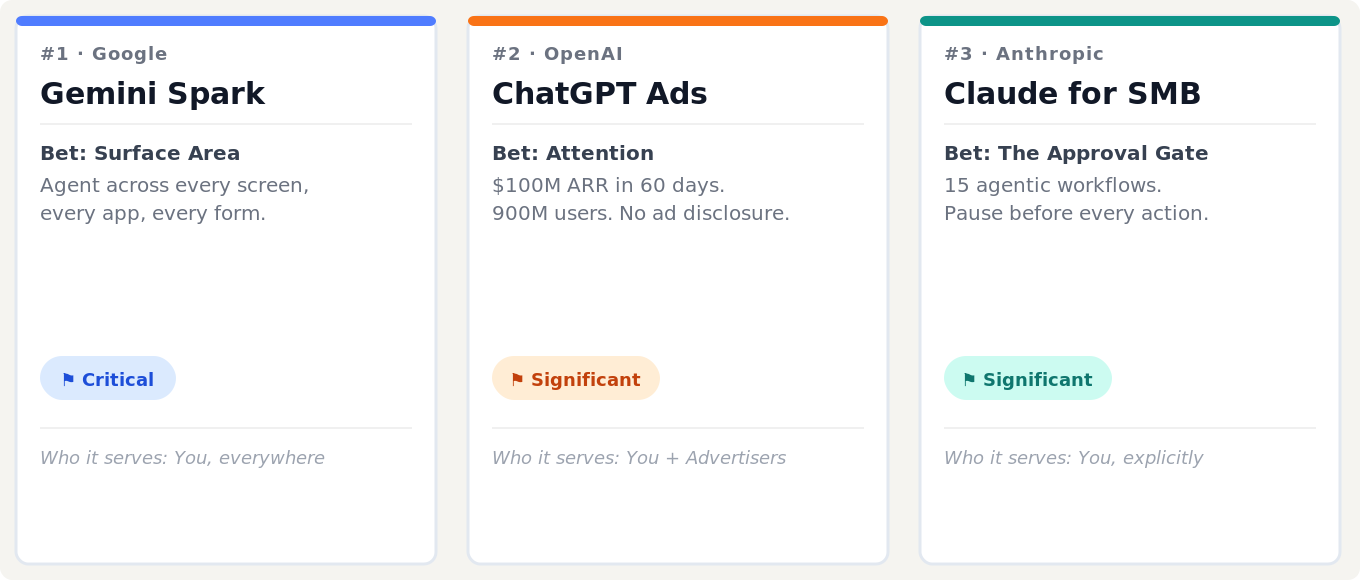
Google didn't ship new models at I/O this week. It shipped an architecture. Gemini Spark is a personal agent that takes actions across your connected apps. Antigravity 2.0 lets you orchestrate multiple agents in parallel from a desktop app. Gemini Omni handles video natively, not as an add-on. Gemini 3.5 Flash matches frontier intelligence at roughly one-third the cost — making agentic loops economically viable for mid-market products for the first time.[1]
Google's answer to the trust question is distribution. The moat isn't model quality, it's surface area. Chrome, Search, Android, Workspace, now a desktop agent hub. The more places Google's AI touches your digital life, the harder it is to choose something else.
For product and UX leaders: your users will soon arrive with AI agents acting on their behalf. Flows designed for direct human input, such as sequential forms, confirmation dialogs, and CAPTCHA gates, may break under agent-driven sessions. Designing for both human and agent usability is no longer an edge case.
Fintech & Financial Services When an agent fills out a loan application or insurance form on a user's behalf, who is legally responsible for the accuracy of the data submitted? Agentic access to financial systems demands new consent scope definitions and audit trail standards and that work hasn't started yet at most institutions.

#2. OpenAI Opens ChatGPT Ads to Everyone
This week OpenAI dropped the $50,000 minimum on its self-serve ChatGPT ad platform, opening it to any advertiser with a campaign budget. The product already hit $100M in annual recurring revenue in under 60 days from launch — one of the fastest ad product ramps in tech history. OpenAI projects $2.5B in ad revenue for full-year 2026.[2]
An AI assistant with paid placements is a fundamentally different trust contract than one without. The early days of sponsored search felt harmless — until it didn’t. What’s most notable here is what’s absent: there is no response-level disclosure telling users when a reply has been shaped by advertiser intent. The contrast to Google’s Content Credentials expansion — which surfaces AI provenance on demand — is striking.
Research on trust calibration in AI systems has found that users given explanations sometimes defer more to AI, not less, producing a false confidence effect. An ad-funded AI without response-level disclosure is the logical endpoint of that dynamic.
Fintech & Financial Services Some financial regulator has determined that incorrect information from an AI chatbot can constitute a UDAAP violation (unfair, deceptive, or abusive acts or practices).[3] If that AI also serves advertiser interests without disclosure, the liability surface for any fintech deploying or integrating ChatGPT expands materially. Legal teams should be reviewing their AI usage policies now.
#3Anthropic’s Approval Gate Is the Design Pattern of the Year
Anthropic launched Claude for Small Business on May 13 — 15 ready-to-run agentic workflows connected to QuickBooks, PayPal, HubSpot, Slack, Canva, Docusign, Google Workspace, and Microsoft 365. No extra charge beyond existing Team or Enterprise plans.[4]
The feature set is interesting. The design constraint is the story: Claude does the work; you approve before anything sends, posts, or pays. This friction-as-feature approach runs directly counter to the prevailing “frictionless” ethos of consumer software — and in a week where Google’s agents have broad default access and OpenAI’s assistant is partly ad-funded, it stands out.
Whether this approach scales without frustrating users who want speed over safety is the defining UX question for agentic products in 2026. But the pattern itself, a structural pause before every consequential action, may be more important than any single workflow it enables.
Fintech & Financial Services The Cambridge Centre for Alternative Finance’s 2026 Global AI in Financial Services Report found that 78% of regulators now rate explainability as critical to their oversight objectives, with formal audit trail guidance expected by year-end.[5] Anthropic’s approval gate creates a natural audit event at every step. For financial services teams under EU AI Act high-risk classification, which explicitly covers credit scoring, fraud detection, and automated access decisions, that architectural choice may matter more than the workflows themselves.
Three products. Three answers to the same question. Google says: the AI serves you everywhere. OpenAI says: the AI serves you and advertisers. Anthropic says: the AI serves you, and it will stop to prove it.
Your users will choose one of these trust contracts, often without realizing they’re choosing. Your job, as a product and UX leader, is to know which contract you’re building on. And to design like it matters. Because it does.
References
Google Blog. “100 things we announced at Google I/O 2026.” May 19, 2026.
blog.google/…/google-io-2026-all-our-announcements
Ads-OpenAI.com. “OpenAI Ads in ChatGPT: Complete Timeline From Leak to $100M ARR.” May 2026.
ads-openai.com/openai-ads-timeline-2026
fin.ai. “AI Agent Compliance for Financial Services (2026).”
fin.ai/learn/evaluate-ai-agent-compliance-financial-services
Anthropic. “Introducing Claude for Small Business.” May 13, 2026.
anthropic.com/news/claude-for-small-business
Cambridge Centre for Alternative Finance. “2026 Global AI in Financial Services Report.”
jbs.cam.ac.uk/…/2026-global-ai-in-financial-services-report