


AI just flagged 23,019 vulnerabilities in the world's most-used open-source software. Less than 1% have been patched. The bottleneck was never discovery — it was always us.
This week is not about AI getting smarter. It is about the infrastructure built to absorb AI's outputs — human review pipelines, consent frameworks, regulatory timelines — running several capability cycles behind the systems they are supposed to govern. Three developments this week make the same argument from different angles.
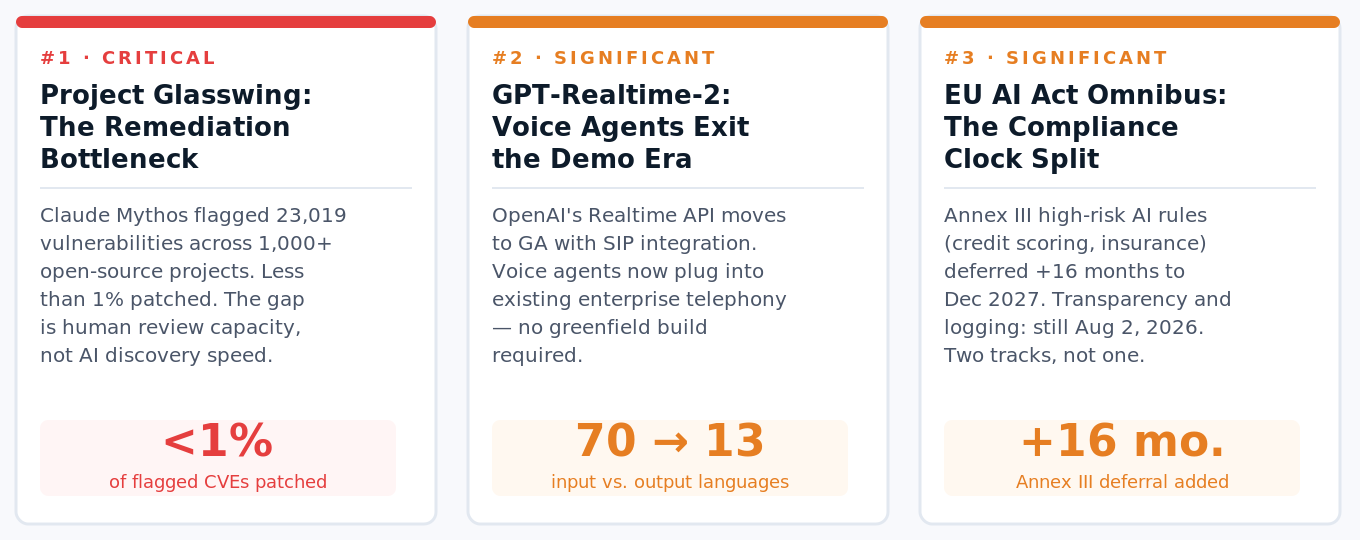
#1 Project Glasswing: The Remediation Bottleneck
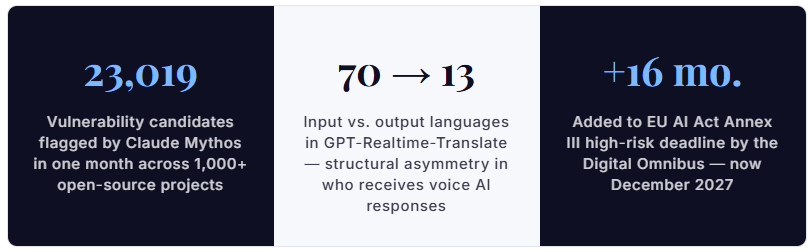
Anthropic’s Claude Mythos Preview scanned more than 1,000 open-source projects and flagged 23,019 vulnerability candidates. After human validation, 1,094 confirmed high- or critical-severity flaws remained.[1] As of the May 22 update, less than 1% of those findings had been patched.[1][3]
The number is not the story. The ratio is. For every confirmed vulnerability, Mythos generated approximately 13 candidates requiring expert human review, a precision rate (7.5%) consistent with traditional static analysis tools, but at a volume no security team was designed to process. The field has spent decades optimizing for vulnerability discovery. It built no equivalent infrastructure for triage at AI velocity.
For product and security teams, this is not a future problem. Every AI-assisted workflow including code review, legal clause generation, diagnostic flagging, will eventually cross the same threshold: output velocity exceeds human review capacity while maintaining non-trivial accuracy. The design question is not “how do we trust the AI?” It is “how do we build a workflow that separates high-confidence findings from low-confidence ones without requiring expert attention on every item?”
Fintech & Financial Services
Financial AI systems operating under post-Omnibus transparency requirements must log every high-risk decision, and those logs must be reviewable by affected individuals and auditors. If AI-generated credit or fraud decisions accumulate faster than compliance teams can review them, the same remediation bottleneck dynamic emerges. Batch disposition interfaces and confidence-weighted audit queues are as urgent in FinServ compliance as they are in security triage.[8]
#2. GPT-Realtime-2: Voice Agents Exit the Demo Era
OpenAI’s three new Realtime API models — GPT-Realtime-2, GPT-Realtime-Translate, and GPT-Realtime-Whisper — moved from beta to general availability on May 7.[4] The same update added MCP server support and SIP phone calling integration, allowing voice agents to operate inside existing enterprise telephony infrastructure. Deutsche Telekom has already deployed GPT-Realtime-Translate for multilingual customer support across European markets.[5]
The practical implication: enterprise voice AI no longer requires a greenfield telephony build. SIP integration means it plugs into existing call routing, IVR trees, and workforce management systems. This is the architectural prerequisite that was missing. It is now present.
The consent and transparency design implications have not caught up. Voice agents operating mid-call, in translated language variants, on behalf of customers who may not know an AI is handling their inquiry represent a consent UX challenge without mature patterns. The “confirm before acting” interaction model — already under strain in agentic desktop contexts — does not translate cleanly to voice, where confirmation signals differ by language and cultural context.
Fintech & Financial Services
GPT-Realtime-Translate’s 70-input, 13-output-language asymmetry has specific implications for financial access. Voice remains the primary interaction channel for underserved and older populations in many markets. A production voice AI that supports 70 languages for input but only 13 for output creates a structural asymmetry: speakers of excluded languages can provide information but cannot receive authoritative answers in their language. Financial institutions building on this infrastructure should evaluate the output language coverage against their actual user demographics before deployment, this is an active design constraint, not a future consideration.[4][8]
#3. EU AI Act Omnibus: The Compliance Clock Split
On May 7, the EU Council and Parliament reached a political agreement under the Digital Omnibus that defers Annex III high-risk AI obligations — including credit scoring, insurance risk pricing, and financial standing assessment — from August 2, 2026 to December 2, 2027.[6] The August 2 transparency and logging requirements are unchanged.
The result is two compliance tracks that most product teams have been treating as one. Organizations that built their AI governance roadmap around a single August 2 deadline have a consequential calibration decision to make immediately: which deliverables belong to which track, and which can be safely deferred.
For teams that built too little: the August 2 transparency requirements, including logging, explainability, documentation, are not deferred. They ship in 64 days. For teams that built comprehensive risk management infrastructure against the original August 2 date: the 16-month extension is real, but financial institutions now operate under national rather than EU AI Office authority, meaning enforcement interpretations may vary by member state.[7]
Fintech & Financial Services
The Omnibus places financial institutions under national regulatory authority for AI Act enforcement, a structural change from the original text’s EU AI Office jurisdiction. For firms operating across multiple EU member states with a single AI credit scoring or fraud detection model, this creates the practical possibility of receiving conflicting compliance directives from different national authorities. AI decision logs, explainability outputs, and human oversight records may need to be structured to satisfy multiple national regimes simultaneously, a documentation architecture problem as much as a legal one.[7][8]
The week’s developments form a single argument: AI’s capability frontier is advancing faster than the human and institutional systems built to absorb, validate, and govern its outputs. The organizations that will navigate this well are not those with the most capable AI. They are those that have designed review pipelines, consent frameworks, and compliance architectures that match the velocity of the AI they are deploying.
That is a design and product problem before it is a technology problem. It is also, unmistakably, this week’s most actionable insight.
References
[1] Anthropic. “Project Glasswing: An Initial Update.” May 22, 2026. anthropic.com
[3] Platform Engineering. “Glasswing Didn’t Just Find 10,000 Vulnerabilities. It Found Cybersecurity’s Next Bottleneck.” 2026. platformengineering.com
[4] OpenAI. “Advancing Voice Intelligence with New Models in the API.” May 2026. openai.com
[6] Council of the European Union. “Artificial Intelligence: Council and Parliament Agree to Simplify and Streamline Rules.” May 7, 2026. consilium.europa.eu
[8] Finextra. “The EU AI Act’s August 2026 Deadline: What Financial Services Firms Must Do Now.” 2026. finextra.com