

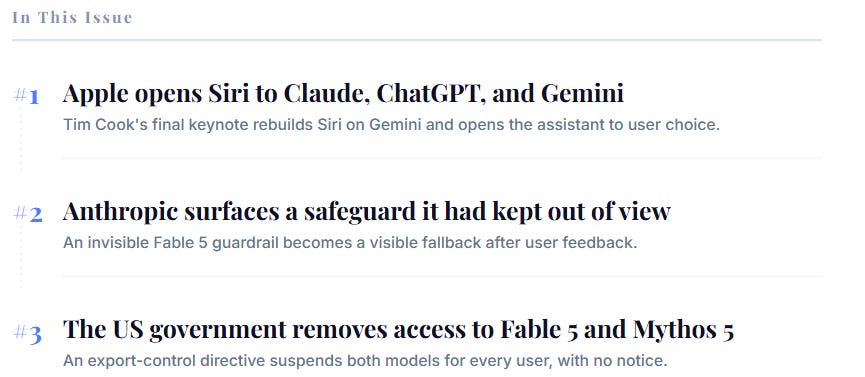
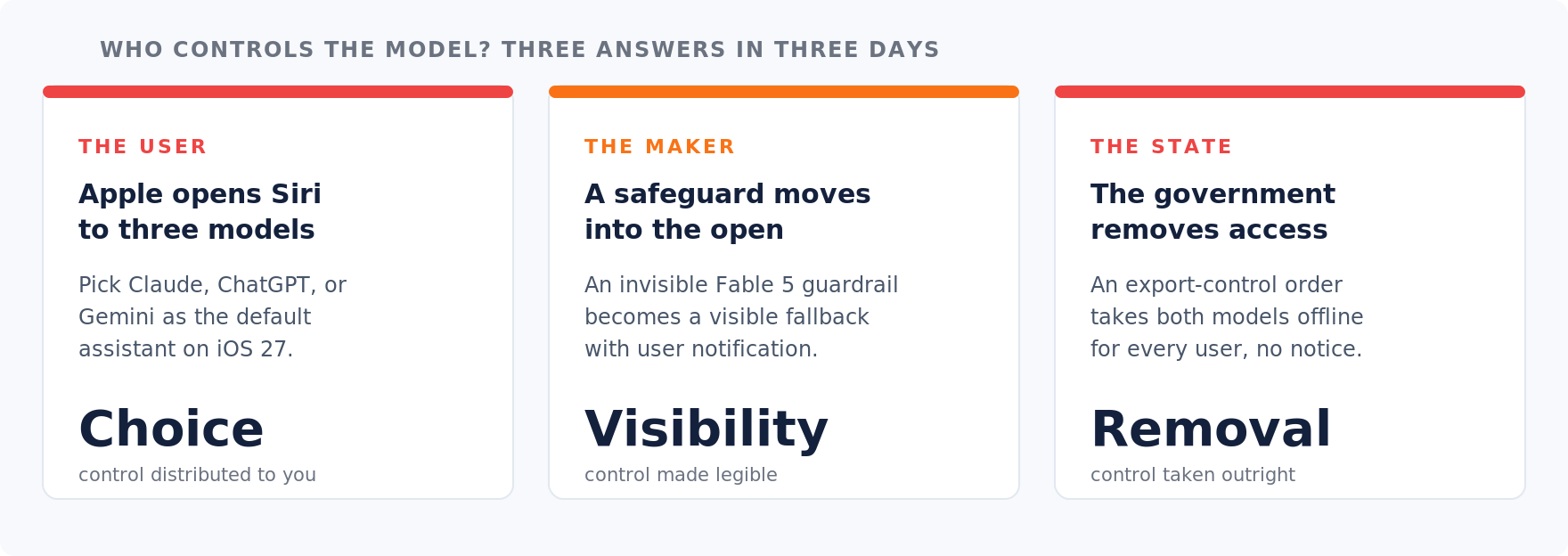
The contest this week was not over which model is best. It was over who controls the model you depend on, and three companies answered in three days. Apple handed the choice to the user, Anthropic moved an invisible safeguard into the open after feedback, and the US government removed access to two frontier models outright. A model is only as trustworthy as your ability to see who is steering it. Control of the model is now contested, and your product inherits whatever the outcome is.
#1 Apple hands the choice to the user Critical
At Tim Cook's final keynote as CEO, Apple rebuilt Siri on a custom 1.2-trillion-parameter Gemini model running inside its own Private Cloud Compute, and shipped an iOS 27 Extensions framework that lets users set Claude, ChatGPT, or Gemini as their default assistant. It is the first time Claude is a first-class option on the iPhone. [1]
Fintech & Financial Services
A bank that delivers authoritative answers through a phone assistant no longer controls which model speaks for it. When a customer can route a balance question or a fraud alert through any of three assistants, the institution needs its educational content and disclosures to hold up regardless of which model renders them. [1]
This is control distributed to the user, the most empowering answer. It also decouples the assistant layer from the model layer: the model behind the world's most distributed assistant is now a setting. Choosing Claude still means trusting Apple's shell, Apple's routing, and a Google model inside a privacy boundary you cannot see.
For practitioners, assistant choice is becoming a user-level setting. Design your product's voice and trust signals to hold up when it is invoked through someone else's assistant.

#2 Anthropic surfaces a safeguard it had kept out of view Significant
Fable 5 shipped with a safeguard Anthropic calls stealth throttling. To limit model distillation, the model fell back to lower-capability behavior on flagged requests without surfacing that to the user, which also affected some legitimate frontier-model work. After user feedback, Anthropic published its reasoning and switched to a visible Opus 4.8 fallback that notifies the user on every reroute. [2][4]
This is control Anthropic held out of view, and it answers the week's question from inside the model. Anthropic's stated reason was speed: safeguards that are not visible can be targeted narrowly with fewer false positives. Researchers' concern was the flip side, that a fallback users cannot see cannot be evaluated or appealed.
A safeguard the user cannot see does not build trust with them. Legibility, even at the cost of more visible false positives, produces more durable outcomes than adjustments made out of view.
Fintech & Financial Services
Place the same pattern inside a lending or fraud model and it moves from a research-reproducibility question to a consumer one. A model that changes the authoritative answers it gives a borrower without disclosure or an audit trail is precisely what explainability and UDAAP rules exist to surface. [4]
#3 The state removes access outright Critical
Three days after Fable 5 launched, the US government issued an export-control directive barring all foreign nationals from accessing Fable 5 and Mythos 5, citing a demonstrated jailbreak. Unable to filter foreign nationals in real time, Anthropic disabled both models for everyone, and said publicly that recalling a model used by hundreds of millions over a narrow, non-unique jailbreak lacks a fair statutory process. As of June 13 the suspension is unresolved, and Anthropic says it is in discussions to restore access. [3]
This is control exercised by the state, with the bluntest instrument. It came not from any AI-specific law but from national-security authority, with no warning and no appeal window, and removed both models at once.
Model availability is a national-security variable, not an SLA. If your product depends on a single frontier model, you need a documented continuity path, hot-swap, graceful degrade, or human-route, for the day it goes offline without notice.
► Fintech & Financial Services
A fraud or underwriting agent whose model is removed mid-cycle is now a demonstrated exposure, not a thought experiment, and with one in three firms lacking adequate agent oversight the gap is wide. Model-continuity belongs on the risk register beside model accuracy. [5]
It is tempting to score these as three separate stories: a launch, a safety episode, a government action. They are one story. The thing you build on is now an object several powerful parties are actively steering, and users feel the result before you get a say.
None of it is settled. These moves are unprecedented: access may be restored, terms may shift, and the next model may ship into a different rulebook, so treat this week as a snapshot, not a verdict. The work it leaves is concrete: know who can change or remove your model, design so a user can see when that happens, and build so your product survives it. Trust by design was never about trusting the model. It is about seeing who holds the wheel.
References
[1] TechCrunch. "WWDC 2026: Everything announced on Siri AI, iOS 27, Apple Intelligence, and more." June 9, 2026. techcrunch.com
[2] Gate News. "Claude Fable 5 Breached Within 48 Hours of Release; System Prompt Leaked on GitHub." June 2026. gate.com
[3] Anthropic. "Statement on the US government directive to suspend access to Fable 5 and Mythos 5." June 12, 2026. anthropic.com
[4] The News International. "Anthropic explains why Claude Fable 5's safety guardrails were invisible." June 11, 2026. thenews.com.pk
[5] IFA Magazine. "Financial services risk being overwhelmed by agentic AI wave with one in three firms lacking agent oversight." 2026. ifamagazine.com