

This week agentic AI stopped behaving like a feature and started behaving like infrastructure, with a bill attached. None of the week’s defining events was a new model. A platform buckled under load that AI agents created, a leading agentic coding tool changed owners for about $60 billion, and the most-used assistant began acting on a schedule while users are away. Here is the practical thread that connects them: the same agent-generated load that broke a platform is what runs up your token invoice, and most of that cost is recoverable. The discipline the field needs next is not a better model. It is better failure design and tighter cost control, and the playbook below is where to start.
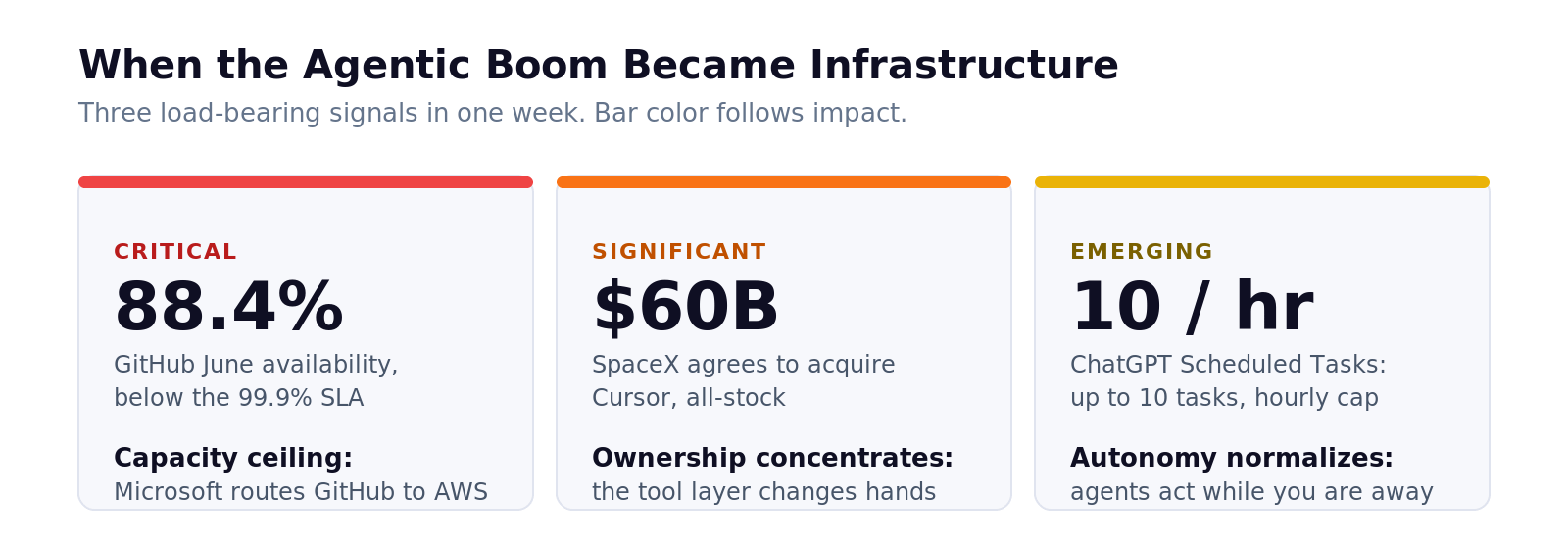
Figure 1. Three signals that agentic AI became infrastructure this week, where cost and reliability, not raw capability, now set the limits.
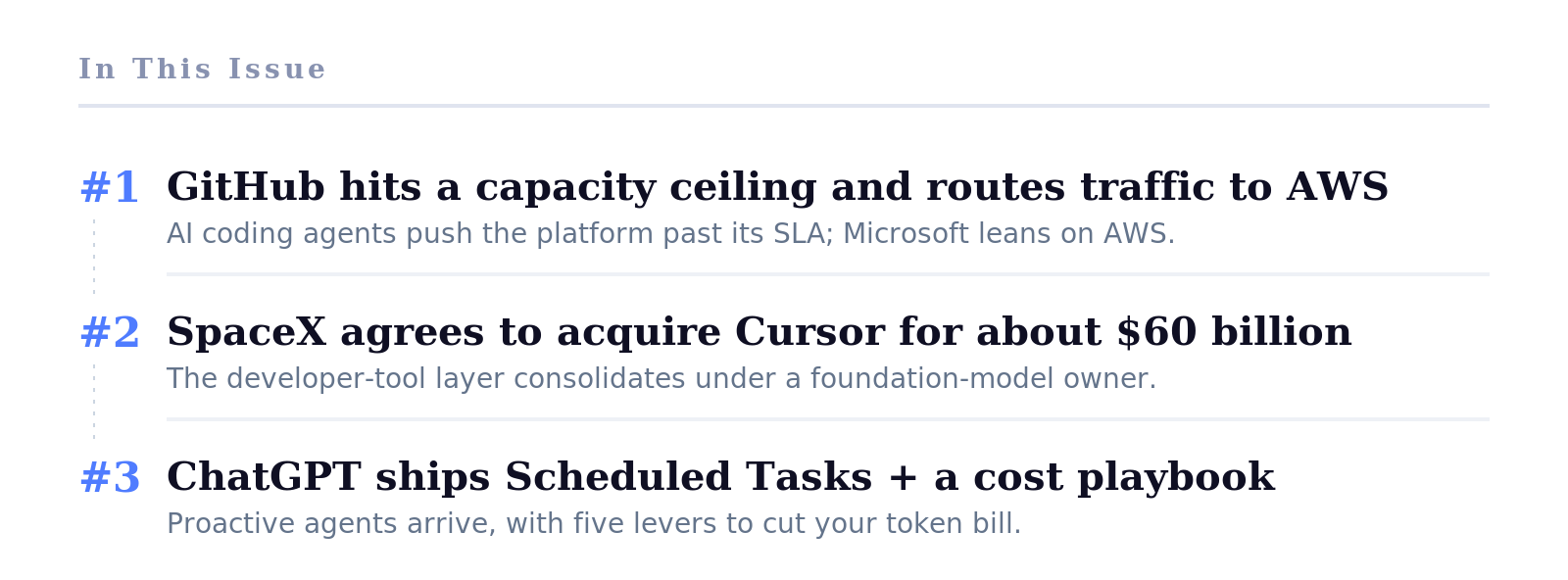
#1 GitHub hits a capacity ceiling and routes traffic to AWS
On June 16, Microsoft confirmed it is routing GitHub traffic through Amazon Web Services after AI coding agents pushed the platform past its limits. GitHub was handling roughly 275 million commits per week, on pace for about 14 billion in 2026 against 1 billion across all of 2025, and June availability ran near 88.4%, below the 99.9% enterprise threshold, after nine outages in May. [1]
This is the first AI workload large enough to break the platform that hosts it. The growth curve is no longer set by how many humans write code; it is set by how many agents do, and each agent commits, tests, and re-runs far faster than a person. The lesson is not that GitHub planned badly. It is that agent-generated load does not obey the assumptions capacity planning was built on, and that load shows up twice: once as an outage, and once as a bill.
Do this
Build degraded-mode behavior before you need it. On an interrupted agent run, render an explicit “what completed and what did not” summary instead of a spinner, and add a per-agent circuit breaker that caps runaway commit, retry, and token spend. Silent partial completion is the failure mode to design against.
Fintech & Financial Services
A payments or lending pipeline that leans on agentic coding or continuous integration now inherits a third party's availability, and supervisory expectations for operational resilience do not pause when a vendor has a bad month. The August 2, 2026 EU AI Act transparency and logging obligations land on top of that dependency, not instead of it. [4]
#2 SpaceX agrees to acquire Cursor for about $60 billion
On June 16, SpaceX confirmed it will acquire Anysphere, the maker of the AI coding tool Cursor, for roughly $60 billion in stock, with the deal expected to close in the third quarter pending regulatory review. [2] It is the largest acquisition of a venture-backed startup outside of intra-company deals, and it completes a year of consolidation in which the major AI coding surfaces came to rest with a handful of owners that also control foundation models or launch infrastructure.
The tool a developer writes software in is becoming an extension of a model or platform owner's strategy rather than an independent layer. Independent tools competed on neutrality; consolidated tools compete on integration. The practical consequence is in the defaults. When the editor, the model, and the deployment target share an owner, the path of least resistance inside the tool quietly favors that owner's stack, and defaults are the most powerful design decision there is.
Do this
Run a one-page default audit on every AI tool you depend on, and repeat it after any ownership change. Check three things: which model it calls by default and whether you can switch; whether your code or data trains the vendor's model unless you opt out; and whether changing providers is a setting or a migration.
Fintech & Financial Services
For regulated teams, this is a third-party and concentration-risk question. Vendor due diligence now has to account for the possibility that a tool's owner, incentives, and default behaviors change after an acquisition, and trust in an agentic vendor has to be re-earned, not assumed, when the nameplate changes. [5]
#3 ChatGPT ships Scheduled Tasks, normalizing proactive action
On June 17, OpenAI launched Scheduled Tasks for paid ChatGPT tiers across web, iOS, Android, and macOS. The feature lets ChatGPT perform recurring or one-off work, reminders, briefings, and monitoring, at set times and send alerts when something changes, even while the user is offline, with a dedicated page to view, pause, edit, or delete each standing instruction. Limits are deliberately conservative: up to ten active tasks and no more than one run per hour. [3]
This moves the most widely used consumer AI from a request-response contract to a standing-instruction one, and that changes the trust calculus. Consent given once, in advance, now has to cover a class of future actions the user will not see individually. When an agent acts while the user is away, the management surface becomes the consent surface.
Do this
Build the standing-instruction list to a checklist: for every task, show what it will do, when it last ran and what it produced, the next run, and a one-tap pause and delete. Add a dormancy nudge that asks the user to confirm or cancel any task that has run unattended for weeks. A proactive feature without a visible off switch trades convenience for anxiety.
Fintech & Financial Services
An AI that takes a financial action on a standing instruction, while the user is offline, must still satisfy the disclosure, suitability, and authorization expectations that apply when a human is present. California SB-833's human-in-the-loop requirement takes effect July 1, 2026, and a standing instruction does not waive it. [4]
Practitioner Playbook
Cutting agentic AI cost and load
Agent teams burn roughly 7x the tokens of a standard session. Most of it is recoverable. Levers ordered by return for effort. [5]
Route by difficulty. Send routine subagent work to a small fast model and reserve a frontier model for hard reasoning. ~40 to 70% saved, lowest effort.
Turn on prompt caching. Put static content (system prompt, tools, reference docs) first and dynamic content last; a cache hit costs about a tenth of normal input. up to ~90% off cached input [5]
Batch anything not real-time. Run reports, evals, and bulk jobs through the Batch API. ~50% off, and up to 80 to 95% combined with caching. [5]
Prune context. Mask irrelevant tool outputs and fetch reference material on demand with retrieval instead of stuffing whole documents into every prompt.
Budget per agent. Log cost per task and set a circuit breaker. The cost-side twin of the reliability breaker in #1, and an early warning that an agent is looping.
File these as three unrelated items, an outage, a deal, a feature, and you miss the through line. They are one story. Agentic AI has crossed from something you invoke into something that runs whether you are watching or not, and infrastructure carries obligations that features never did. It has to stay up, its ownership has to be legible, its autonomy has to be revocable, and its cost has to be governed on purpose rather than discovered on the invoice.
None of this is settled. The Anthropic Fable 5 and Mythos 5 suspension is still unresolved as of June 20, and a 2-million-token Gemini frontier model is expected to reach general availability any day, which would make context discipline a live cost question for many more teams. Treat this as a snapshot, not a verdict. The work it leaves is concrete and on your desk this week: design the degraded path, audit your tool defaults, give every standing instruction an off switch, and run the five-lever playbook against your agent bill. Trust by design was never about trusting the system. It is about being able to see, undo, and afford what it does on your behalf.
References
TechTimes. "GitHub's AI Agent Crisis Forces Microsoft to Tap AWS as Outages Break Enterprise SLAs." June 16, 2026. techtimes.com
CNBC. "SpaceX to acquire the AI coding startup Cursor for $60 billion." June 16, 2026. cnbc.com
9to5Mac. "OpenAI launches scheduled tasks in ChatGPT, details here." June 17, 2026. 9to5mac.com
Finextra. "The EU AI Act's August 2026 Deadline: What Financial Services Firms Must Do Now." 2026. finextra.com
McKinsey. "State of AI trust in 2026: Shifting to the agentic era." 2026. mckinsey.com