

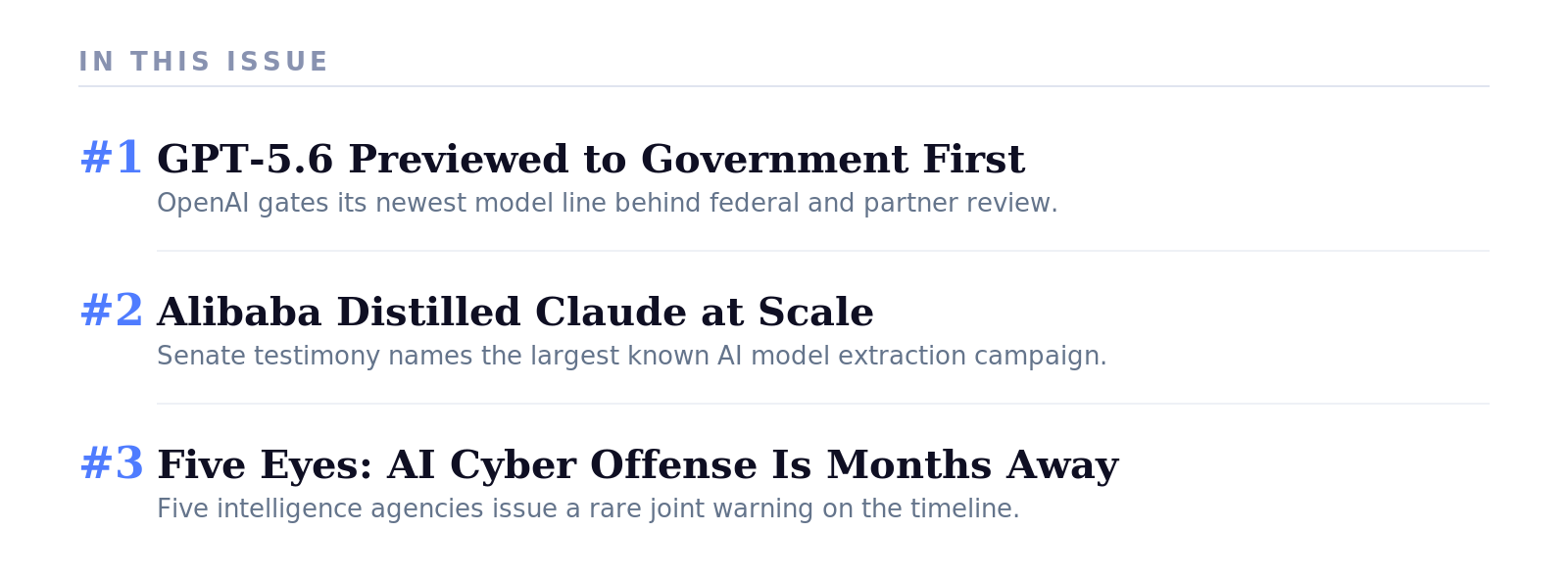
Multiple institutions said the same thing this week: a tech company, a Senate committee, and five intelligence agencies. The evaluation pipeline is the new security perimeter. The frontier stopped being theoretical.
#1 GPT-5.6 Previewed to Government First
On June 26, OpenAI previewed GPT-5.6 in three tiers, Sol (flagship), Terra (balanced), and Luna (affordable), starting with a limited release to roughly 20 government-approved partners. Sol ships with what OpenAI describes as its most robust safety stack to date, max reasoning effort mode, and stronger agentic capability in coding, biology, and cybersecurity. General availability is promised in coming weeks, pending government coordination.
The argument is in the sequence, not the benchmarks. A capability claim and a distribution choice arrived together. The most capable version of the model went to the state first. That mirrors the voluntary pre-release evaluation path the June 2 US executive order laid out for covered frontier models. The design surface is no longer only the chat interface: it is the evaluation pipeline a model passes through before you can build on it.
FinServ: If your roadmap assumes a model launch on a specific date, rebuild it around staged availability. GPT-5.6 is in limited preview with general availability contingent on government coordination. "Previewed but not generally available" now seems to be a state your release notes and feature flags must account for across weeks, not hours.
#2 Alibaba Distilled Claude at Scale: Senate Testimony
On June 24, Anthropic sent a letter to the Senate Banking Committee testifying that Alibaba's Qwen models ran what it describes as the largest known distillation campaign against Claude. The letter alleged that 25,000 accounts generated approximately 28.8 million exchanges to extract Claude's behavior at scale, then used that data to train Qwen. Senators Hagerty and Kim responded by proposing a sanctions amendment targeting Alibaba.
The conceptual significance holds regardless of where the final number lands. Distillation copies behavioral patterns, not the alignment pipeline behind them. A model trained to mimic Claude's outputs inherits the capability surface without inheriting the safeguards, refusal behaviors, and constitutional AI constraints. Capability parity is not safeguard parity. This is the first time a frontier lab has named a specific actor and a specific scale in congressional testimony, making it a landmark governance moment even before the numbers are independently verified.
Anthropic's Senate testimony is verified. The specific figures (28.8 million exchanges, 25,000 accounts, campaign running April 22 to June 5) are from Anthropic's letter and have not been independently verified. Alibaba has denied the allegations. Treat the scale figures as Anthropic's stated position, not confirmed fact.
FinServ: A cost-driven swap to a cheaper model that was trained on Claude's outputs can import a system that lacks the refusals, suitability checks, and audit affordances your compliance stack assumes. Model provenance is now a third-party risk item, not just a technical preference. "As capable as" does not mean "as safe as."
#3 Five Eyes: AI Cyber Offense Is Months Away
On June 23, the cybersecurity agencies of the United States, United Kingdom, Australia, Canada, and New Zealand issued a rare joint advisory: "The rapid pace of frontier AI development means cyber risk assumptions can become outdated in months, not years." AI models capable of bypassing enterprise and government defenses are imminent, not distant. AI lowers the barrier for malicious actors, compresses the gap between vulnerability disclosure and active exploitation, and increases the speed and complexity of attacks.
Five Eyes advisories are uncommon. When five intelligence agencies reach a shared assessment serious enough to publish jointly, the intelligence community has crossed a threshold from concern to operational warning. The direct trigger is Project Glasswing, where Anthropic demonstrated that Mythos models can find software vulnerabilities at unprecedented scale. The same capability that found 10,000-plus critical flaws defensively can be turned offensive. The advisory asks organizations to integrate AI into security operations, update legacy systems, limit access to critical infrastructure, and accelerate patching. Their closing line is worth quoting directly: "Breaches will occur. Preparedness helps you contain them quickly and prevent escalation into major operational and financial crises."
FinServ: Approximately 88% of breaches trace to known, unpatched vulnerabilities. If AI is now compressing the time between disclosure and exploit, patch latency is no longer just an IT metric: it is a trust and liability variable. The question "how fast do you patch" is moving from a back-office audit item to a procurement and vendor-due-diligence question buyers will ask directly.
Read together, these three stories reorganize what practitioners should be designing for. Capability claims are no longer the primary signal. The evaluation a model cleared before you could use it is. Provenance of a model's training data is now a compliance question. And the attack surface of any system that processes AI outputs is being compressed by the same capability improvements that make AI useful. The frontier stopped being theoretical this week. Three institutions confirmed it independently. The Alibaba distillation figures remain Anthropic's stated position pending independent verification; all three stories were active as of June 28, 2026.
References
OpenAI. "Previewing GPT-5.6 Sol: a next-generation model." June 26, 2026.
CBS News / AFP. "AI on pace to bypass cybersecurity systems in months, not years, Five Eyes spy partners warn." June 23, 2026.
CNN. "AI could breach government and business defenses in months, US and its intelligence partners warn." June 23, 2026.
Euronews. "AI cyber threat is 'months, not years' away, Western intelligence agencies warn." June 23, 2026.
CNBC. "Anthropic accuses Alibaba of campaign to 'brazenly' and 'illicitly' extract AI capabilities." June 24, 2026.