

The frontier stopped being a place any single lab stands alone. In one 48-hour window this week, OpenAI made GPT-5.6 generally available, xAI shipped Grok 4.5 with an Opus-class claim, and Meta opened its best model through a paid API, three near-equivalent frontier systems arriving on top of Anthropic's Sonnet 5 and Fable 5 from the week before. The news is not that any one model got better. It is that frontier capability became abundant and cheap at the same moment, and once that happens, the model stops being what your product competes on. What people can actually choose between is trust: whether they can verify what the model says and afford what it does. Capability is now table stakes. The interface around it is the product.
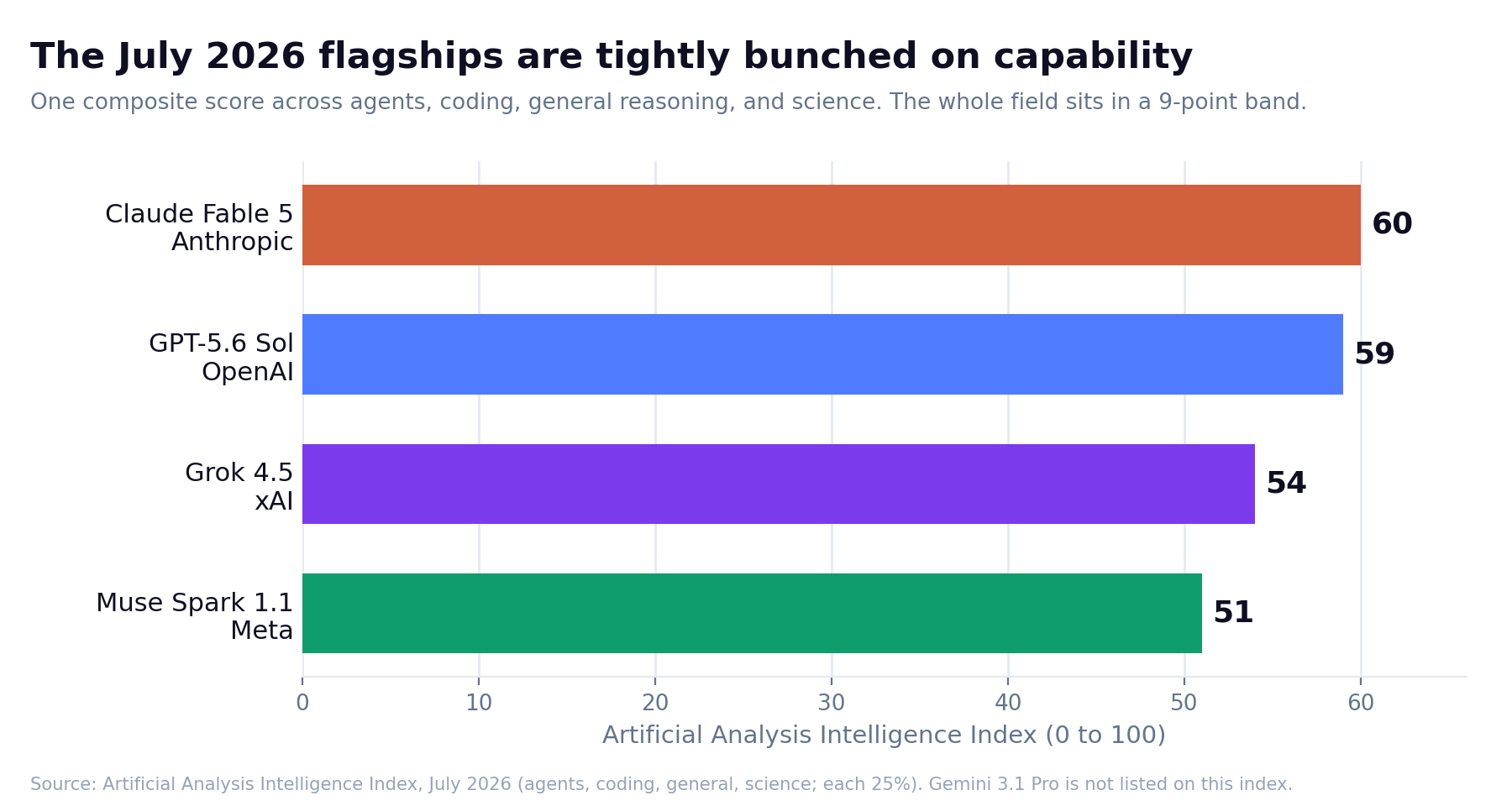
Figure 1. On a composite capability index, the July 2026 flagships sit inside a 9-point band. On raw ability they are near-equals; the gap that matters shows up in price (Figure 2).
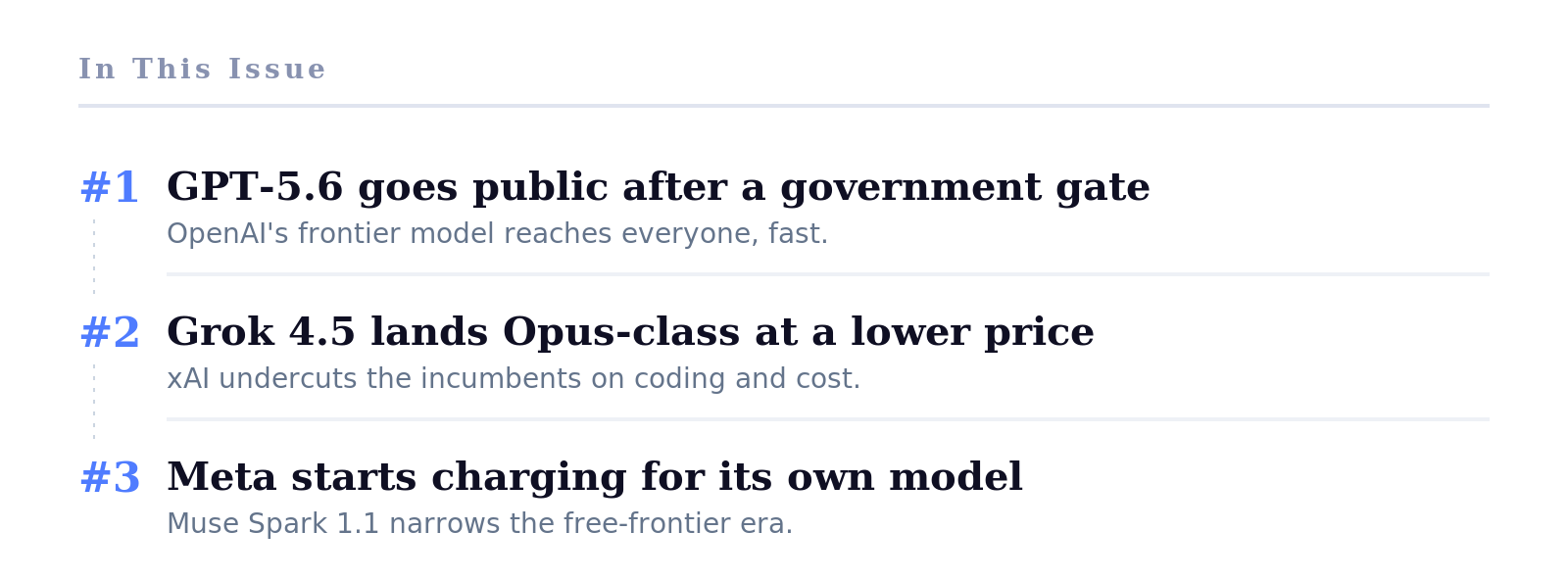
#1. ChatGPT-5.6 goes public after a government gate Critical
On July 9, OpenAI moved GPT-5.6 (the Sol, Terra, and Luna tiers) from the limited preview it began June 26 to general availability across ChatGPT, Codex, and the API, after an added review period with the US administration. [1] In parallel, OpenAI and Cerebras described running GPT-5.6 Sol on wafer-scale hardware at up to roughly 750 tokens per second, well above typical GPU-served frontier throughput. [5]
Two things moved at once. A model that was policy-gated in June is now available to everyone, which tells teams that a gate can be a phase rather than a permanent state, though the phase is real and its length is set by review, not engineering. And at that speed an agent can plan, call a tool, read the result, and re-plan inside a single human turn, so agentic loops feel immediate instead of batched. Faster loops raise throughput, and they also raise the cost of a wrong step taken before anyone can intervene.
► Takeaway
At roughly 750 tokens a second, an agent plans, acts, and moves on before a person can read the result, so reviewing after the fact quietly stops protecting anyone. Put your one human checkpoint immediately before the irreversible step, and gate on that, not on a summary shown once the action is already done.
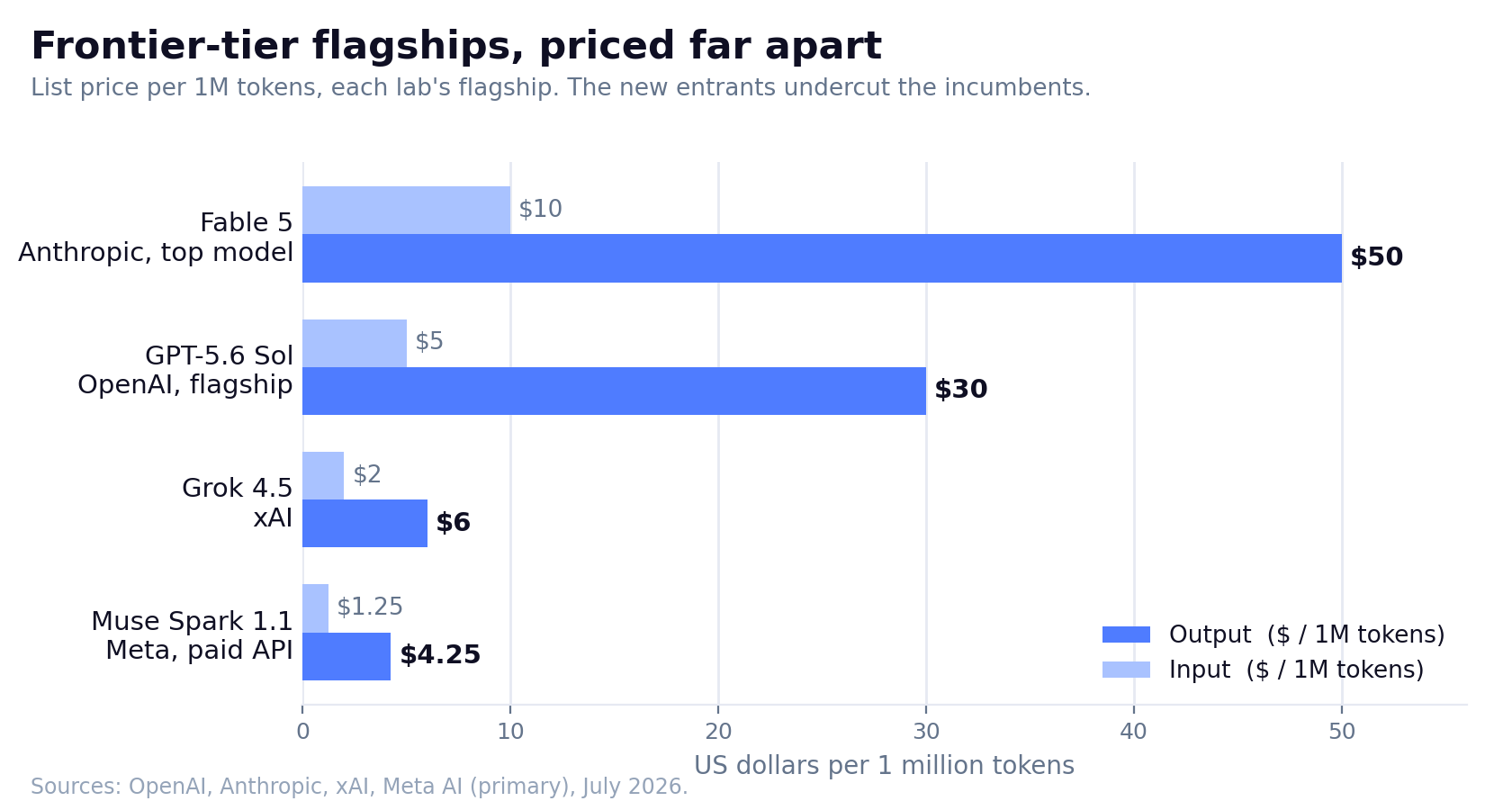
Figure 2. What each lab’s flagship costs, per million output tokens. Near-equal on capability (Figure 1), the same models are priced as much as 12x apart.
#2. Grok 4.5 lands Opus-class at a lower price Significant
On July 8, xAI released Grok 4.5 for coding and agentic work, trained in part on real Cursor developer sessions and priced around 60% below Opus 4.8 and GPT-5.5. By xAI's own four published benchmarks, it beats Opus 4.8 on two and trails on two. [2] Elon Musk framed it as an Opus-class model that is faster, more token-efficient, and cheaper, with EU availability targeted for later in July.
A fourth credible frontier-tier coding model, priced under the incumbents, is the clearest sign yet that near-frontier capability is commoditizing on price. The mixed benchmark record is the honest part: "Opus-class" is a marketing frame, and the vendor's own numbers show wins and losses by task. For a buyer, parity is now a per-task question, not a leaderboard rank, and the deciding factors shift toward price, latency, and whether the model behaves well on your specific workflow.
#3. Meta starts charging for its own model Emerging
On July 9, Meta introduced Muse Spark 1.1, a multimodal reasoning model built for coding, tool use, and computer use with a one-million-token context window, and opened it to outside developers through a new paid Meta Model API. [3] This is the first time Meta has charged businesses for access to its models, a shift away from the open-weight strategy the company was known for. Meta framed the pricing, reported at roughly $1.25 and $4.25 per million input and output tokens after free credits, as aggressive against Anthropic and OpenAI.
When the industry's most prominent open-weight advocate begins metering its best model, the free-frontier option narrows and the competition moves to the terms of access. Low per-token pricing is a real advantage and also a design signal: metered economics reward products that reach the answer in fewer tokens and punish sprawling agentic loops, which puts cost discipline squarely inside the user experience rather than the billing back office.
Responsible AI signal
A former Fed chair joins Anthropic's oversight trust
Also on July 9, Anthropic appointed Ben Bernanke, the former Federal Reserve chair, to its Long-Term Benefit Trust, the independent body that can elect a growing share of its board. [6] The signal worth marking: the risk being staffed for is economic, workforce displacement, wealth concentration, and systemic stability, not only model-level safety. Named critics doubt that mission-governance constrains a fast-scaling lab; supporters counter that an independent trustee with no equity raises the cost of drifting. Who can actually hold a frontier lab to its mission stays an open, industry-wide question.
File these as three product launches and you miss the shift. The story is not that four labs can each build a frontier model. It is that once four of them can, and sell it cheaply, the model becomes the easy part again, and the hard part moves back to the layer you own: whether a person can trust the output, see what it cost, and undo what it did. Abundance does not lower the design bar. It raises it, because the thing users choose between is no longer capability. It is confidence.
This is a snapshot, not a verdict. As of July 11, the GPT-5.6 speed figure is vendor-reported and not independently reproduced at sustained scale, the Grok 4.5 and Muse Spark 1.1 prices are introductory and may move once credits lapse, Grok is not yet available in the EU, and the August 2 EU AI Act deadline has not yet arrived. What could change next week: independent speed benchmarks, EU launches, a Gemini 3.5 Pro general release into a far more crowded field, and the first real compliance signals from regulated teams. The work it leaves is on your desk now: move oversight ahead of the action, evaluate cheap models on your own tasks, put cost in the interface, and keep both your model and your compliance file swappable. Trust by design was never about trusting the model. When every product can call the same frontier, it is about being able to see, afford, and undo what it does on your behalf.
References
[1] OpenAI. "GPT-5.6: Frontier intelligence that scales with your ambition." July 9, 2026. openai.com (GA confirmed by CNBC, July 8, 2026).
[2] xAI. "Introducing Grok 4.5." July 8, 2026. x.ai (launch corroborated by Axios, July 8, 2026).
[3] Bloomberg. "Meta Starts Charging for AI With Muse Spark 1.1 Agentic Model." July 9, 2026. bloomberg.com (model details: Meta AI blog, July 9, 2026).
[4] Finextra. "The EU AI Act's August 2026 Deadline: What Financial Services Firms Must Do Now." 2026. finextra.com
[5] Cryptobriefing. "OpenAI's GPT-5.6 achieves inference breakthrough powered by Cerebras wafer-scale compute." July 2026. cryptobriefing.com (~750 tokens/second, vendor-reported).
[6] Anthropic. "Ben Bernanke appointed to Anthropic's Long-Term Benefit Trust." July 9, 2026. anthropic.com (corroborated by Bloomberg and CNBC, July 9, 2026).