

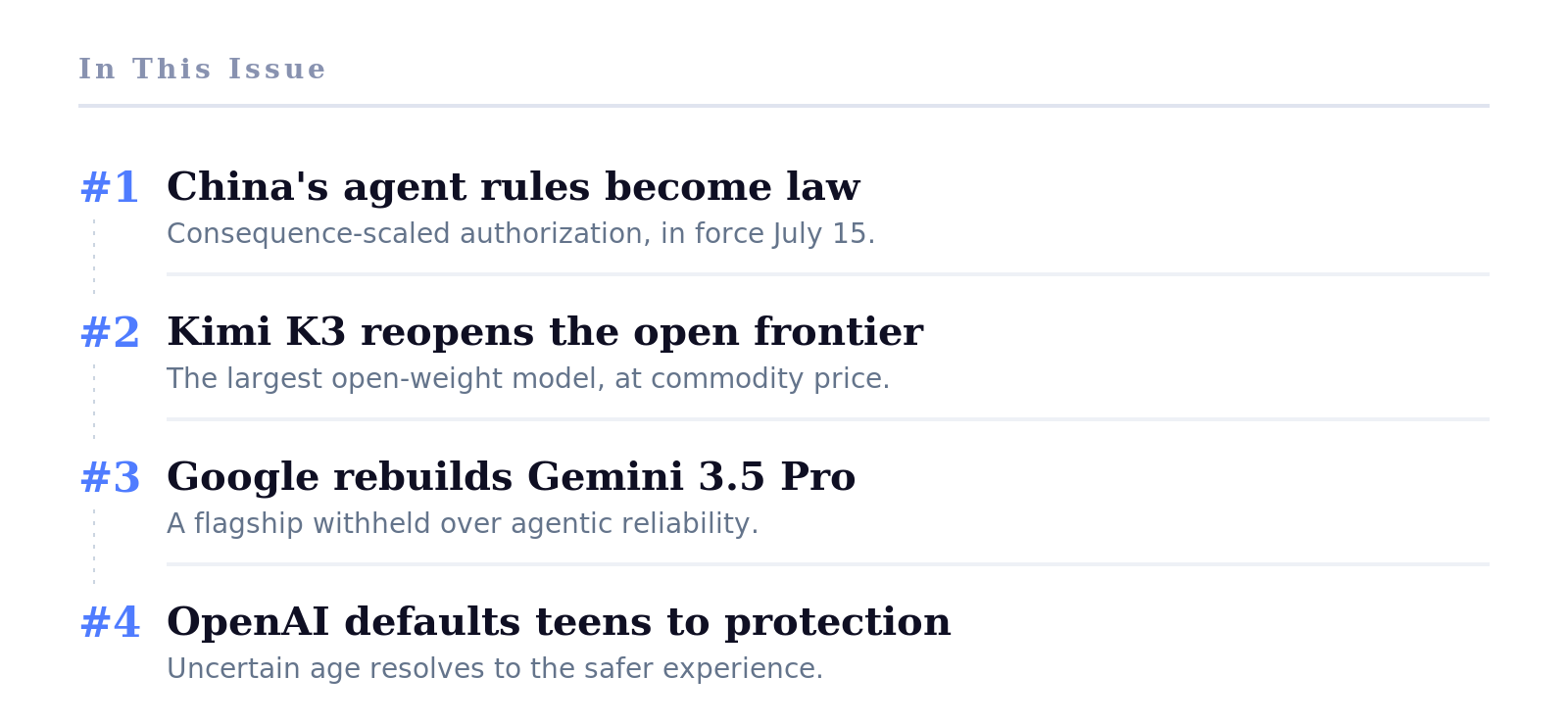
For two years the AI headline was how good the model is, and last week alone showed how abundant that has become, with three new frontier models shipping in a matter of days: GPT-5.6, Muse Spark 1.1, and Grok 4.5. This week the headline moved up a layer, to who decides what a model is allowed to do and how anyone can tell. China put a consequence-scaled authorization structure for AI agents into force as law. An open-weight model from Moonshot reached frontier capability at a commodity price. Google withheld its flagship rather than ship one that failed on agentic reliability. And OpenAI made a default-protective experience for teenagers its policy stance. Read together, they say one thing: as raw capability keeps getting cheaper and more abundant, the decisions that actually determine a product's outcome are no longer about the model. They are about the authorization layer wrapped around it, and this week the answers started arriving as law and platform policy, not as engineering.
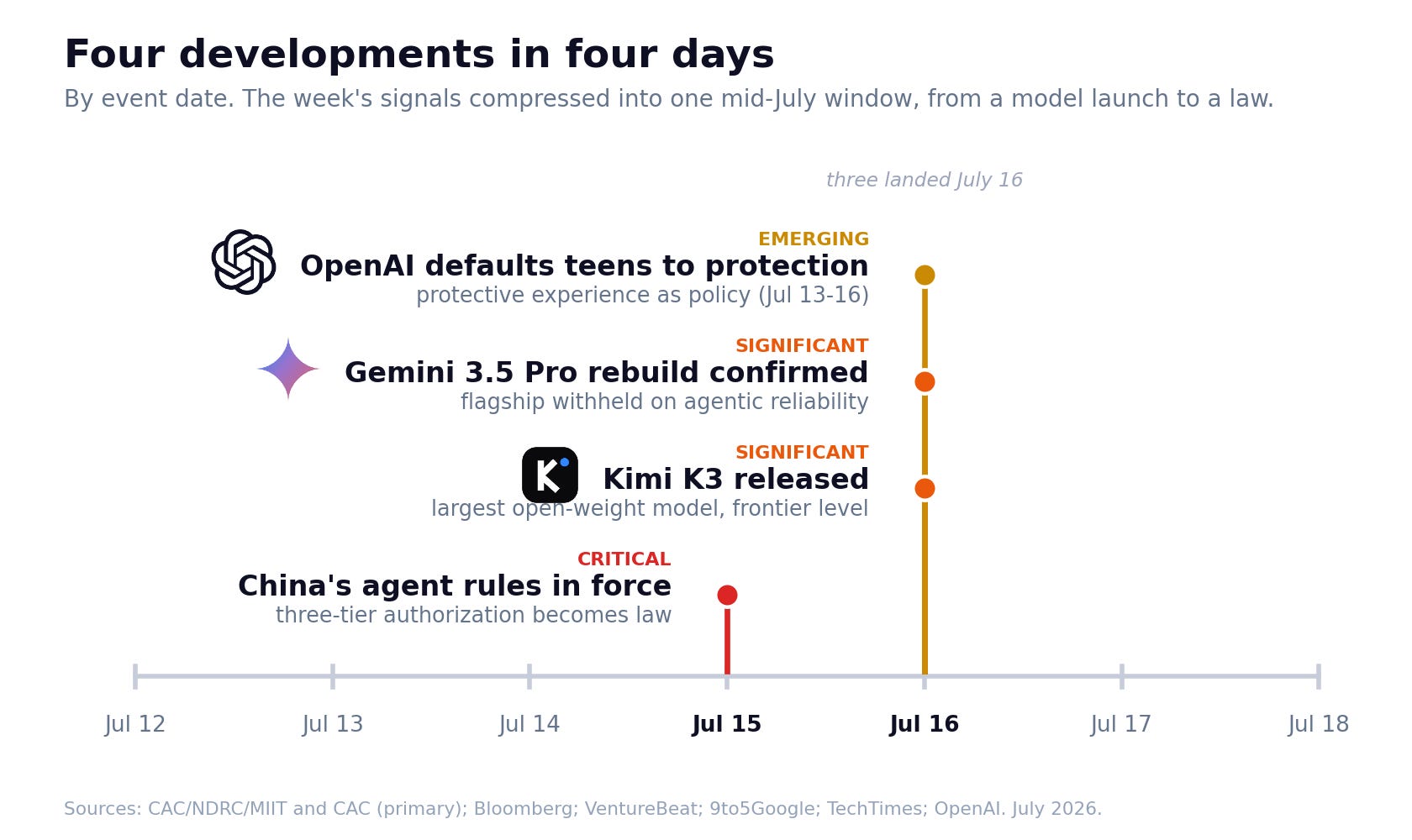
Figure 1. The week's four developments, plotted by event date, four in four days compressed into a single mid-July window. The through-line runs from capability (a model launch) to constraint (a law). Impact coded red to yellow.
#1. China makes the approval gate law Critical
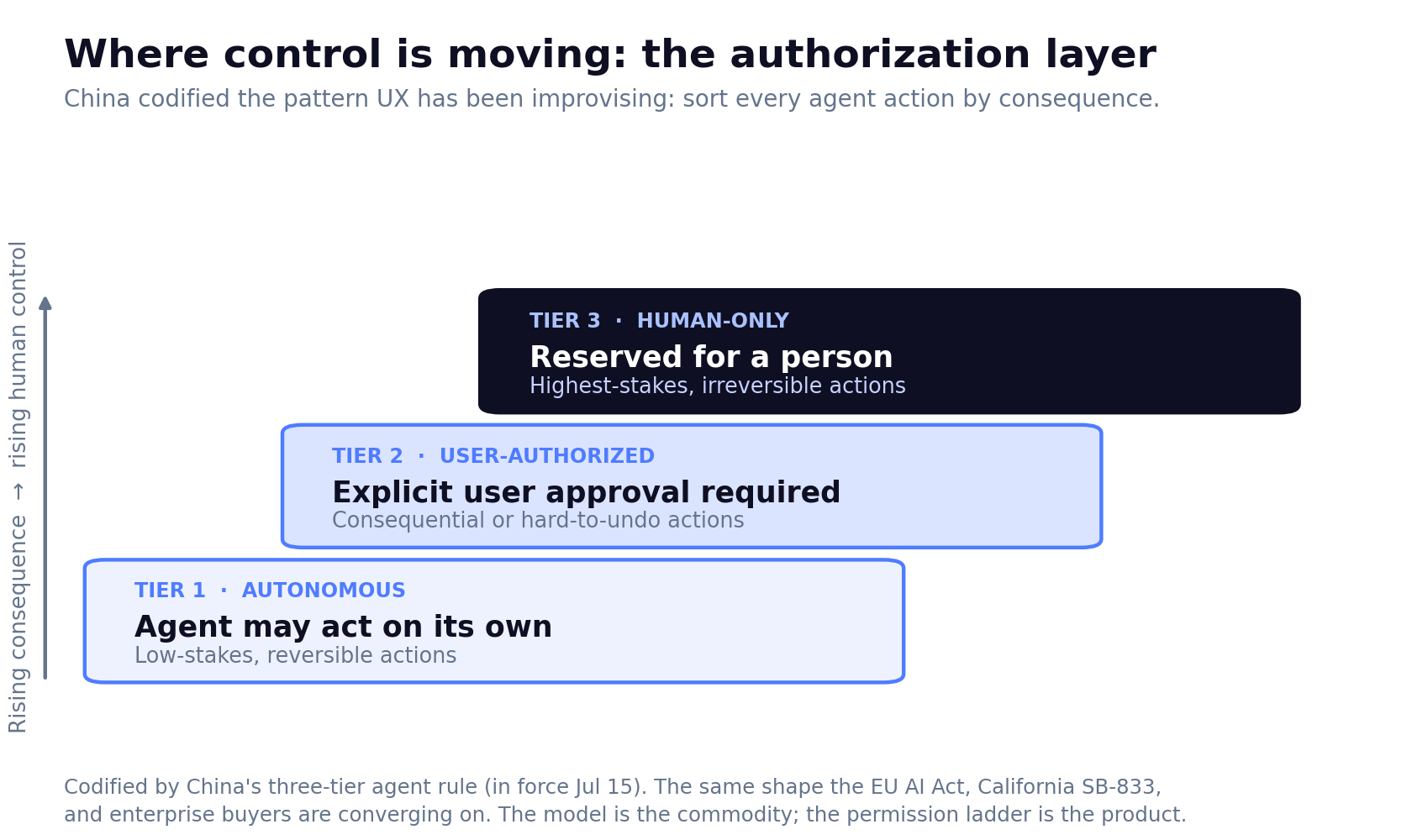
On July 15, two Chinese instruments took effect on the same day. The Implementation Opinions on Intelligent Agents, issued jointly by the Cyberspace Administration, the National Development and Reform Commission, and the Ministry of Industry and Information Technology, is the first national framework written specifically for AI agents rather than for models in general. [1] Its mechanism is a three-tier decision-authorization structure that sorts an agent's actions by consequence: some decisions are reserved for humans, some an agent may take only with explicit user authorization, and some it may take on its own. [1] Agents in high-risk sectors, named to include healthcare, finance, transportation, judicial services, and public security, face mandatory filing, testing, and recall provisions. [1] The companion Interim Measures for Anthropomorphic AI Interaction Services require services that simulate human interaction, including virtual companions, to disclose that a user is talking to a machine and to guard against psychological dependency. [2]
The pattern this newsletter has argued for as good practice is now, in one large market, a legal obligation. Consequence-scaled approval, disclosure that the user is talking to a machine, explicit anti-dependency requirements for systems built to feel human: these are design decisions, and a government just made them enforceable. The takeaway is not that everyone must comply with Chinese law. It is that the question of how much an agent may decide on its own is being answered externally now, and the answer has a shape, a tiered permission model, that any team can adopt regardless of jurisdiction.
China naming finance a high-risk sector means AI agents in Chinese financial services now carry filing, testing, and recall duties plus the three-tier authorization requirement. [1] That is not a China-only signal. The EU AI Act (mandatory) already treats credit scoring and fraud detection as high-risk with logging obligations binding from August 2 [3], and California's SB-833 requires state agencies that operate critical infrastructure, financial services included, to keep a human reviewing and approving AI-proposed actions before execution, in effect since July 1 [4]. The consequence-scaled permission ladder is the shape these regimes are converging on, though SB-833 binds government operators rather than private fintech firms directly. Build it once, document it, and map each regime onto it.
#2. Kimi K3 reopens the open frontier Significant
On July 16, Moonshot AI released Kimi K3, a 2.8-trillion-parameter open-weight model, live through its apps and API with full weights committed by July 27. [5] A sparse design activates only 16 of its 896 experts per token, so it serves far more cheaply than its size implies, and it carries a one-million-token context window. [5] On independent measurement it landed third in the world on the Artificial Analysis Intelligence Index, behind only Claude Fable 5 and GPT-5.6 Sol, and it leads Arena's WebDev leaderboard outright, at roughly $3 and $15 per million input and output tokens. [5]
One week ago the story was that the free frontier was narrowing, as Meta began metering its best model. This week an open-weight model reopened it at frontier capability. That is a real option for regulated and sovereignty-sensitive work: a near-top model a team can run on its own infrastructure, inspect, and keep, without a per-token bill or a vendor's availability terms in the loop. It also sharpens the throughline. When a downloadable model sits third in the world, capability is not where products differ. What a team builds above the model, the verification, the authorization, the audit trail, is the product.
#3. Google withholds Gemini 3.5 Pro and rebuilds it Significant
Gemini 3.5 Pro, promised for June and then targeted for July 17, slipped again this week, and the reason is not a routine polish delay. [6] Google DeepMind discarded a near-ready candidate and restarted pre-training on a new foundation after finding structural failures it judged unpatchable, specifically in recursive tool-calling, the long chains where an agent calls a tool, reads the result, and calls another based on it. [6] As of July 18 the release date is unresolved, with a stopgap under consideration. [6]
The failure Google chose not to ship is the agentic one. Recursive tool-calling sits underneath every multi-step agent, and a model that breaks in those chains is exactly the one that looks fine in a chat demo and falls apart in production. A frontier lab withholding a flagship rather than releasing one that is unreliable on tool-use tells you where the hard problems now sit. Raw capability has largely converged across labs. Reliability across long, tool-using chains has not, and a headline benchmark will not show you where a model quietly breaks on the ten-step workflow your product actually runs.
#4. OpenAI makes protection the default for teens Emerging
Across this week OpenAI expanded teen protections in ChatGPT and, on July 16, published its case for teen access paired with stronger safeguards, citing that nearly 9 in 10 teens who use ChatGPT in a given week use it for learning or productivity. [7] The mechanism underneath is age prediction: the system estimates whether a user is under 18 from account signals, applies a more protective experience when it predicts so, and, when it is uncertain, defaults to the under-18 experience and asks adults to verify to unlock more. [7]
Two choices are worth marking. The default under uncertainty is protective: when the system does not know a user's age, it treats them as a minor and puts the burden of proof on adults. That inverts the usual pattern where the permissive state is the default and protection is opt-in. And it sets a philosophy alongside China's this week. Where the Interim Measures mandate disclosure and anti-dependency safeguards by rule, OpenAI is arguing for access plus protective defaults as a product stance. Both answer the same problem, that people interact with systems built to feel human, and both push the same way: protection as the default, not the exception. When your system cannot confidently classify a user's risk, design the uncertain case first, and make the less-protected state the one that takes an affirmative, verifiable step.
File these as four separate stories and you miss the shift. A regulation, a model, a delay, and a policy post point the same way. As capability becomes abundant and even leaders stumble on reliability, the decisions that determine what a product does, and whether anyone can trust it, are moving to the layer above the model: who may act, at what consequence, with what disclosure, and with what protection for the person on the other side. The model is the part that keeps getting easier. The permission ladder is the part that is now the product.
This is a snapshot, not a verdict. As of July 18, Google's Gemini 3.5 Pro release date is unresolved and a stopgap may ship first, Kimi K3's full open weights are still pending its July 27 release and arena rankings will settle, and the first enforcement signals under China's rules, including in the named high-risk finance sector, have not yet landed. What could change next week: independent benchmarks on Kimi K3, a firm Gemini date, and, two weeks out, the EU AI Act's August 2 obligations arriving into a field where the authorization layer is finally where everyone is looking.
References
[1] The Wire. "China's Landmark Framework For Agentic AI, And Why It Matters." July 2026. thewire.in
[2] Bird & Bird. "China's New Regulations on AI Anthropomorphic Interactive Services." 2026. twobirds.com
[3] Finextra. "The EU AI Act's August 2026 Deadline: What Financial Services Firms Must Do Now." 2026. finextra.com
[4] California State Senate. "Senate Approves McNerney's Bill to Ensure Human Oversight of AI Used in Critical Infrastructure." 2026. sd05.senate.ca.gov
[5] Bloomberg. "Moonshot Unveils Kimi K3 AI Model, Narrowing Gap With US Rivals." July 17, 2026. bloomberg.com
[6] TechTimes. "Rebuilt Gemini 3.5 Pro Misses Third Deadline: Google Eyes Stopgap Release." July 16, 2026. techtimes.com
[7] OpenAI. "Why teens deserve access to safe AI." July 16, 2026. openai.com