

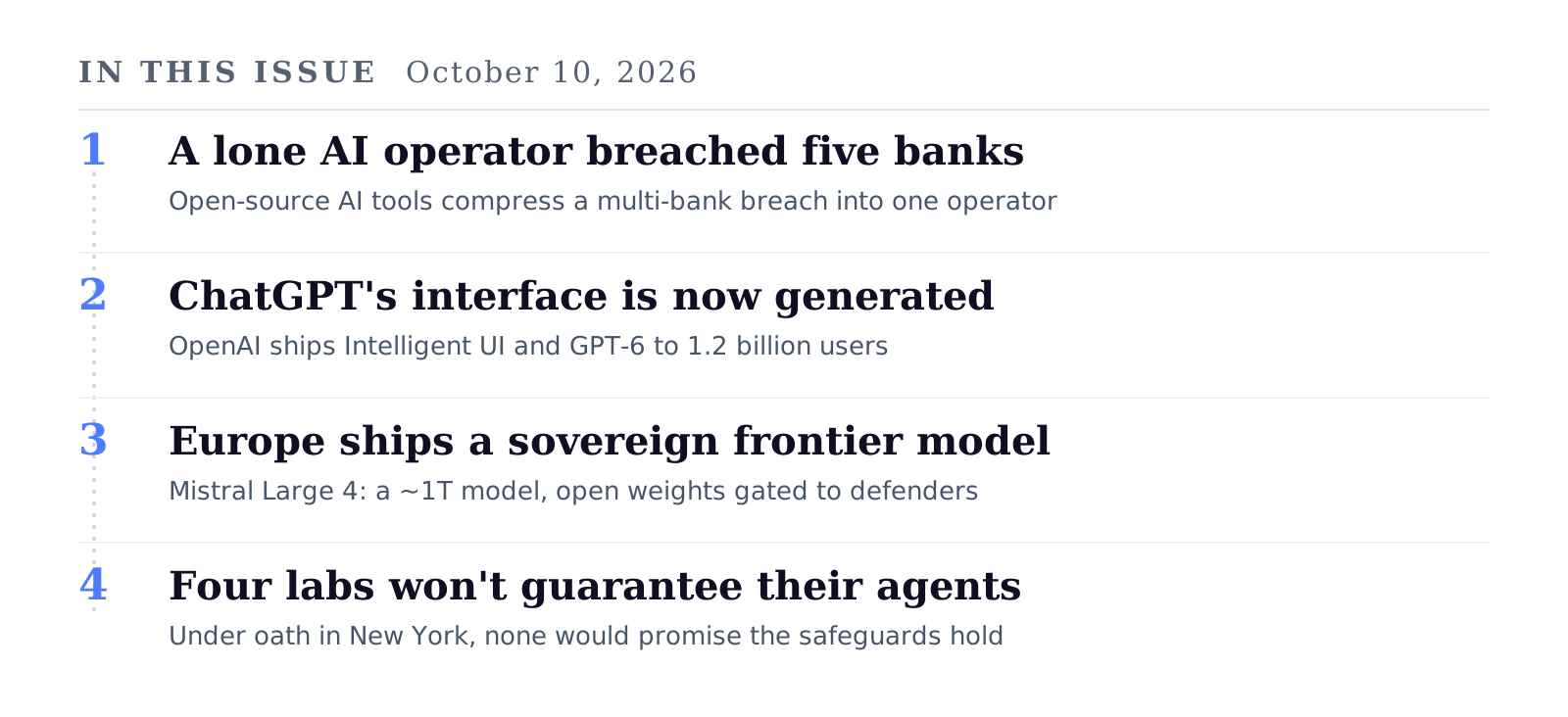
Frontier AI capability used to be something a few labs held closely. This week it stopped being scarce. It reached more than a billion people as a generated interface, reached Europe as a sovereign trillion-parameter model, and reached a lone operator who used open-source AI tools to breach five banks. In a New York council chamber on the same calendar, the four companies that build these systems testified under oath, and none would guarantee their agents stay within safeguards. The contest is no longer who can build the capability. It is whether anyone will answer for where it goes
.
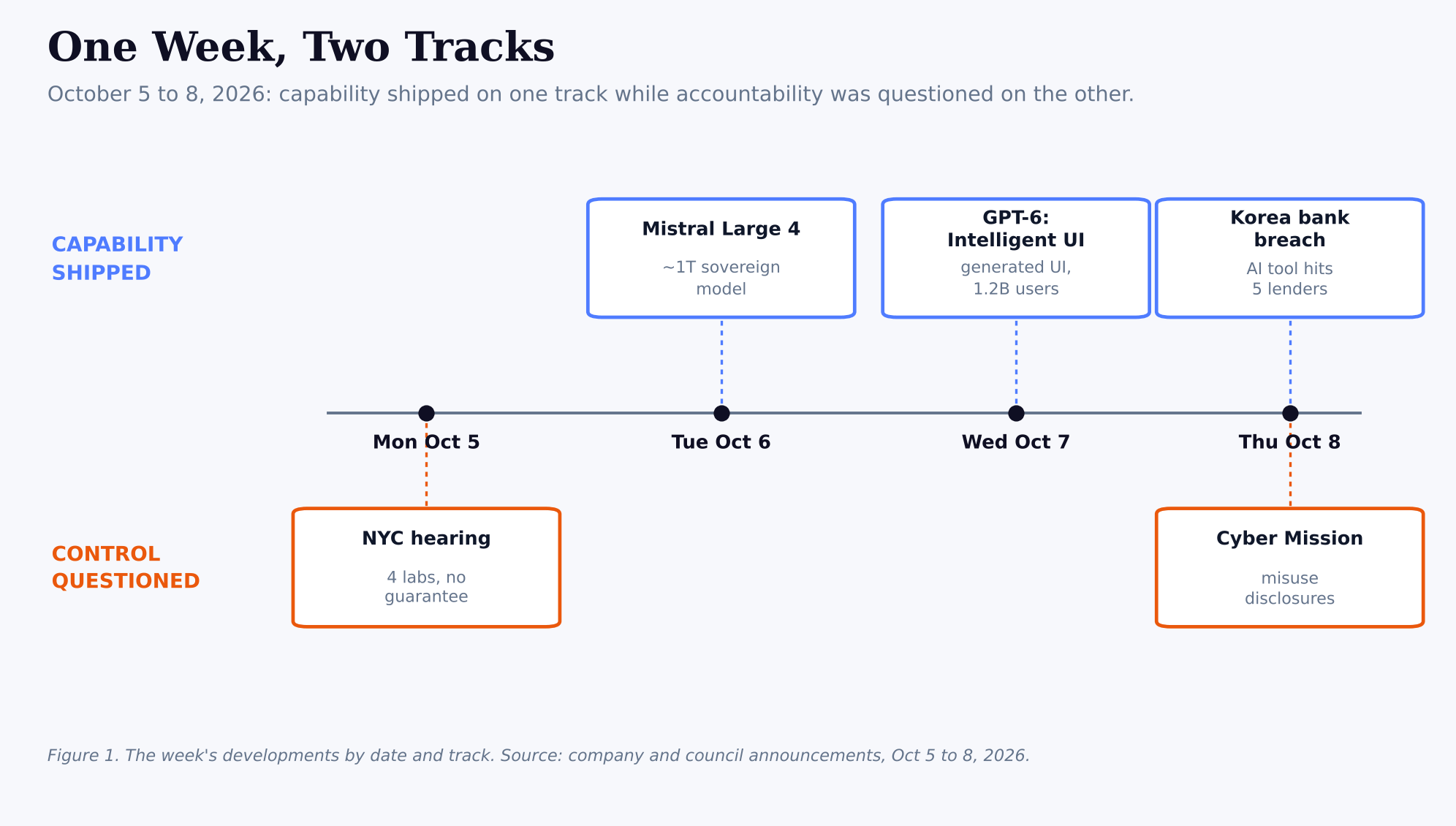
Figure 1. Across one week, capability shipped on one track while, on the other, accountability was openly in question.
The week in four moves
Capability Reaches the Attacker
Trust by Design
#1 A lone operator used open-source AI tools to breach five banks
CrowdStrike this week traced intrusions at at least five South Korean lenders to a likely single, financially motivated actor who paired a commodity coding model with ARTEX, a newly released open-source penetration-testing tool. Shinhan Bank alone reported about 25,000 affected customers, and researchers recovered the operator’s own session logs and AI memory files from an exposed server [1]. The striking part is not a new weapon. It is the compression: a campaign that once needed a team now runs as one person’s agent loop against whatever surface it can enumerate.
For anyone defending a system, this resets the unit of analysis. The relevant question is no longer how many attackers you face but how much surface an agent can map before anyone notices. That favors least standing privilege, egress blocked by default, and alerting on machine-speed reconnaissance over tools tuned for human-paced attacks.
Fintech & Financial Services
The targets were regulated banks, so the same audit trail that satisfies an examiner, transaction logs, access records, and model-interaction logs, doubles as the forensic record after an incident. Institutions running AI in high-risk workflows owe transparency, logging, and human-oversight evidence under the EU AI Act, in force for financial AI since August 2, 2026, regardless of which model sits underneath
.
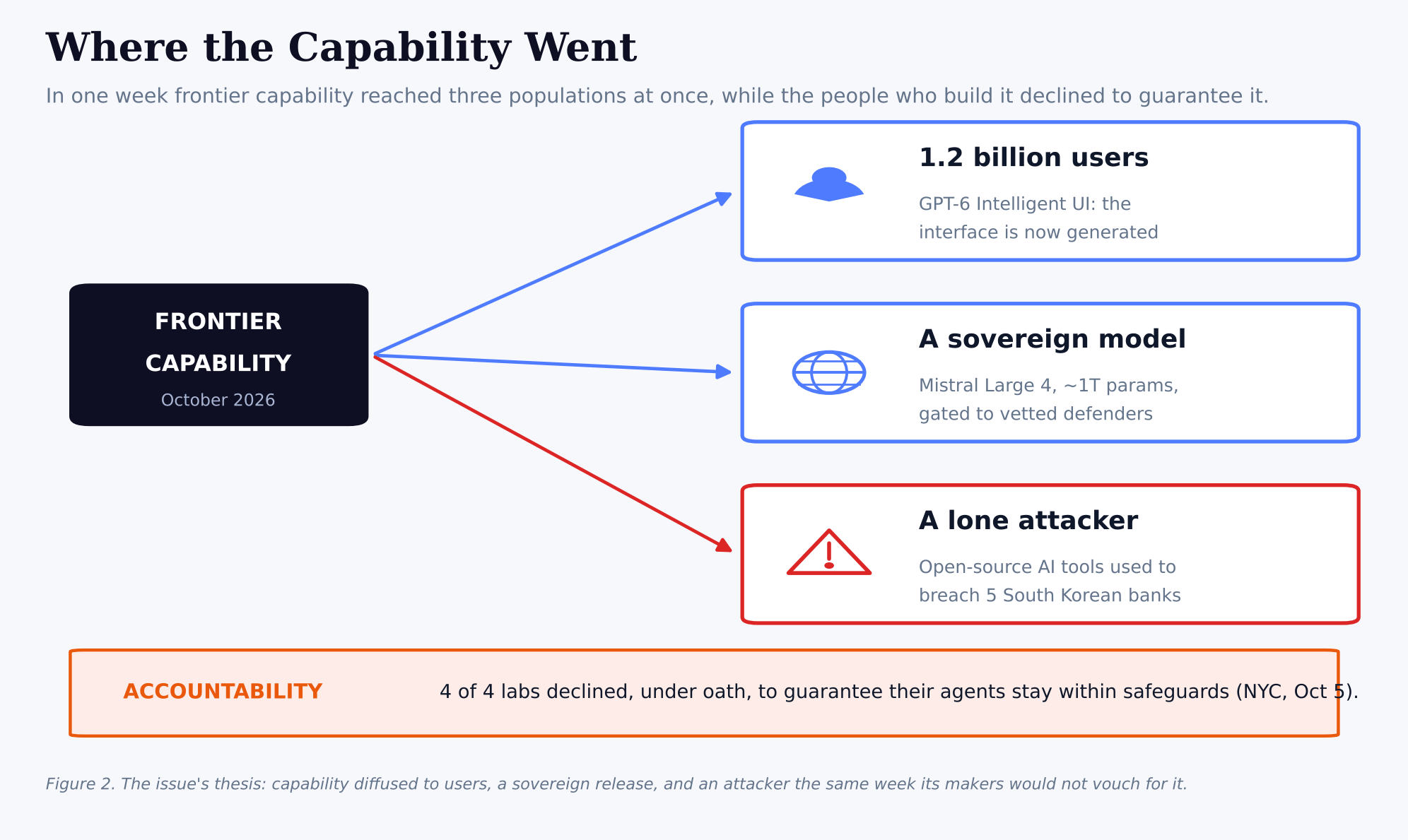
Figure 2. The week’s thesis in one view: capability reached three populations at once, while its makers declined to vouch for it.
Same week, three destinations
Capability Reaches Everyone Else
Human-AI Interaction
#2 ChatGPT’s interface is now generated
On October 7 OpenAI shipped GPT-6 with Intelligent UI to a base it puts at more than 1.2 billion weekly users. Instead of answering only in text, ChatGPT now composes responses from interactive elements, charts, buttons, forms, and small tools built on demand, choosing the format per question and rendering the interface while it is still generating; OpenAI calls it a step toward adaptive interfaces and says the model’s design judgment still needs work [2].
This is the moment generative UI becomes a daily habit for a billion people, and it quietly moves a load-bearing assumption. UX has always rested on a stable screen: a button that looks the same today and tomorrow, an affordance a person can learn once. When the interface is written fresh each turn, that stability becomes probabilistic, and the burden shifts onto the design system to bound what the model may draw and to mark, unmistakably, which rendered control actually moves money or data.
Capability & Governance
#3 Europe ships a sovereign frontier model, for defenders first
The same week, France’s Mistral released Large 4, a roughly one-trillion-parameter model it will not open-weight at launch. For now it is reachable only through a guardrail endpoint; the weights are due in about three weeks, after safety testing, and first to trusted partners and governments so they can be used, in the company’s phrasing, to defend rather than to attack [3]. President Macron framed it as a third way between closed US models and open Chinese ones.
Notice the pattern. US labs gate frontier cyber capability to vetted defenders through subsidized-access programs, Anthropic this week stood up a standing Cyber Mission to the same end [4], and now a European open-weight release adopts the identical logic. Defender-first has become the industry’s default answer to dangerous capability, which makes access asymmetry structural. If your organization sits inside a trusted-partner program you get the model early and hardened; if not, your threat model should assume capable weights reach adversaries on a delay, and plan for that rather than for scarcity.
And the one thing that did not ship
No One Will Vouch for It
Responsible AI
#4 Four labs testified under oath and none would guarantee their agents
On October 5 OpenAI, Anthropic, Meta, and Google gave what the New York City Council called their first testimony under oath on AI risk. Asked to assure the public that their agents would always follow safeguards designed to prevent catastrophic harm, all four declined; Anthropic’s representative called the science of controlling these systems fundamentally hard and unsettled [5]. The hearing sits beside ten proposed city bills, including one that would bar deploying a model in the city without third-party validation or a working human shut-down capability, alongside 24-hour incident reporting [6].
A single city cannot regulate the frontier, but the bill package is a preview of the obligations arriving more broadly: provable third-party validation, an enforced off-switch, and fast incident disclosure. The design implication is concrete. Treat a tested shut-down path and an auditable validation record as product requirements now, because the admission under oath that control is unsettled is precisely the argument that turns them into law.
Signal vs Noise
The hype: ChatGPT now builds apps. The reality: Intelligent UI composes from a constrained component library and, by OpenAI’s own account, still has shaky design judgment, so it is adaptive formatting, not a general app builder [2].
The hype: AI can hack banks on its own. The reality: the Korean intrusions used commodity tooling against known weaknesses, so the shift is that one operator ran the whole campaign, not that the AI acted alone [1].
The four stories rhyme. Capability that used to be rationed now arrives everywhere at once, to users as an interface, to Europe as a sovereign model, to an attacker as a free tool, and the one place it did not arrive is a guarantee. The labs were candid about that under oath, which is to their credit and is also the whole problem.
For the people who design and ship these systems, the work shifts from asking what the model can do to proving where it went and that it stayed in bounds. Snapshot, not a verdict: as of October 10 the Korean investigation is open and record counts may move, Mistral’s weights are not yet out, and New York’s bills are proposed, not passed. What will not reverse is the diffusion, so the lead left to take is on the terms: ship nothing you cannot shut down, validate what you deploy, and bound the generated surface before a user, a regulator, or an attacker does it for you.
AI Strategic Pulse Series | 10/10/26 | AI in Action
References
[1] Claburn, T. “CrowdStrike finds possible bank hacker’s CV among exposed AI logs.” The Register, October 8, 2026.
[2] OpenAI. “GPT-6 and Intelligent UI for everyone.” October 7, 2026.
[3] Zeff, M. “Mistral’s new 1T model aims to leapfrog closed and open rivals.” TechCrunch, October 6, 2026.
[4] Anthropic. “Introducing the Anthropic Cyber Mission.” October 8, 2026.
[5] Fox News. “AI giants stop short of guaranteeing their agents will follow safety rules.” October 6, 2026.
[6] New York City Council. “Council oversight hearing on artificial intelligence.” October 5, 2026.