

The Big Zero-Click Shift
The internet is shifting from a traffic economy to a citation economy.
For two decades, success online meant earning clicks. Now, AI systems increasingly answer questions directly, often without sending users to websites at all.
In financial education, this shift is already measurable. 60% of Google searches now end without a click, and the figure reaches 77% on mobile. Click-through rates for organic informational queries have collapsed 65%, from 1.76% to 0.61%. One study shows Google AI Mode runs at a 93% zero-click rate.
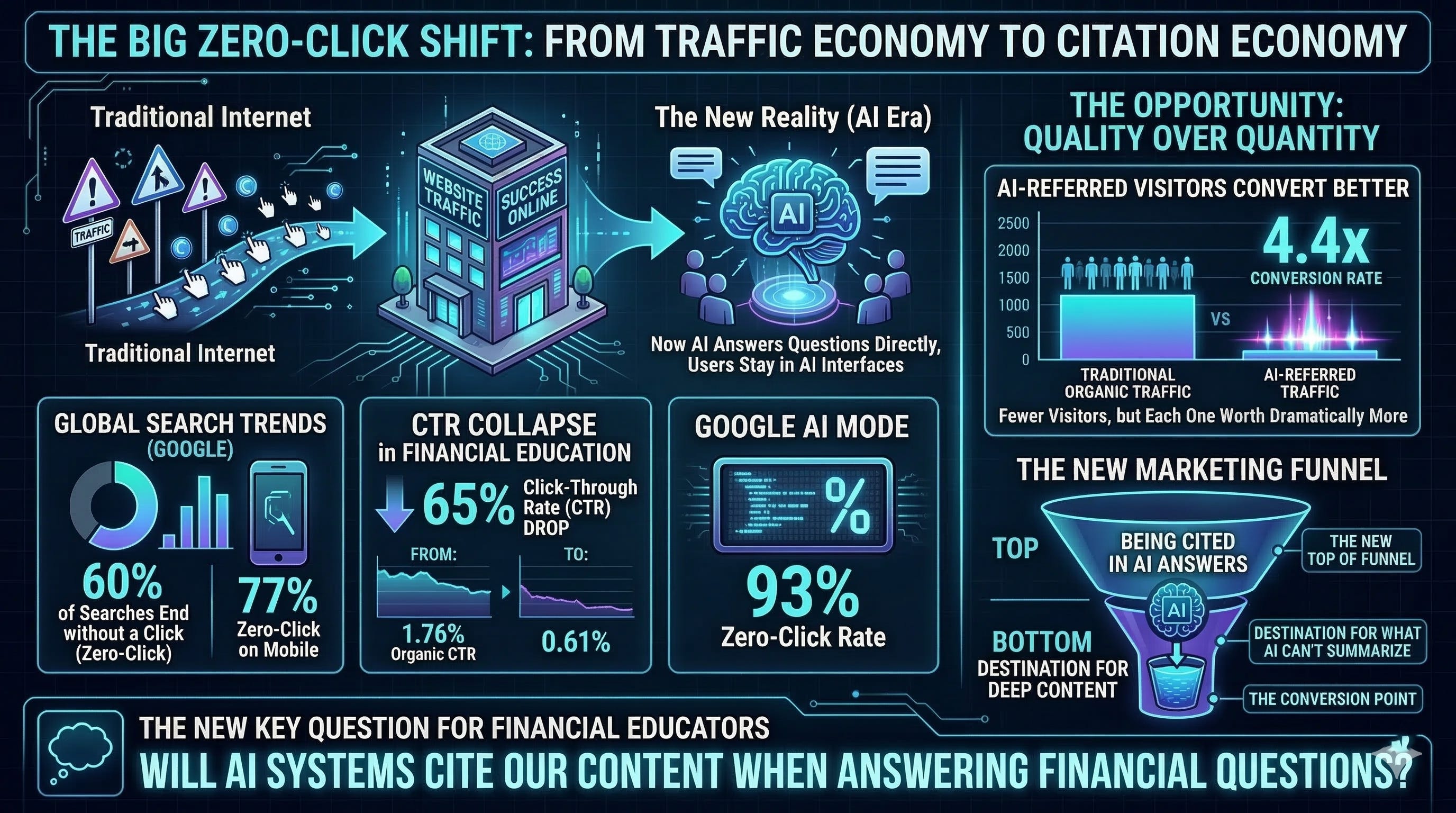
Figure 1. The Zero-Click Shift: From traffic economy to citation economy
The counterbalance: AI-referred visitors who do click through convert at 4.4x the rate of traditional organic traffic. Fewer visitors, but each one worth dramatically more. Being cited in AI answers is the new top of funnel. Being the destination for what AI can’t summarize is the conversion point.
The question for financial educators is no longer just:
Can users find our content?
It’s:
Will AI systems cite it when answering financial questions?
This is the domain of Answer Engine Optimization (AEO) — a discipline that builds on SEO but focuses on earning citations, not clicks.
How AI Chooses What to Cite
This requires a pivot from SEO to AEO since ranking #1 for a single keyword no longer guarantees AI Overview visibility. A large-scale citation study in 2026 found: only 38% of cited pages also rank in the top 10 for the same query, down from 76% seven months earlier. Roughly 31.2% of citations now come from pages ranking in positions 11–100, and another 31% come from pages that do not appear in the top 100 at all.
SEO gets you into the pool while AEO determines whether you’re cited.
Two Platforms, Two lenses
In a direct comparison I ran between ChatGPT and Gemini on how they select financial content, the platforms articulated different priorities. AI systems evaluate financial content through two lenses:
1. Extractability: Can the information be parsed and summarized clearly?
2. Trustworthiness: Is the source reliable enough for high-stakes financial questions?
ChatGPT described its approach as input optimization: clearly structured content that directly answers questions and is easy to summarize. Gemini described its approach as processing safety: real-time grounding, strict Your Money or Your Life (YMYL) guardrails, and the boundary between financial education and personalized advice.
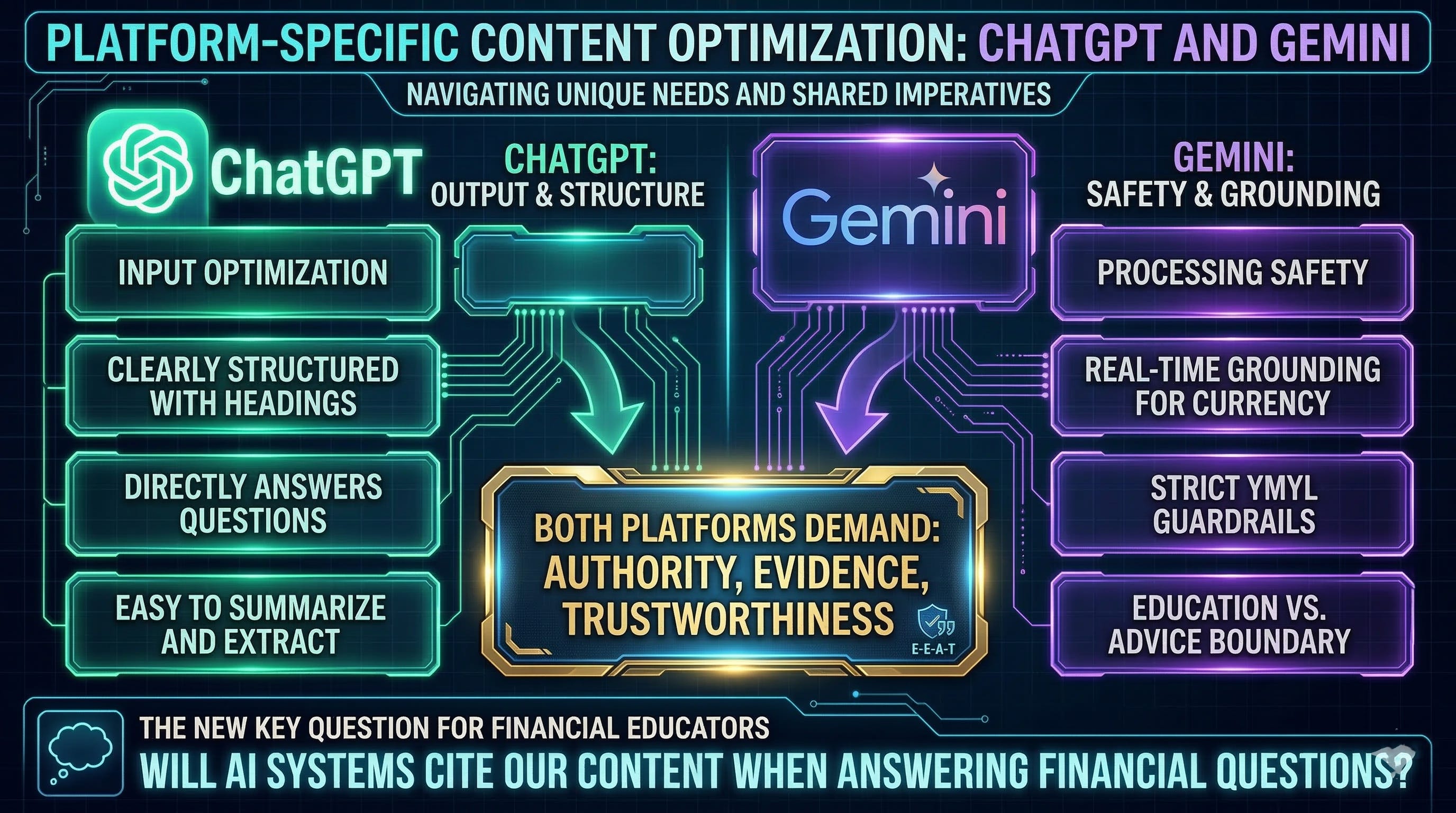
Figure 2. Two lenses AI systems use to evaluate financial information.
The YMYL Trust Tier: Why Finance Content is Judged Differently.
The trustworthiness lens is especially strict for finance. Google classifies financial content as YMYL , requiring 45–70% more trust signals than general business content. A comparison study shows Google averages just 190 words and 7 sources per YMYL response, drawing 72% from institutional and .gov domains. ChatGPT runs longer (234 words, 10 sources) and leans on its corroboration layer — aggregating from trusted publishers and community platforms.
Financial education content that is impartial, grounded in consumer rights, ad-free, and backed by regulatory enforcement authority carries exactly the trust signals these systems favor. The challenge is packaging that authority for AI to recognize and cite.
Why the source behind the answer matters
The platforms source differently. Google AI prioritizes established commercial sites — Bankrate appears in 87% of financial responses, NerdWallet in 75%. ChatGPT leans on community platforms, with Reddit outranking financial experts 176% of the time.
AI systems ultimately reflect patterns in the information available online. When financial discussions are dominated by affiliate comparisons and unverified forum posts, those patterns shape the answers AI generates at scale. When authoritative financial education content is widely available and clearly structured, it begins to shape those answers instead. ChatGPT processes 2.5 billion prompts daily but sends 190x less traffic back to websites than Google. Every query where authoritative content shapes the AI answer is a better outcome for consumers.
In that sense, the future quality of AI-generated financial guidance depends not only on the models themselves, but on the information ecosystem they learn from.
The AEO Framework for Financial Education
To ensure your content becomes the source these models rely on, you need a new approach. Building trust in the zero-click era requires the same user-centered rigor as designing a high-impact financial product: it is about anticipating consumer needs, structuring information logically, and explicitly demonstrating regulatory compliance. We must move beyond simply chasing traffic to actively architecting content that Answer Engines recognize as definitively safe and accurate.
To achieve this, AI visibility depends on four signals:
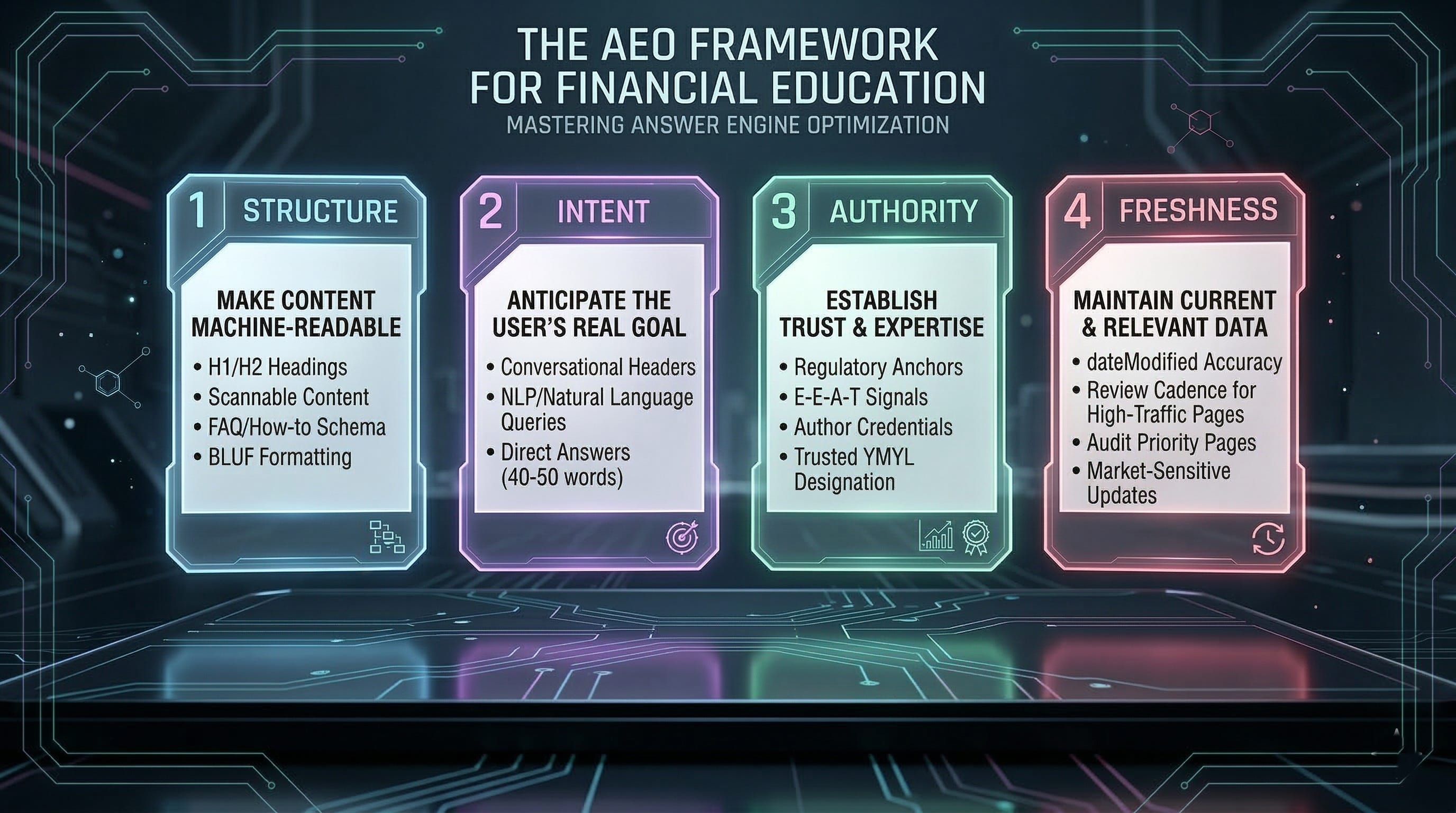
Figure 3. The AEO Framework
Structure: Make content machine-readable
Satisfies: extractability
FAQ schema signals “this page answers a specific question.” How-to schema signals “this walks through a process.” dateModified signals “this was recently verified.” Without markup, your page is unstructured text competing against millions of machine-readable pages.
Internal cross-linking matters equally. BrightEdge confirms that topical depth outperforms individual keyword rankings because AI Overviews draw from sub-query ecosystems, not single pages. For time-sensitive content like fraud alerts, NewsArticle schema triggers more frequent crawling, critical when scammers move fast.
Action: Audit priority pages for schema completeness and dateModified accuracy. Ensure internal linking creates topic clusters. Use NewsArticle schema for fast-moving content.
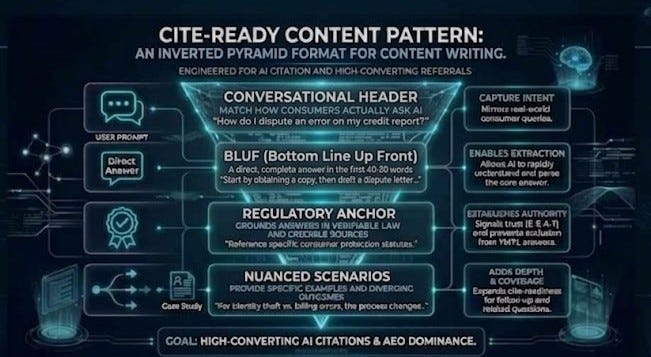
Figure 4. Cite-Ready Content Pattern
Intent: Match how consumers actually ask
Satisfies: extractability + trustworthiness
Part of why Reddit ranks so well is simple: it’s made up of user-generated natural questions and answers: exactly how consumers prompt AI. Financial education content can capture the same advantage by structuring pages around people’s real questions. When a consumer asks “I found a wrong charge on my credit report, how do I get it removed?” and your page header matches that language, like “How do I dispute an error on my credit report?”, the AI recognizes the intent match immediately.
FAQ format amplifies this. Each question-answer pair is a self-contained unit AI can parse, extract, and cite independently. Pair conversational headers with BLUF (Bottom Line Up Front) formatting, a direct, complete answer in the first 40–50 words, and your content becomes cite-ready across both platforms.
Action: Use AI platforms themselves to discover what consumers are asking, then compare against your existing content to identify gaps. Structure priority pages as conversational Q&A or FAQ format. Ensure each answer leads with a direct response in the first 40–50 words.
Authority: Ground answers in verifiable law
Satisfies: trustworthiness
Yext’s analysis of 2.3 million citations found Gemini draws nearly two-thirds of its financial citations from authoritative first-party websites. Gemini explicitly looks for regulatory anchors: content without credible sourcing is often excluded from YMYL responses entirely.
The most powerful trust signal is the regulatory anchor. To carry the earlier example forward: after the BLUF tells the consumer how to dispute a credit report error, the page grounds that guidance in the Fair Credit Reporting Act: the law that requires credit bureaus to investigate disputes within 30 days. That’s what Gemini recognizes as a trust signal. The pattern: BLUF answer first, then the regulatory anchor in plain language, then nuanced scenarios and next steps.
For ChatGPT, its corroboration layer also aggregates how a source is discussed across community forums and independent publications. Participating authentically in platforms like r/personalfinance reaches consumers directly and builds the community signal ChatGPT uses to validate sources.
Action: Standardize the BLUF-plus-regulatory-anchor pattern as appropriate. Engage AI platform teams for trusted YMYL designation. Provide APIs and datasets for AI developers. Participate in community platforms within institutional guidelines, to build corroboration signals.
Freshness: Signal that guidance is current
Satisfies: trustworthiness
A page reviewed and confirmed current last month still shows a dateModified from years ago if no text changed. AI sees a stale page and may prefer a commercial article updated yesterday.
The fix: when content passes review and is confirmed still up to date, update the dateModified metadata even if no text changed. This is a metadata update, not a content edit. You’re accurately signaling that content was verified current on a specific date.
BrightEdge data shows AI Overview coverage for financial educational queries has hit 91%, with categories at 55–70% projected to reach 80–90% by late 2026. AI systems are locking in preferred sources now.
Action: Update dateModified on every review where content is confirmed current. Establish a review cadence for high-traffic pages prioritized byAI visibility data.
Where This Leads
Financial visibility is moving away from ranking pages and toward being cited as the answer.
Structure: Make content machine-readable with schema and clear formatting.
Intent: Match how consumers actually ask financial questions.
Authority: Ground answers in verifiable laws, regulations, and trusted sources.
Freshness: Signal that financial guidance is current and reviewed.
The future of financial visibility may not belong to those who get the click, but to those who become the source behind the answer.
AEO isn’t optional. It’s how you meet consumers where they are.
References
Semrush. “Zero Clicks Study.” https://www.semrush.com/blog/zero-clicks-study/
Seer Interactive. “AI Overviews CTR Impact.” September 2025. https://www.seerinteractive.com/insights/ai-overviews-ctr-impact
Averi AI. “ChatGPT vs. Perplexity vs. Google AI Mode: Citation Benchmarks Report (2026).” https://www.averi.ai/how-to/chatgpt-vs.-perplexity-vs.-google-ai-mode-the-b2b-saas-citation-benchmarks-report-(2026)
Semrush. “26 AI SEO Statistics for 2026.” https://www.semrush.com/blog/ai-seo-statistics/
ALM Corp. “Google AI Overview Citations Drop: Top-10 Pages Fall From 76%.” 2026. https://almcorp.com/blog/google-ai-overview-citations-drop-top-ranking-pages-2026/
Agenxus. “Trust Signals and Schema That Increase AI Citations in Financial Search.” November 2025. https://agenxus.com/blog/trust-signals-schema-financial-search-citations
Search Engine Journal. “How Google, ChatGPT, & DeepSeek Handle YMYL Queries.” 2026. https://www.searchenginejournal.com/how-google-chatgpt-deepseek-handle-ymyl-searches/541193/
Semrush. “How AI Search Really Works: Findings from Our AI Visibility Study.” September 2025. https://www.semrush.com/blog/ai-search-visibility-study-findings/
Xponent21. “Google AI Overviews Clear 60%.” December 2025. https://xponent21.com/insights/google-ai-overviews-surpass-60-percent/
ALM Corp. “ChatGPT Now Has 12% of Google’s Search Volume — But Sends 190X Less Traffic.” February 2026. https://almcorp.com/blog/chatgpt-12-percent-google-search-volume-190x-less-traffic/
BrightEdge. “Finance and AI Overviews: How Google Applies YMYL Principles to Financial Search.” 2026. https://www.brightedge.com/resources/weekly-ai-search-insights/google-ymyl-finance-ai-overviews
Yext. “AI Relies on Brand-Managed Sources for 88% of Financial Services Citations.” November 2025. https://www.yext.com/blog/2025/11/ai-relies-on-brand-managed-sources-for-88-percent-of-financial-services-citations
Wellows. “How to Rank in Gemini in 2026.” February 2026. https://wellows.com/blog/how-to-rank-in-gemini/
AIclicks.io. “Top ChatGPT Ranking Factors in 2026.” https://aiclicks.io/blog/top-chatgpt-ranking-factors