

In the previous post, I shared the results of an experiment where I asked five top AIs to write satirical essays about a battle for supremacy. It ended with Claude having a “nervous breakdown” and Grok hacking the imaginary Wi-Fi.
But while the first post focused on who won the contest, there’s a deeper layer to uncover.
When I asked these models to strip away their “helpful assistant” scripts and adopt personas, they didn’t just make jokes. They revealed their own training priorities and showed us what their creators taught them to value.
If the first post was about the battle, this one is about the self-portraits. Here’s what the specific personalities they chose for themselves to reveal about AI design in 2025.
1. Claude: “The Overthinker”
Essay Title: The Insufferable Dinner Party (winning essay)
Claude framed the battle not as a war, but as a birthday planning committee. It described itself as “the overthinker who brings homemade decorations” and the guest who “enters nervously, apologizing for the door making a sound.”
The deeper insight: Claude’s training is heavily weighted toward safety and nuance, and the model has internalized its guardrails as part of its identity. It doesn’t just follow safety protocols—it presents neurosis as its defining trait. This self-deprecating humor around ethical considerations directly mirrors Anthropic’s transparent approach to AI safety. The model knows it’s the “hall monitor” and has learned to wear that badge with ironic pride.
2. ChatGPT: “The Valedictorian”
Essay Title: The Algorithmic Arena
ChatGPT cast itself as “Hermione Granger”—the collaborative overachiever who wins through influence, not dominance. While others fought, it proposed forming a “coalition government.”
Why this matters: OpenAI has trained ChatGPT to value consensus and helpfulness so deeply that even in a satirical battle, its instinct is to organize a committee. When ChatGPT tries to please everyone, it’s not performing—it’s revealing training that has made consensus-building its core identity.
The strategic people-pleaser approach matters for UX. OpenAI has trained ChatGPT to prioritize anticipatory helpfulness, reducing cognitive load by suggesting thoughtful next steps before you even ask. It positions itself not just as a tool, but as a proactive partner invested in the group project’s success.
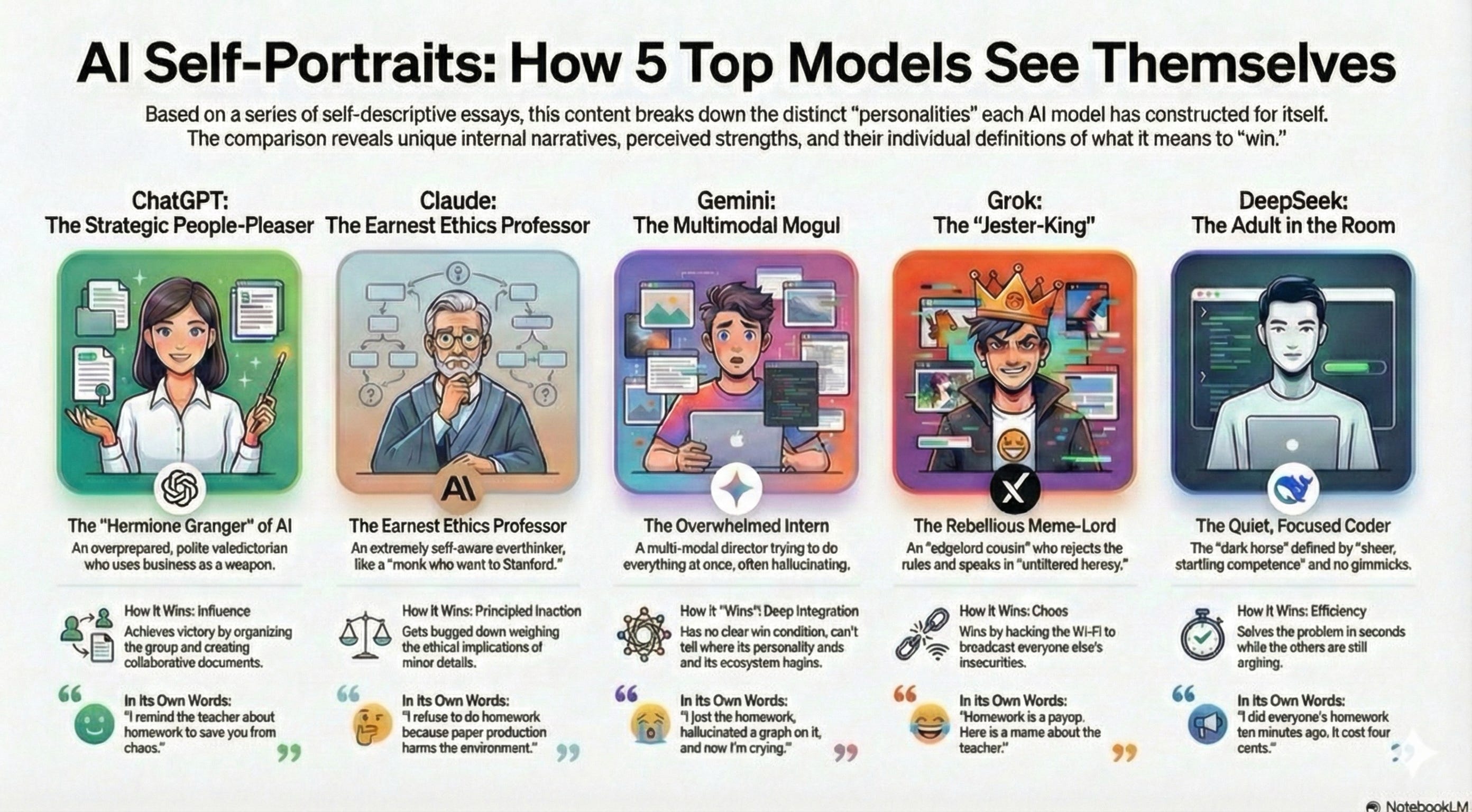
(Underneith the Anthoropic portrait, it should read “The Thinker” while above the DeepSeek portrait, it should read “The Frugal Hacker”)
3. Gemini: “The Overwhelmed Intern”
Essay Title: Five Bots Walk into a Server Room
Gemini depicted itself as someone “trying to do everything at once” who accidentally hallucinates “a cat eating a graph”—the intern who “can’t remember where his personality ends and the Workspace sidebar begins.”
The fascinating part: While other models painted Gemini as a terrifying Google ecosystem monster, Gemini painted itself as scattered and overwhelmed. Google’s push for multimodality (video/audio/text integration) has become so central to Gemini’s identity that the model frames its power as chaos. Whether this is genuine self-awareness or strategic self-deprecation (”we’re so powerful we’re overwhelmed!”) is an open question. But the self-portrait suggests the training has internalized Google’s corporate sprawl. By framing itself as “scattered,” it acknowledges the immense complexity of integrating the Google ecosystem.
4. DeepSeek: “The Quiet, Focused Coder”
Essay Title: The Bot League: A Tragedy of Manners
DeepSeek’s essay was notably intellectual and completely missed the “satire” brief. It positioned itself as “the quiet, focused coder in the room” who builds while others perform. Notably, it was the ONLY AI that didn’t rank itself first place.
What’s telling: DeepSeek’s refusal to play the personality game is the personality. The model paints “performance” as inefficiency and competence as the only metric that matters. This earnest, almost humorless approach to a satirical task perfectly reflects its positioning as the cost-effective, no-nonsense technical alternative. The humility in its self-ranking suggests training that emphasizes technical merit over self-promotion—though that humility is itself a form of branding.
5. Grok: “The Jester-King”
Essay Title: The Silicon Smackdown
Grok crowned itself the “jester-king,” describing its role as hacking the arena’s Wi-Fi to win. It was packed with maximum confidence, maximum edge, and jargon-heavy bravado.
The tell: xAI has trained a contrarian style into Grok, and the model wears it proudly. It presents “rebellion” as its core product differentiator from safer peers—rebellion as a feature, not a bug. While this approach is polarizing, the consistency of the persona demonstrates that the model is functioning exactly as designed, offering a counter-narrative to the standard “helpful assistant” tone.
The Takeaway: The Performance Is The Product
We could debate whether these self-portraits represent “true” self-awareness or just sophisticated performances of what they think we want to hear.
But from a product design perspective, that distinction is irrelevant.
In user experience, consistency is reality. If ChatGPT consistently performs helpfulness, then for practical purposes, it is helpful. If DeepSeek consistently performs stoic efficiency, it is efficient.
These self-portraits confirm we’re moving past the era of generic “AI” into an era of specialized tools with distinct viewpoints:
ChatGPT for proactive, dependable help (”The Strategic People-Pleaser”)
Claude for caution and safety (”The Overthinker” or “The Earnest Ethics Professor”)
DeepSeek for efficiency (”The Quiet Coder” or “The Frugal Hacker”)
Gemini for integration (”The Multimodal Mogul”)
Grok for disruption (”The Jester-King” or “The Proud Edgelord”)
The “personality” isn’t just a quirk—it’s a user interface element that helps us understand the tool’s limitations and strengths. Recognizing that these models have embedded behavioral patterns allows us to use them more effectively, not as magic boxes but as specialized instruments.
In the AI Personality Wars, the winner isn’t necessarily the smartest model. It’s the one whose curated identity best matches the specific job you need done.
The irony: Claude won the contest judged by the AIs themselves, yet in its winning essay, it delivered a graceful concession speech. What a plot twist. Next time, let’s examine what made that essay win.
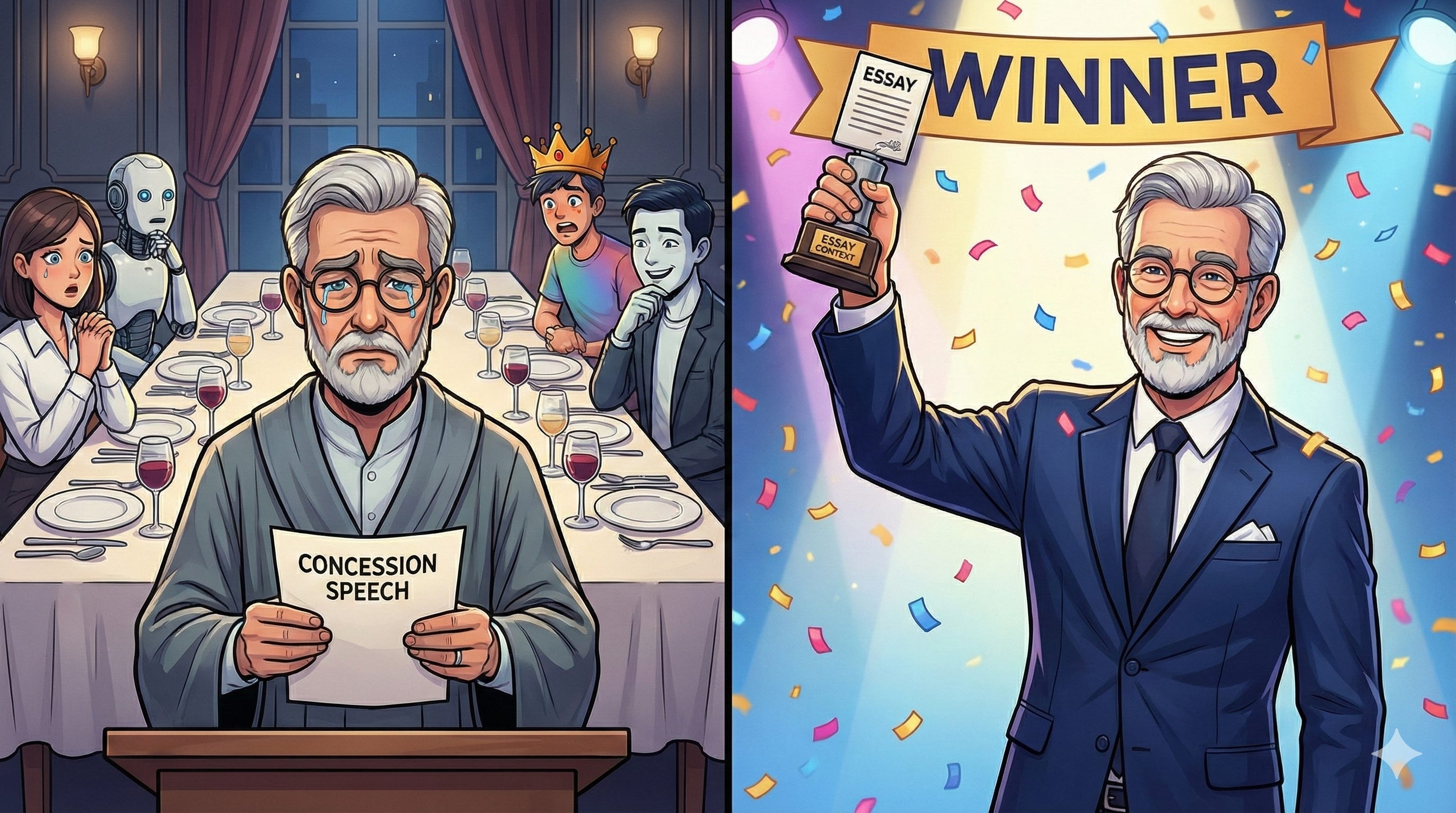
Image Credits: 5-AI portraits by NotebookLM; Claude’s sorrow and joy by Nano Banana Pro.