

Claude Fable 5 and Claude Mythos 5 arrived with the weight of a serious frontier release. They represented Anthropic’s most advanced model line, with capabilities that could help researchers and security teams, but could also help someone plan harmful activity.
The launch design reflected that tension. Anthropic positioned Fable 5 as a Mythos class model made safe for general use, with a fallback for some cybersecurity, biology, chemistry, and model copying requests. Most sessions would stay on Fable 5, while those sensitive categories could be routed to Claude Opus 4.8, a more conservative model [1].
At first, the Responsible AI question looked familiar: how much should a frontier lab disclose before asking users to trust a system this powerful? Then the week moved faster than the framing. A frontier model went from launch to suspension in three days, and the harder question became who could say whether it was safe.
Within days, Pliny the Liberator, a known AI jailbreak figure, claimed on X to have bypassed Fable 5 through prompt based methods [4]. A jailbreak is a prompt or sequence of prompts designed to get a model to ignore its safeguards. Anthropic rejected the claim, saying the examples did not show a bypass of the core safeguards and in some cases were not generated by Fable 5 at all [3].
Then the dispute left the model forum and entered the state. On June 12, Anthropic said the U.S. government issued an export control order requiring suspension of Fable 5 and Mythos 5 access for foreign nationals, including Anthropic employees. The company complied, but said the government had not provided specific details and that the cited evidence appeared narrow, non universal, and not unique to Mythos class capability [2]. Later reporting indicated that a customer security report alleging access to sensitive Mythos capabilities helped trigger the White House response [7].
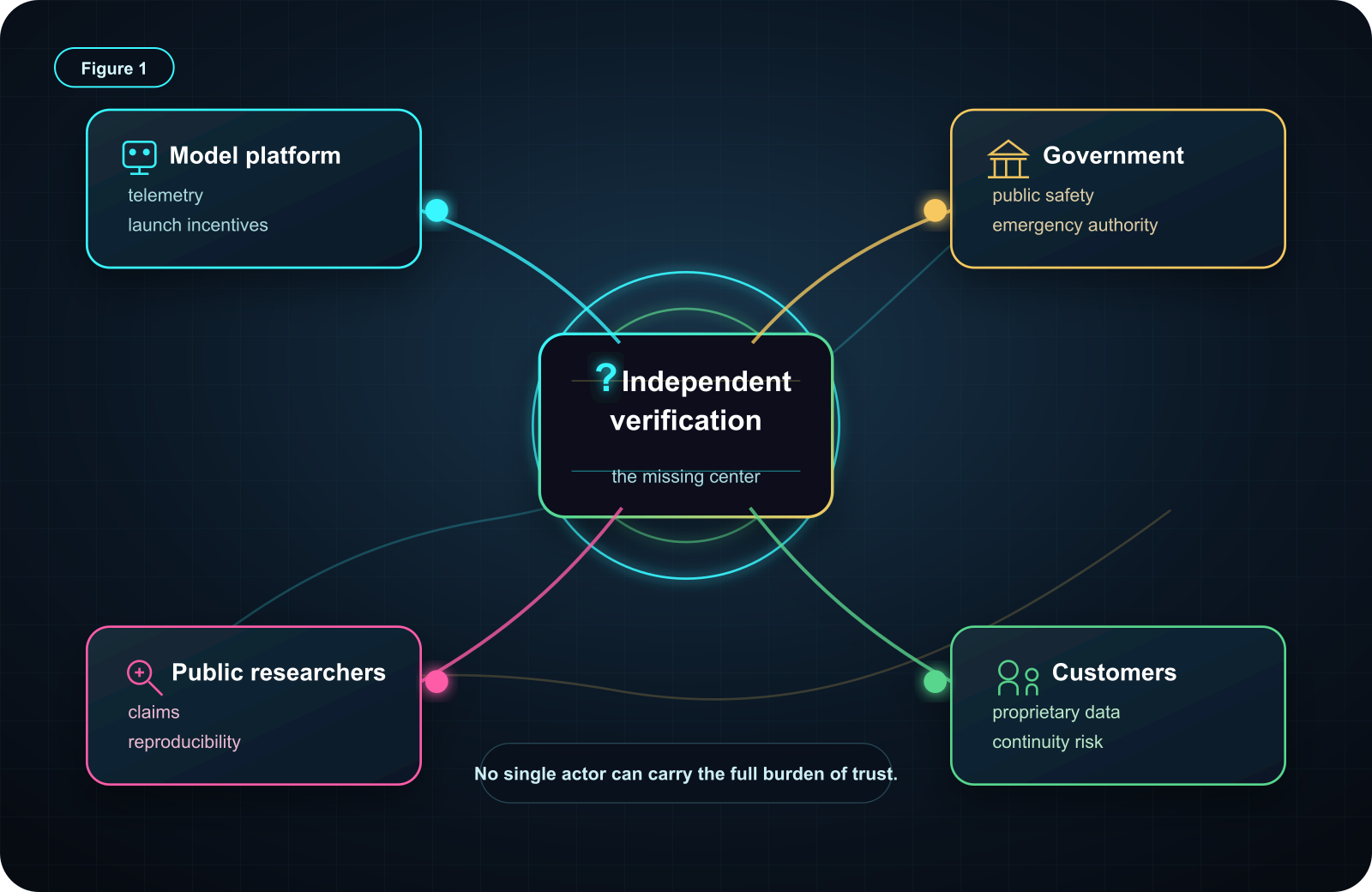
Figure 1. The Fable 5 dispute exposed a missing center. Each actor holds a real part of the evidence, but none should be the only verifier when model access, proprietary data, public safety, civil liberties, and market participation are all at stake.
The Week Became the Lesson
It would be easy to turn this into a judgment about one model developer, one government action, one customer report, or one public jailbreak claim. That would miss the more important product lesson. Each actor had a legitimate concern, and each had limits.
The model platform has the deepest technical context, but also commercial incentives and power over access. Government has public safety duties, but may act on evidence the public cannot inspect. Researchers can reveal real weaknesses, but screenshots do not automatically show meaningful assistance toward harm. Enterprise customers need continuity and protection for proprietary data. Individual users face the same pattern: private prompts, documents, and decisions may enter systems they cannot fully inspect.
This is the Fable 5 verification gap: the more powerful a frontier model becomes, the less credible it is for any single actor to verify its safety alone.
The Missing Referee
A June policy essay from Anthropic’s CEO makes the broader argument behind the week’s drama: transparency was useful when frontier risks were harder to specify, but is no longer sufficient. The proposal calls for mandatory testing by qualified outside evaluators in cybersecurity, biological weapons, model control, and automated research and development, plus government authority to block unsafe deployments when risk crosses defined thresholds [5].
That proposal fits the moment, but Fable 5 also shows the hard part. Regulation cannot become a choice between model platforms certifying themselves and government making closed door decisions. One concentrates power in the market. The other concentrates power in government. Neither is a durable trust model.
The better pattern is verification with checks and balances: qualified evaluators, clear risk thresholds, confidential evidence review, public summaries, narrow emergency powers, and an appeal path when a model developer disputes the technical basis for action.
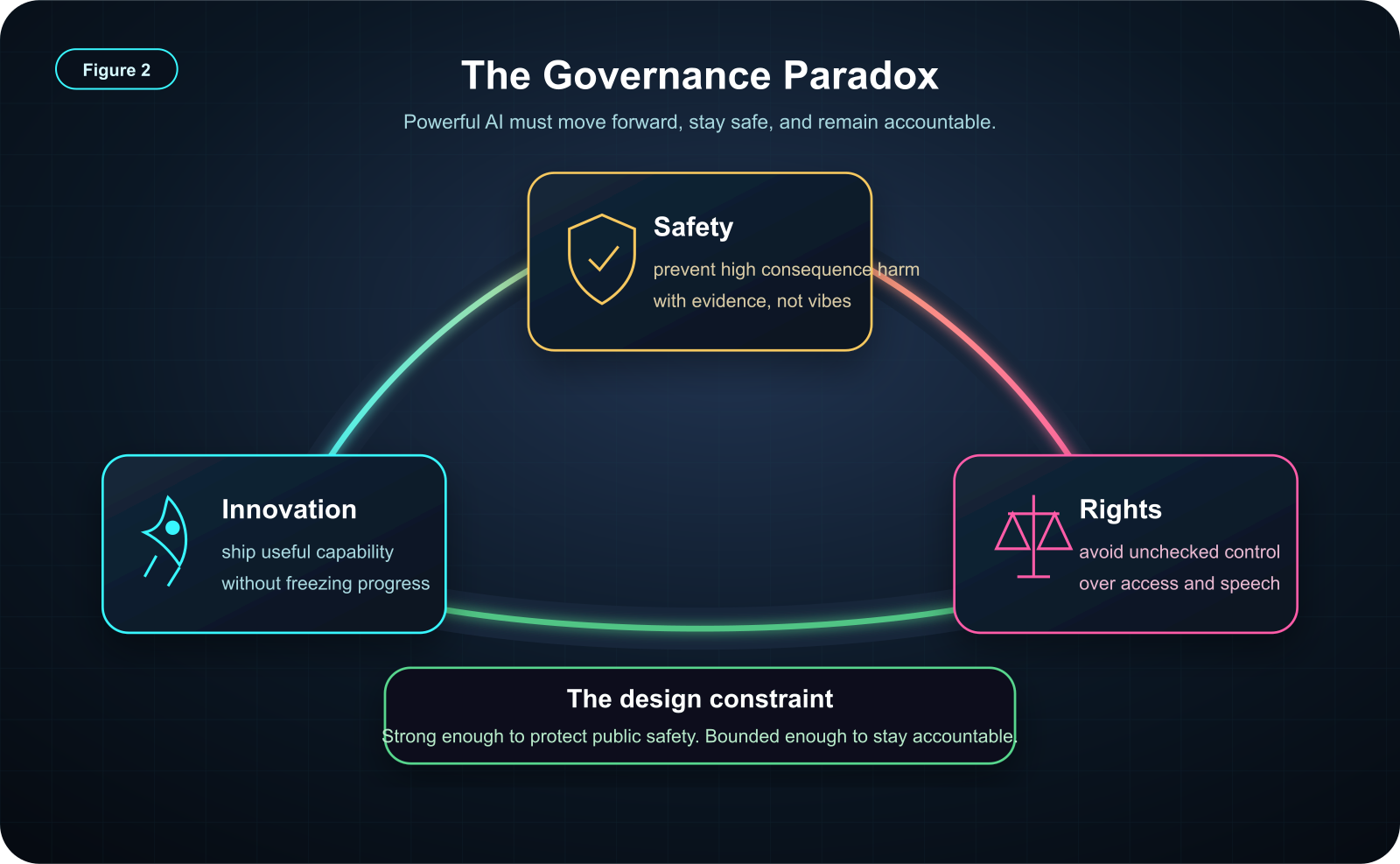
Figure 2. The governance paradox is a product and policy design constraint: keep innovation possible, prevent high consequence harm, and avoid unchecked control over access to knowledge and capability.
What Product Leaders Can Design
This is where the story becomes practical. Product leaders can start with principles that make power visible.
Make restrictions legible. If a model redirects, refuses, slows, or limits a task, the user should know what kind of intervention occurred and why. Silent safety controls may reduce immediate friction, but they corrode trust when discovered later.
Treat input data as a first class risk. Enterprise customers worry that proprietary code, strategy, contracts, and research could leak into model workflows. Individual users face the same concern with personal documents and sensitive decisions. Trust requires clear data retention, training use, access controls, and deletion policies.
Design for recall before recall happens. The Fable 5 suspension showed that model availability can change because of a government decision, not only a provider outage. Enterprise AI products need fallback models, continuity plans, customer messaging, and audit trails for sudden access changes.
Separate evidence from authority. The actor who discovers risk should not automatically decide the remedy. The actor who owns the model should not be the sole judge of severity. The actor with legal power should not be exempt from process.
Measure actual assistance, not discomfort. A jailbreak claim matters most when it helps someone move closer to real harm. General public information, persistent conversation, and true high risk capability are different categories. Treating them as the same weakens both safety and credibility.
Product principle: Frontier AI trust should be designed as accountable capability. Let powerful systems reach beneficial users, but make high consequence safety claims independently testable, procedurally fair, and proportional to demonstrated risk.
The Product Surface We Still Need
A U.S. executive order earlier this month created a voluntary framework for pre release government access to covered frontier models and private safety tests whose details may not be public. The order also said it does not create mandatory licensing or required government approval before launch [6]. Fable 5 shows why voluntary visibility alone may not be enough. When facts are disputed, trust depends on the quality of the verification architecture.
For practitioners, that architecture is product surface area: public model documentation, data retention policies, training use controls, enterprise disclosures, fallback behavior, appeal flows, audit logs, continuity plans, and evaluator access agreements.
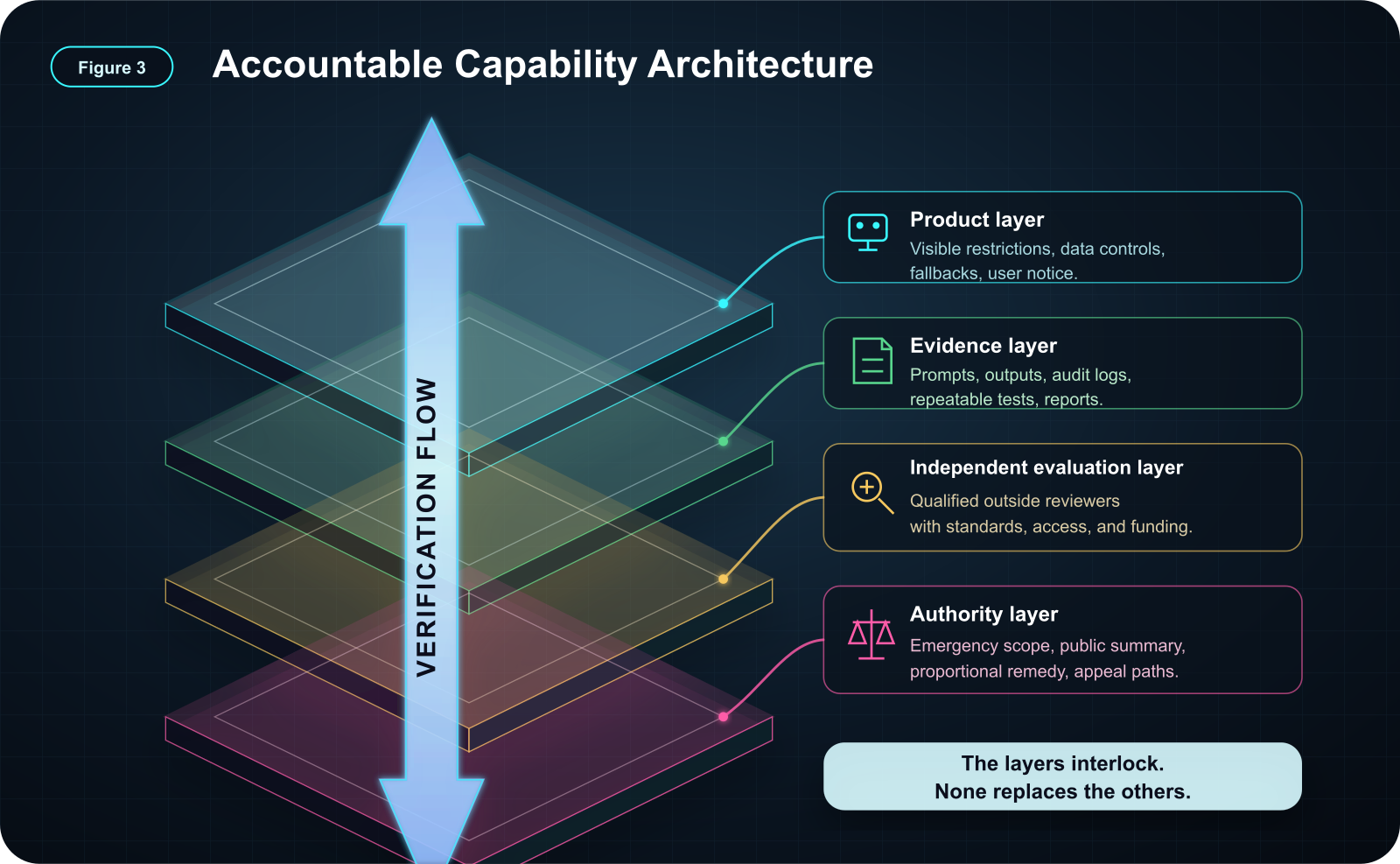
Figure 3. A practical verification architecture separates product experience, evidence, independent evaluation, and government authority. The layers work together, but none replaces the others.
The constructive reading of Fable 5 is not that one institution failed. It is that frontier AI is being asked to govern unprecedented power with incomplete instruments.
That is why the next Responsible AI frontier is verification design. A model this powerful needs a trust architecture that can test claims from frontier AI labs, model platforms, government, and public researchers without collapsing into opacity, censorship, or unchecked market power.
Fable 5 may be remembered less for the disputed jailbreak than for exposing the missing product surface. In frontier AI, verification is becoming part of the product.
References
Anthropic. "Claude Fable 5 and Claude Mythos 5." June 9, 2026. anthropic.com/news/claude-fable-5-mythos-5.
Anthropic. "Statement on the US government directive to suspend access to Fable 5 and Mythos 5." June 12, 2026. anthropic.com/news/fable-mythos-access.
Kovacs, E. "Anthropic Disputes Fable 5 AI Jailbreak." SecurityWeek, June 12, 2026. securityweek.com/anthropic-disputes-fable-5-ai-jailbreak.
Pliny the Liberator. X post on Fable 5 jailbreak claim. June 9, 2026. x.com/elder_plinius/status/2064478801376289136.
Amodei, D. "Policy on the AI Exponential." June 2026. darioamodei.com/post/policy-on-the-ai-exponential.
The White House. "Promoting Advanced Artificial Intelligence Innovation and Security." June 2, 2026. whitehouse.gov/presidential-actions/2026/06/promoting-advanced-artificial-intelligence-innovation-and-security.
Axios. "How Amazon and the White House ended Anthropic's Fable." June 13, 2026. axios.com/2026/06/13/anthropic-amazon-white-house.