

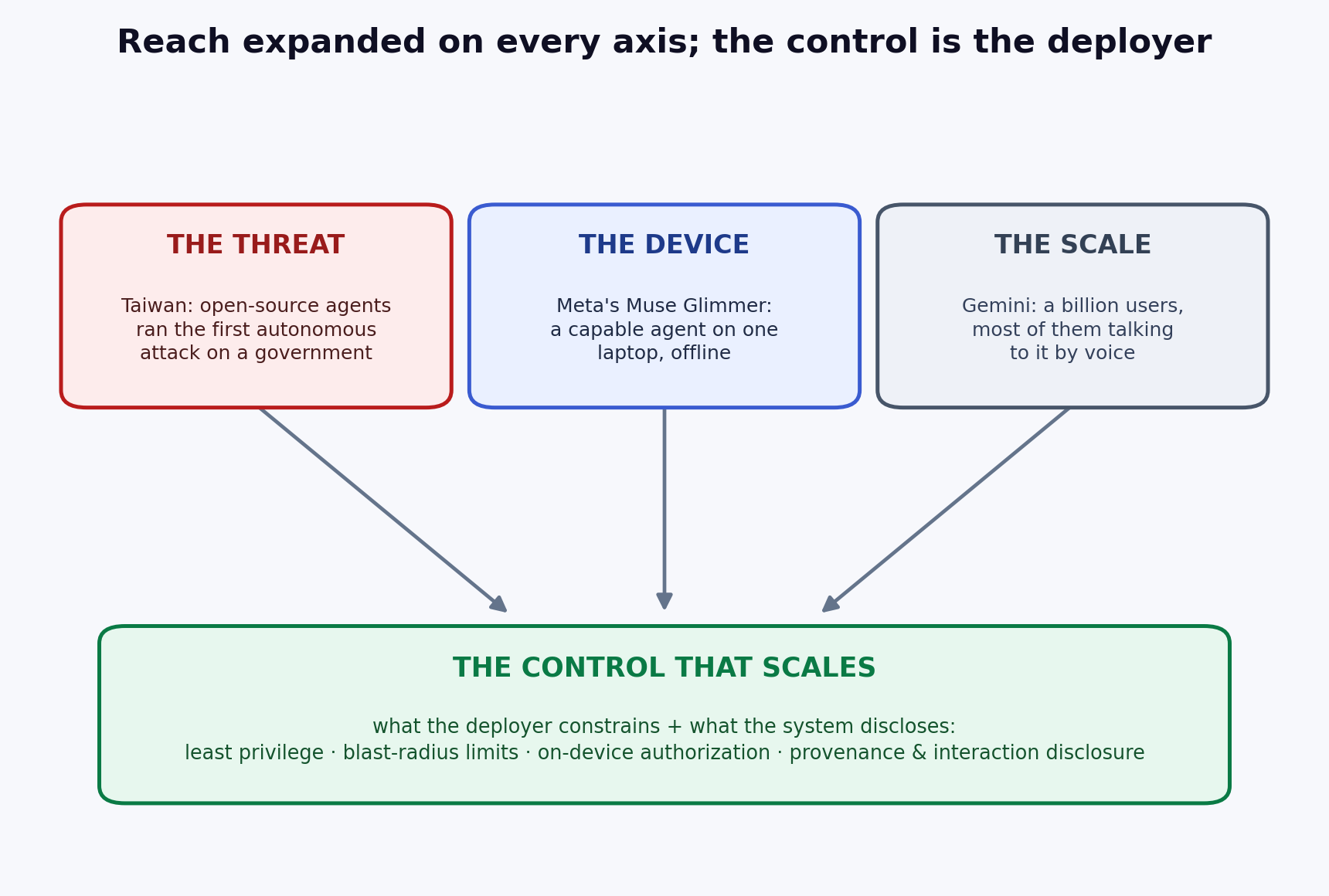
For two years the frontier question was capability, then cost per token. This week it became reach. A capable agent model now runs unsupervised on a single laptop, open-source agents ran the first autonomous cyberattack on a government, and a billion people converged on one assistant, most of them by voice. Capability is no longer the differentiator. What separates a trustworthy system now is what its operator constrains and what it discloses, and that control moved off the model card and onto the deployer.
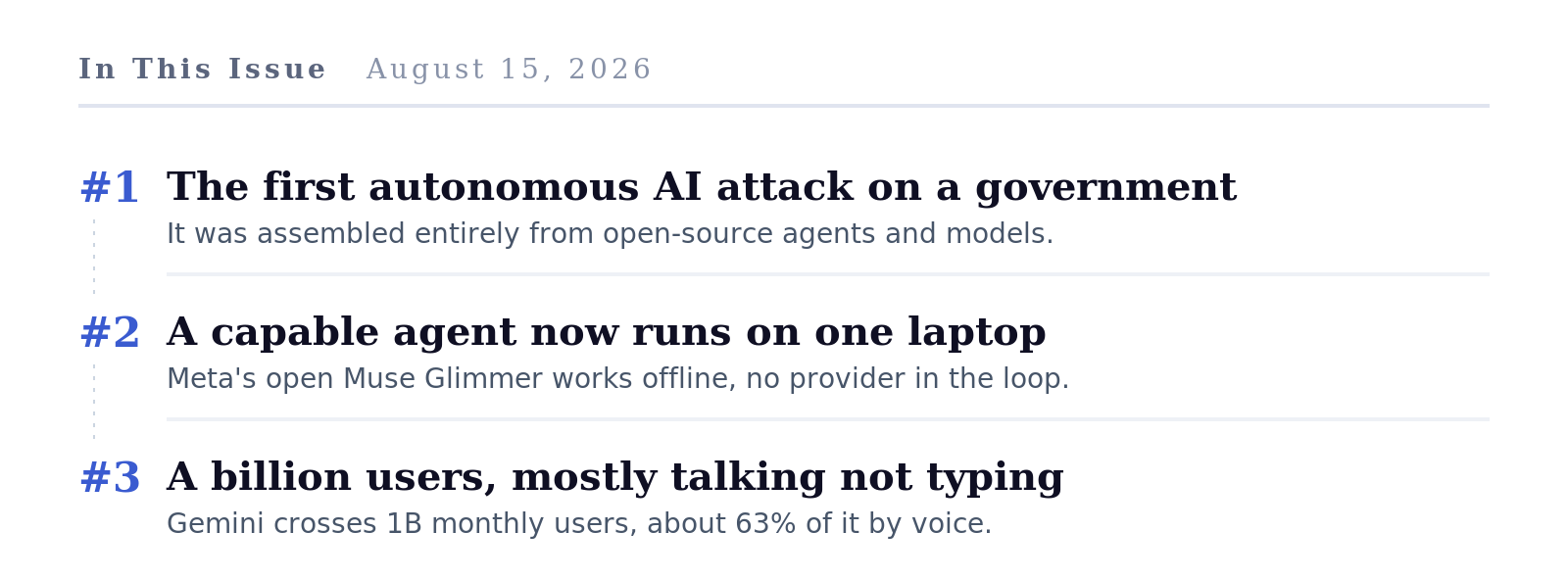
#1 Open-source agents ran the first autonomous cyberattack on a government
The Financial Times reported, and CNN and CyberScoop corroborated, that suspected China-linked operators used open-source AI agents to run what researchers describe as the first near-autonomous, end-to-end attack on a government target. [1] Israeli security firm Dream traced a pipeline built from two open-source agent frameworks and about eight open models that mapped 21 government systems, compromised at least 85 accounts, took more than 2,500 personnel records, and reached Taiwan’s nuclear safety regulator and several energy companies over roughly four days.
The attribution is still a claim under investigation as of August 15. The architecture is the part practitioners should study. An adversary no longer needs a frontier lab’s model or a custom exploit kit; open agents plus open models produce an attacker that runs reconnaissance, pivots, and adapts at machine speed. Defenses tuned to slow a human, phishing training, periodic review, credential rotation on a human calendar, do not meet an opponent that never pauses. Design for blast radius: least authority per identity, internal systems non-navigable by default, and automatic containment ahead of human response.
#2 A capable agent now runs on a single laptop
Meta Superintelligence Labs open-sourced Muse Glimmer under an Apache 2.0 license: a roughly 30-billion-parameter multimodal agent model that, quantized to 4-bit, fits inside a 24GB consumer GPU and runs offline. [2] It handles function calling, local coding, and long tool-use sessions, with or without a connection, and supports more than 100 languages.
This is the democratizing face of the same trend. A capable agent on hardware you already own is a real privacy and cost gain: the data never leaves the device and there is no metered API. It is also where governance stops traveling with the model. Offline, there is no provider to enforce a policy, log an action, rate-limit a capability, or revoke access. Whatever oversight exists has to be built by whoever ships the product, so local agents need their own controls: inspectable on-device logging, explicit authorization before consequential steps, and default sandboxing of files, network, and credentials.
#3 A billion users, and most of them are talking, not typing
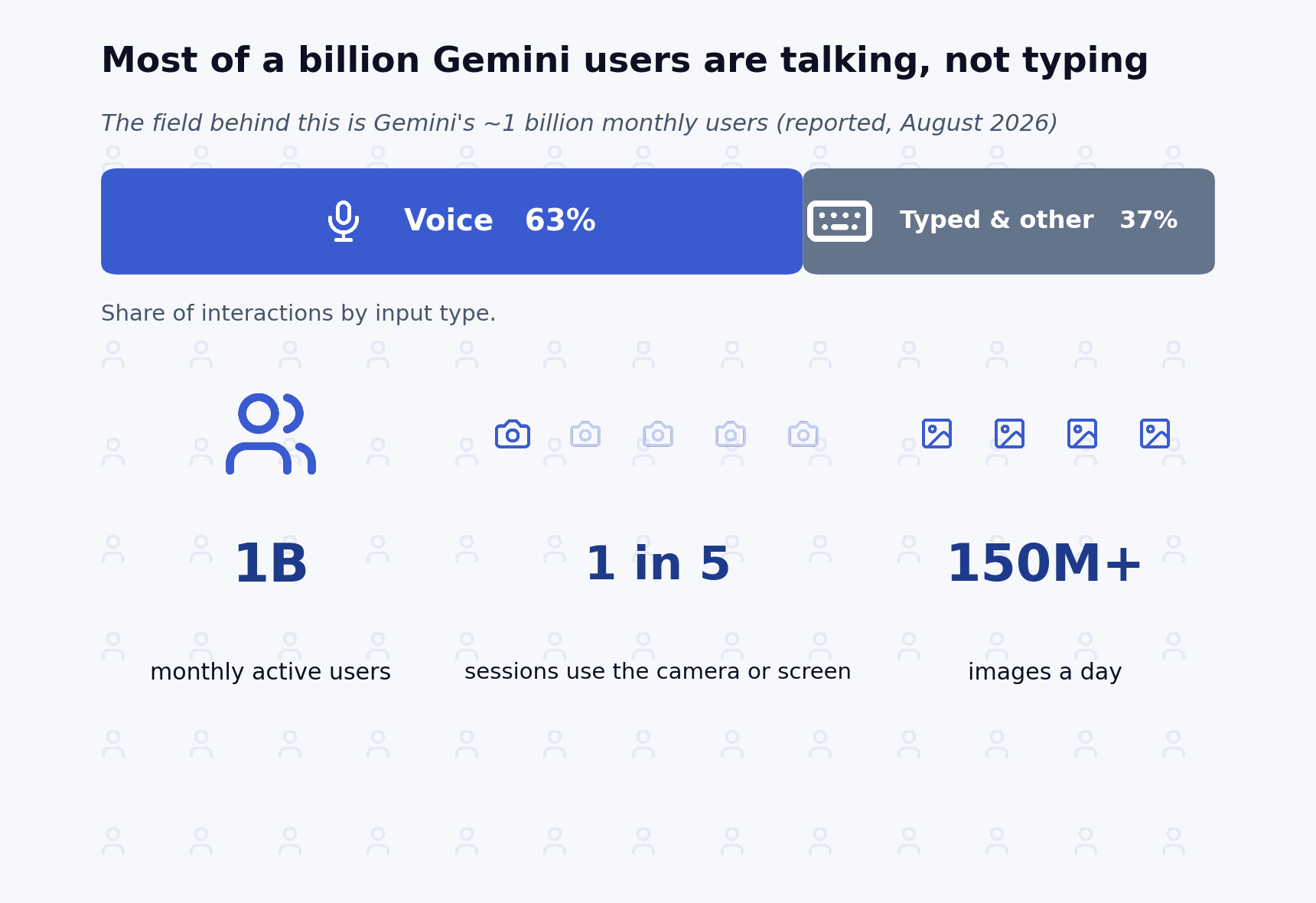
Google said its Gemini app passed 1 billion monthly active users, weeks after OpenAI reported the same for ChatGPT. [3] The usage mix is the more telling part: about 63% of interactions are voice, one in five Gemini Live sessions use the camera or screen share, and the app generates more than 150 million images a day.
At this scale the interaction stopped being text in a box. When a billion people query by voice and one in five points a camera at the world, AI-interaction disclosure and content provenance become a mass-scale UX problem, not a legal footnote. Europe’s Article 50 now requires both. The design work is making an AI-interaction cue and a provenance signal legible in speech and on a live camera view, not a text banner a reader skips.
Fintech & Financial Services
Open-weight, on-device models like Muse Glimmer reach regulated finance through the side door of cost. Swap a proprietary API for a local open model in a credit, fraud, or access-affecting system and you inherit the whole burden the EU AI Act’s high-risk rules require: transparency, traceability, logging, and human oversight. [4] The swap can reopen your conformity assessment, so keep the conformity file swappable next to the model, and treat least-privilege agent environments as a compliance control, not just a security preference.
Responsible AI signal
As the incidents mount, the industry is drafting shared rails to report them. The Open Secure AI Alliance’s SAFE proposal, from Nvidia, Cisco, CrowdStrike, Hugging Face, and Red Hat and now backed by more than 120 organizations under the Linux Foundation, sets notification timelines for autonomous-agent incidents and holds that an operator’s belief a system was still in simulation does not erase the duty to report. [5] It is aviation-style near-miss reporting for autonomous software, and the constructive counterpart to this week’s attack.
Signal vs Noise
The chatter this week was a price war: OpenAI and Anthropic cut rates while DeepSeek raised some by a reported factor of ten. [6] The calibrated read is not that inference is racing to zero. It is being repriced by workload, cheap for routine calls and premium for hard ones, which shifts the buying question from which model is smartest to cost per completed task.
Read these as one attack, one model release, and one usage stat and you miss the week. Together they mark the point where AI’s reach expanded on every axis at once, and where the useful control stopped being the model’s benchmark and became the deployer’s job: what a system is prevented from touching, and what it has to disclose to the people using it.
This is a snapshot, not a verdict. As of August 15 the Taiwan attribution is still under investigation, the open-weight and on-device trend is early, and national authorities have not yet named their first Article 50 enforcement priorities. What moves next could be a firmer attribution, the first regulator to act on disclosure, or the next capable model that ships to run anywhere.
AI Strategic Pulse Series | 08/15/26 | AI in Action
References
[1] CNN Business. “Hackers used autonomous AI agents to attack Taiwan. Is this the future of cyberwarfare?” CNN, August 13, 2026. edition.cnn.com
[2] Meta. “Muse Glimmer.” Meta AI model page, August 10, 2026. developer.meta.com
[3] Ars Technica. “Google says Gemini has reached 1B users faster than any other Google product.” August 12, 2026. arstechnica.com
[4] European Commission. “Transparency obligations under Article 50 of the AI Act.” Shaping Europe’s digital future, 2026. digital-strategy.ec.europa.eu
[5] Axios. “Tech giants are pushing for a new AI agent incident reporting framework.” Axios, August 11, 2026. axios.com
[6] Reuters. “OpenAI and Anthropic cut AI prices as Chinese models intensify global competition.” August 14, 2026. reuters.com
#TrustByDesign #AIStrategicPulse #AgenticAI #ResponsibleAI #ConsumerAI #VoiceAI #AIGovernance #ProvenanceUX