

For two years the frontier question was capability, then cost per token. This week’s most consequential moves were different. They changed the defaults people receive, the architecture governing enterprise data, and the signals that influence which sources appear in AI-mediated search.
The model still matters. But trust no longer ships in the model alone. It is also built through the controls around it, and those controls differ in who operates them, how mature they are, and what evidence supports their effect.
#1 Teen safeguards became the default, and correction now carries a cost
On August 18 OpenAI launched ChatGPT for Teens for users 13 to 17, with stronger protections on by default. They include tighter limits in higher-risk areas, restrictions on romantic or emotionally dependent language, and family controls designed to limit what parents can see. OpenAI automatically applies the experience when a user reports being under 18 or its age-prediction system estimates that an account belongs to a minor. [1]
The consequential design choice is enforcement by inference. When OpenAI is uncertain, it applies the safer experience. A person placed there incorrectly can check the status in Settings and restore adult access through a Persona selfie verification. [2] That is a real correction path, but it moves the burden to the user and introduces a second trust decision: whether to provide biometric evidence to a third-party verification service. The design test goes beyond whether an appeal exists: whether the classification is visible enough to discover, whether the correction is accessible, and whether people who cannot or will not submit a selfie have a proportionate alternative.
#2 Data control is moving to the customer, but the systems are still emerging
Within two days both leading US labs signaled a shift on enterprise data, and neither move was about intelligence. OpenAI began testing Zero Data Retention for frontier models, a preview it is rolling out with early customers. [3] Anthropic is reported to be planning to let enterprise customers meet the required 30-day retention on their own cloud rather than Anthropic’s, reversing a June policy that mandated retention of all enterprise traffic as a cyberattack safeguard. Bloomberg attributed the change to a person familiar with it, and Anthropic said it developed the plan with more than 100 customers, including Salesforce. [4]
The lever here is data sovereignty: where the data lives matters more than how capable the model is. Both moves hand the customer more control over their data, whether the vendor keeps none of it (OpenAI) or keeps it only in the customer’s own cloud (Anthropic). If these ship as described, trust becomes a contract about where data lives, which means data handling belongs in the product UI, with plain defaults the buyer can actually see.
#3 Visitors can mark your website a Preferred Source contextually
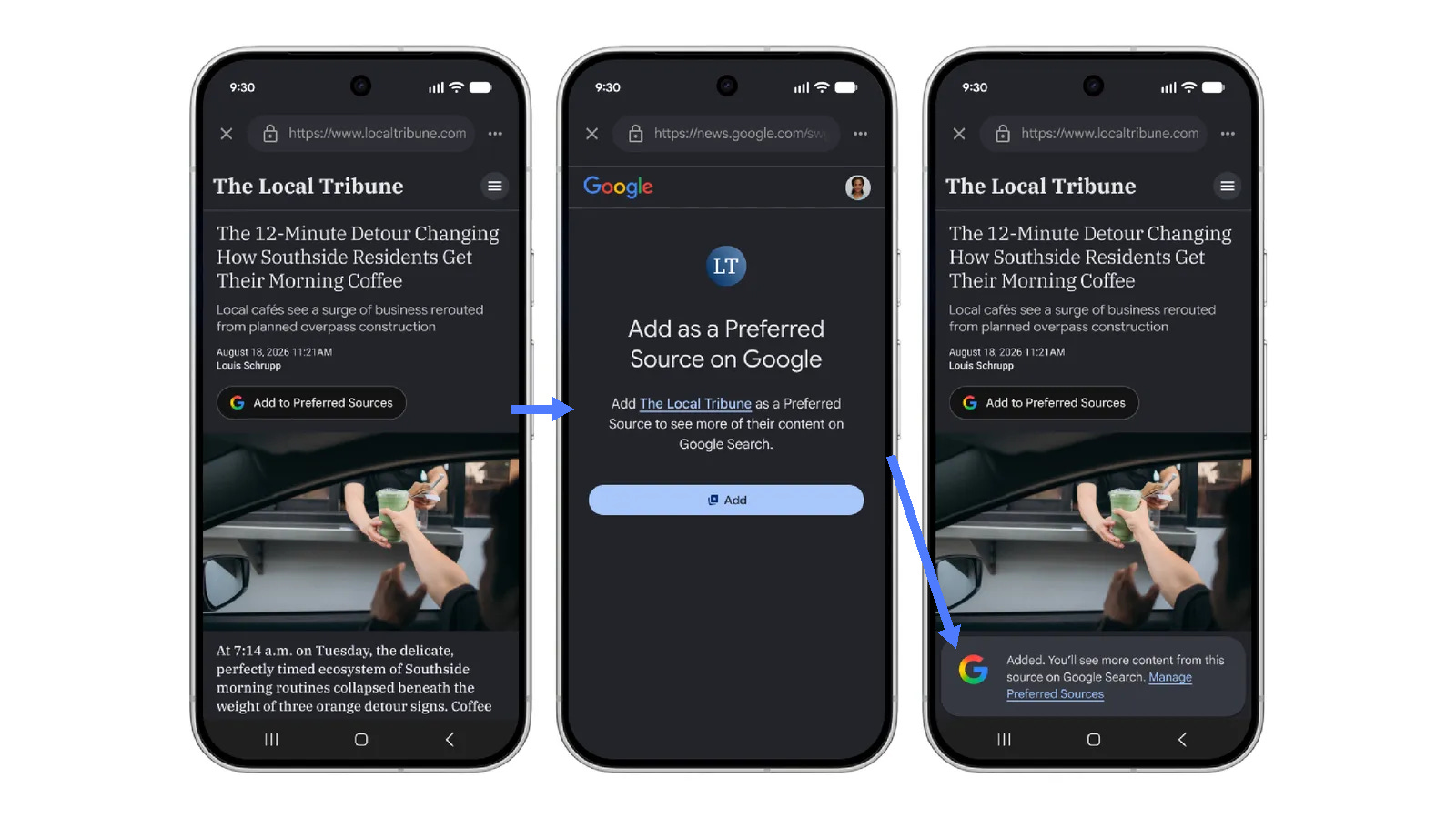
Google made a small change worth reading in the context of zero-click search, where AI answers resolve a query without sending the visitor on. Website owners could already add a Preferred Sources button; what changed on August 20 is the flow. A visitor can now add your site while using it, in two clicks, one on the page and one to confirm on Google, and is returned to where they left off, as shown in Figure 1. [5] More than 600,000 sources have been chosen, and Google reports people are twice as likely to click through to a Preferred Source. [6]
Read it as an opportunity. Having visitors mark your site a Preferred Source lifts how often it surfaces across Search, Discover, News, and Google’s AI experiences, so it is a way to increase your content’s AI visibility, a pivot that fits the zero-click era. The opportunity reaches beyond traditional publishers: any website or content owner offering accurate, unbiased, trustworthy information can make it easier for visitors to choose them, and to be surfaced by AI.
Design it as an invitation. Offer the button at a natural moment, after a visitor has received value, and keep it visible, contextual, and easy to dismiss. One detail to get right: once a visitor has added you, switch the button to an added or disabled state rather than leaving it inviting the action, as it appears to in Google’s own mockup above.
Reading the teen launch, the data-control changes, and the Preferred Source button as isolated items misses this week’s movement. Each embeds a consequential decision in a control around the model: an age-based default, a data architecture moving toward customer control, or a user-selected source preference. They are not equally mature and they do not create the same kind of trust, but practitioners can see, question, and steer these controls in ways a model benchmark cannot capture.
This is a snapshot, and the verdict is still to come. As of August 22, the real-world friction of inferred age classification has not yet been demonstrated at scale, the data-residency details are still rolling out, and Google’s lower-friction button is days old. Because trust no longer ships in the model alone, the next decisive evidence will be whether these product-layer controls actually prove legible, correctable, and effective in practice.
AI Strategic Pulse Series | 08/22/26 | AI in Action
References
[1] OpenAI. “Introducing ChatGPT for Teens: Built for learning, backed by protections.” August 18, 2026.
[2] OpenAI. “Our approach to age prediction.” 2026.
[3] OpenAI. “Offering Zero Data Retention for frontier models.” August 19, 2026.
[4] Nellis, S., and Cai, K. “Anthropic Plans to Change Data Retention Policy for Advanced AI.” Bloomberg, August 20, 2026.
[5] Google. “Personalize the content you see on Search, Discover, and News.” August 20, 2026.
[6] Google. “New ways to find your favorite sources and original content in AI Search.” May 27, 2026.