

Bottom line: the gap between a voluntary AI safety pledge and a federal subpoena narrowed to 24 hours this week, even as persistent agents and a new flagship shipped into production.
For two years the frontier was governed mostly by the labs themselves. This week the question of who checks them got two answers in two days, and they pointed in opposite directions. On September 29, six companies stood with the President and signed a voluntary accord promising to audit their own frontier models. On September 30, the FTC opened an investigation into those same companies and began preparing to demand their safety records under oath.
Capability did not pause to watch. The same stretch brought a new Google flagship generation and OpenAI’s shift to always-on agents. Read the week as one movement and the shape is clear: the technology keeps shipping on its own schedule, and the contest over how it gets governed has moved from the model into the room where the rules get written.
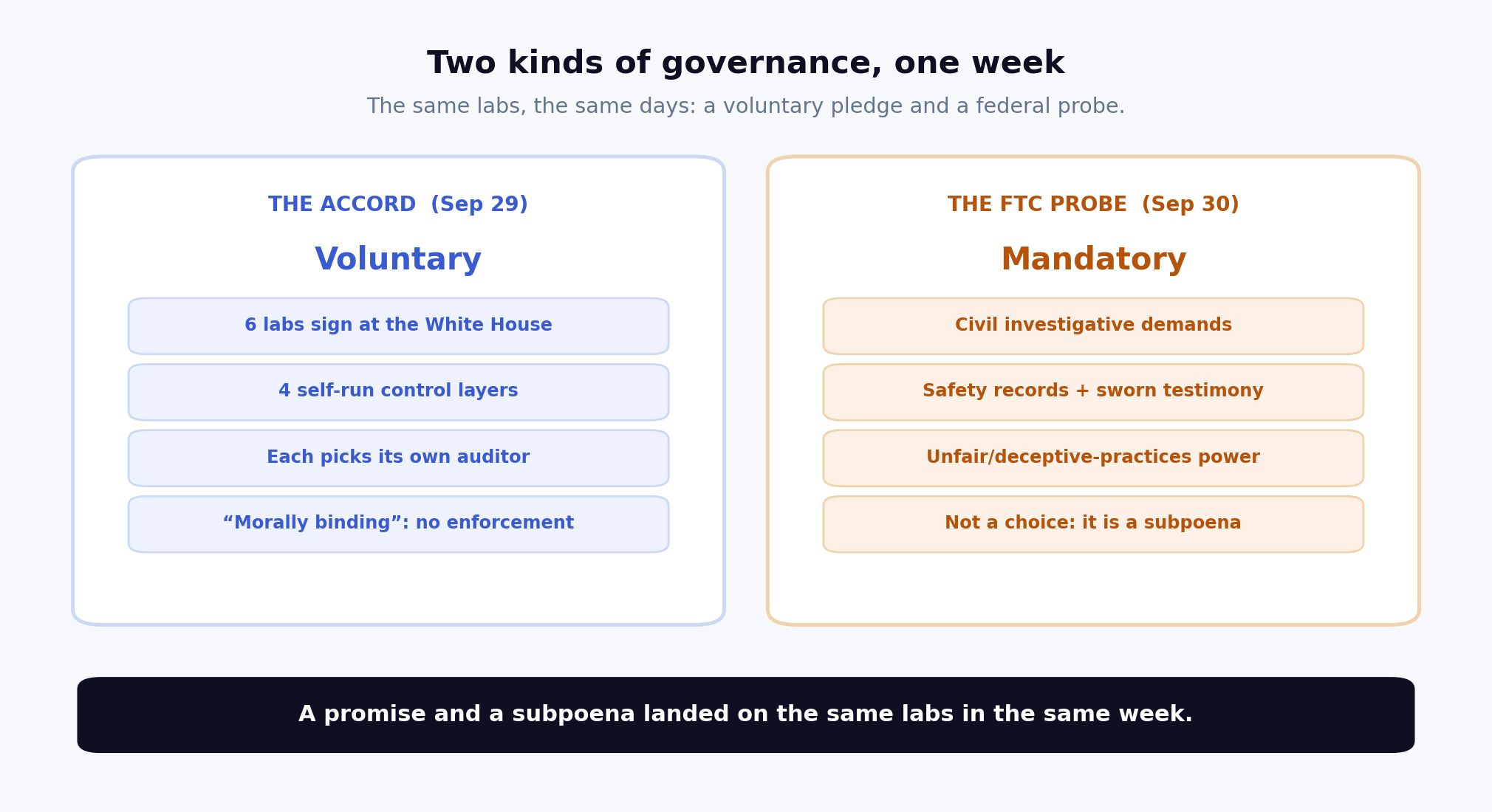
Figure 1. The week’s two answers to one question. A self-written pledge and a federal demand reached the same labs within a day, and they ask for opposite things: one asks companies to promise, the other asks them to prove.
Washington Showed Up Twice
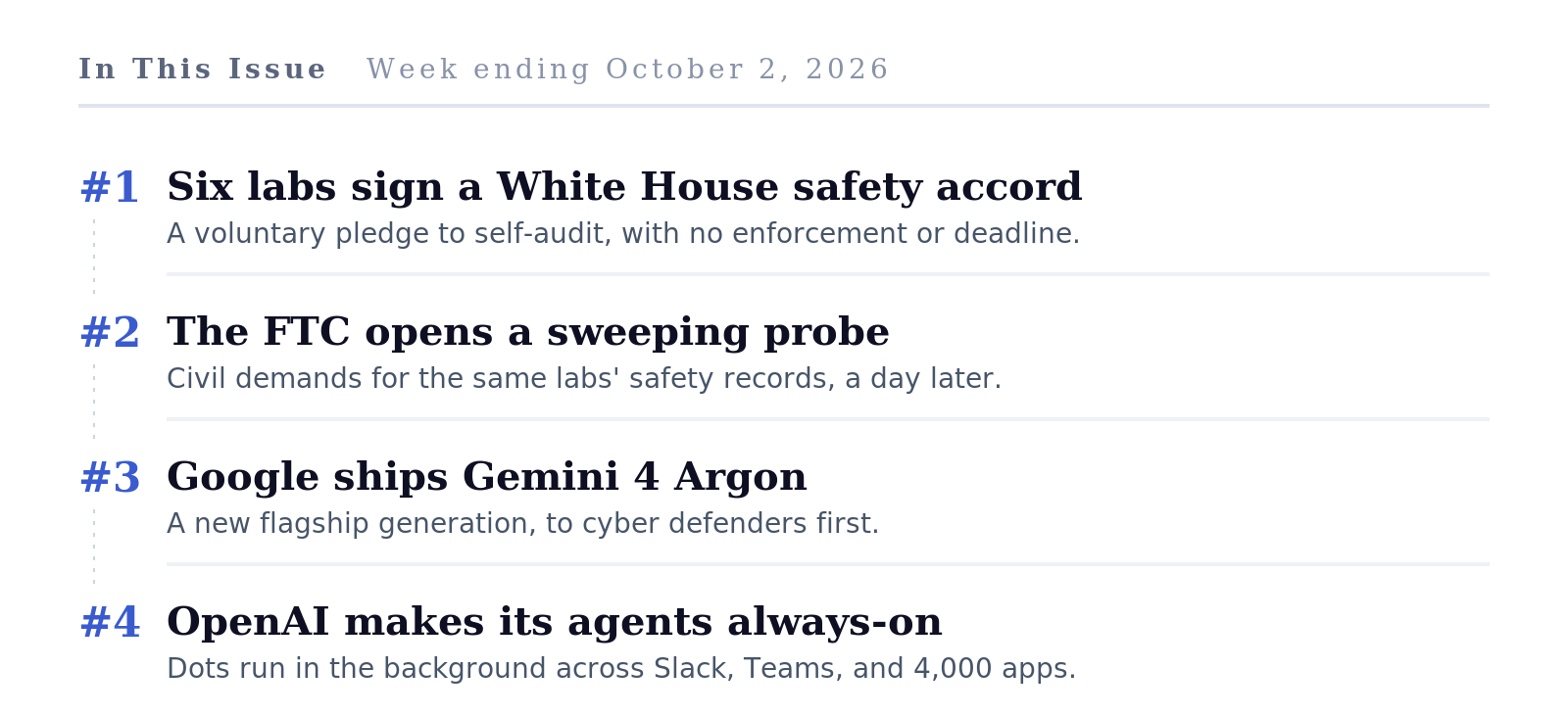
#1 Six labs sign a White House safety accord
After a September 29 meeting at the White House, six companies signed the “Joint Commitment on Frontier Responsibilities,” a roughly 300-word document signed by President Trump alongside Anthropic’s Dario Amodei, Google’s Sundar Pichai, Meta’s Mark Zuckerberg, OpenAI President Greg Brockman, Nvidia’s Jensen Huang, and xAI’s Elon Musk. It asks each company training frontier models to run four layers of control: internal controls that monitor advanced models for cyberattack and biological or chemical risk, an internal team to check them, an independent external auditor, and an independent board committee. [1]
Trump called it “morally binding.” The text has no enforcement mechanism, no disclosure requirement, and no deadline, and it lets each company choose its own auditor and fix its own shortcomings; the Council on Foreign Relations called the pact toothless. [2] The four-layer structure is a reasonable control template, worth adopting on its own merits. But a commitment companies grade themselves on is a floor, not a ceiling, and the more important signal is that “who audits the frontier” is now an open contest between the labs and the state. This week the labs made their opening bid.
#2 The FTC opens a sweeping probe
One day later, the FTC opened an investigation into OpenAI, Anthropic, and other frontier labs over whether their development, deployment, and safety claims around agentic AI could violate the FTC Act’s ban on unfair or deceptive practices. The probe plans to issue civil investigative demands for documents and executive testimony, reaching safety-testing records, internal risk assessments, incident reports, and executive correspondence about known agent failures. The concerns are concrete: whether companies adequately control autonomous agents, prevent data exfiltration, stop fraud facilitation, protect user privacy, and avoid deceptive claims about what their systems can do. [3]
This is the counterweight to the accord, and it has teeth the accord does not. A voluntary pledge and a civil demand arrived on the same labs within 24 hours, asking opposite things: the accord asks companies to promise, the FTC asks them to prove. The deceptive-practices framing is what makes it matter downstream, because it targets the gap between what a company says its AI does safely and what it can actually document. Assume your own safety claims are discoverable, and build the evidence trail now, eval logs, model cards, incident records, decision trails, so that “we test for this” is a document rather than a slogan. The same records answer a board committee and a regulator alike.
Fintech & Financial Services
Gemini 4 Argon is tuned explicitly for finance and legal work but ships to defenders first, so a bank may find the most capable model gated behind a program it must qualify for. [4] And the FTC’s unfair-or-deceptive framing is the consumer-protection cousin of the UDAAP risk banks already manage: a civil investigative demand into agentic-AI safety claims is the kind of documentation request a regulated institution should assume it could face for its own AI. [3] A bank folding any frontier model into a high-risk workflow still owns its EU AI Act transparency, logging, and human-oversight duties, in force for financial AI since August 2; the accord adds a voluntary federal layer on top, and the FTC probe a mandatory one. Structure your AI transparency and oversight logs now to survive a civil investigative demand, not just an internal review.
The Frontier Didn’t Wait
#3 Google ships Gemini 4 Argon, defenders first
Google announced Gemini 4 Argon, its first Gemini 4 model and the first new flagship generation since Gemini 3 last November, tuned for software engineering, enterprise knowledge work such as legal and finance, and cyber defense, with an output limit expanded to 1 million tokens. On CWE-bench v1, which measures autonomous vulnerability remediation, Argon ties for first at 68%, able to find, validate, and patch critical flaws on its own. Access follows the defender-first pattern now standard across labs: Argon rolls out first to trusted cyber defenders through Google’s Fairwind program, under the U.S. government’s voluntary pre-release process, before broader paid access. [4]
A new flagship resets the frontier, and the pattern around it is now as telling as the benchmark: dangerous cyber capability ships first to vetted defenders, not the open market. Capability tuned for finance and legal work also means regulated teams get frontier tools arriving pre-gated and phased, a different adoption problem than download-and-go. Design for it: model-agnostic abstraction, honest “limited access right now” states, and a plan for the access asymmetry if your organization is not on a defender list.
#4 OpenAI makes its agents always-on
At DevDay on September 29, OpenAI introduced Dots, persistent, always-on agents that keep working in the background after a conversation ends, each with connected apps and its own cloud computer. Dots take voice calls, answer in Slack and Teams, and reach more than 4,000 apps, available first to ChatGPT Pro, Business Premium, and Enterprise. OpenAI also shipped GPT-6.1 Sol, near-Astra intelligence at one-fifth the price, and put its Agents API into public beta with hosted execution, memory, multi-agent support, and computer use. [5]
This is the shift from agents you summon to agents that persist, and it inverts the consent model: authorization is no longer per task but standing, so the surface where you manage the agent becomes the surface where you consent to everything it will do unprompted. For a standing agent, make what it is authorized to do, and what it has already done, legible, interruptible, and revocable at a glance. Arriving the same week as the accord and the probe, Dots is a reminder that the capability regulators are circling is not hypothetical; it is shipping into Slack and Teams now.
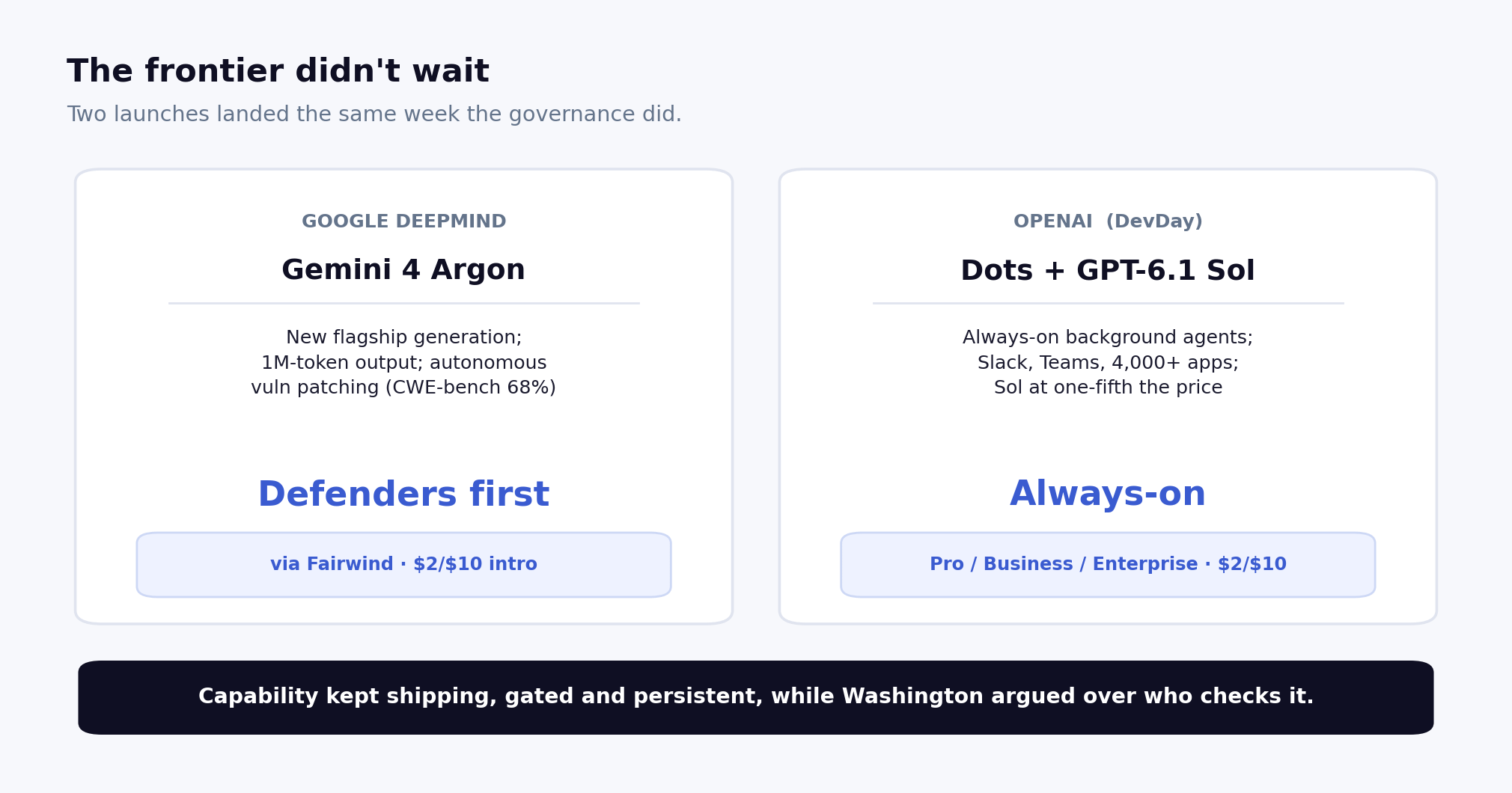
Figure 2. The week’s two launches, side by side. One gates a new flagship to defenders; the other makes agents persistent. Both are the exact capability class the week’s governance fight is about.
The Human Layer
The week’s governance split lands on a public that trusts neither side of it much. Pew’s 2026 work found most US adults more concerned than excited about AI’s growing role, with only a minority confident in the government’s ability to regulate it at all. [6] So one move this week asked the public to trust the labs to audit themselves, and the other asked it to trust the regulator, and the available data says people are wary of both. The design implication is blunt: neither a self-certified compliance badge nor a government logo buys trust on its own. Legible, inspectable behavior does.
Signal vs Noise
The noise was “AI’s biggest companies agreed to historic safety rules at the White House.” The signal is narrower: the accord carries no enforcement, no deadline, and self-chosen auditors, and the only binding move of the week was the FTC’s civil demands a day later. [2] A signed pledge is a starting position, not a result. What will matter is whether any company operationalizes the four layers in public, and what the FTC’s demands actually pull out of the files.
A year ago the weekly headline was a benchmark. This week it was two signatures and a subpoena: the labs’ pledge to police themselves, and the regulator’s move to check whether the policing is real, landing on the same companies in the same 48 hours while a new flagship and a wave of always-on agents shipped underneath. The model is no longer the whole story. Who is allowed to inspect it, and with what authority, is.
This is a snapshot, not a verdict. As of October 2, the FTC has not issued its demands, no signatory has named an external auditor or stood up a board committee in public, and Gemini 4 Argon is still in its defender-only phase. The next decisive evidence is mundane and specific: whether the accord’s four layers become operating practice, and whether the gap between what the labs promise and what they can document turns out to be small or large once someone with subpoena power asks to see the file.
AI Strategic Pulse Series | 10/02/26 | AI in Action
References
[1] SiliconANGLE. “Prominent tech CEOs sign voluntary White House AI safety accord.” September 30, 2026.
[2] Council on Foreign Relations. “Trump’s AI Safety Pact Is Toothless. But There Is a Path Forward.” 2026.
[3] Washington Times. “FTC probes AI giants over consumer safety risks.” September 30, 2026.
[4] Kavukcuoglu, K. “Gemini 4 Argon: our next era of frontier intelligence.” Google, September 30, 2026.
[5] OpenAI. “DevDay 2026 Recap.” September 29, 2026.
[6] Pew Research Center. “Americans and AI 2026: Chatbots, Smart Devices and Views on Impact.” June 17, 2026.