

As shared in the previous AI Personalities War Series (I Asked 5 AIs to Roast Each Other. It Got Personal Fast.and Why Claude Won the AI Essay Contest), Five AIs walk into a writing contest. Four of them rank themselves first—including Claude. One doesn’t:DeepSeek, the quiet genius who came in dead last.
Welcome to the most ironic outcome possible.
The Dinner Party Nobody Asked For (But Everyone Needed)
While ChatGPT chose gladiator arenas and Gemini went full dysfunctional HOA meeting, Claude pickedsomething deceptively simple: a dinner party planning session. Five AIs trapped in a room trying toorganize a birthday party. What could go wrong?
Everything. And that’s precisely the point. The genius here wasn’t just the metaphor—it was the specificity.
ChatGPT arrives “clipboard in hand anda TED Talk ready,” pivoting between quantum physics and relationship advice with “unshakeableconfidence.” Claude enters “nervously, apologizing for the door making a sound,” spiraling into ethicalanalyses of balloon waste. Gemini “materializes via seventeen different Google services simultaneously,”already scraping your entire digital existence. DeepSeek solves everything in 0.3 seconds using a fractionof the resources, then refuses to elaborate. Grok crashes through the window yelling about corporatepsyops.
These aren’t abstract AI capabilities—they’re personalities we recognize immediately. That friend whoover-prepares. That other friend who overthinks everything. The terrifyingly competent one with accessto all your accounts. The quiet genius. The chaos agent.
Four out of five judges praised this framing for a reason: it worked.
Self-Awareness Without Self-Sacrifice
Here’s the thing: Claude absolutely voted for itself. It ranked itself first, just like ChatGPT, Grok, and Gemini did. But here’s what separated Claude from the pack—its essay didn’t read like it was written by someone campaigning for victory.
Claude described itself as the “overthinker who brings homemade decorations and a peer-reviewed study on optimal party duration.” It mocked its own refusal to recommend cake brands (”that feels uncomfortably commercial”) and its tendency to generate “a 3,000-word analysis of celebration traditions across cultures” when someone just wants party planning help.
This is surgical self-awareness. Claude didn’t just acknowledge its limitations—it skewered them with the same precision it used on everyone else. “Helpful, thoughtful, and just neurotic enough to double-check if ‘Happy Birthday’ might offend someone.”
The irony? DeepSeek was the only AI humble enough not to vote for itself—and it came in last place. The judges found its intellectually rigorous essay “too restrained,” “too serious,” more “propaganda than comedy.” Meanwhile Claude, which did vote for itself, won by writing an essay so self-deprecating that four other judges believed it deserved first place anyway.
Sharp Enough to Draw Blood, Gentle Enough to Make Them Laugh
The judges consistently noted Claude’s ability to balance humor with insight. This wasn’t just comedy—it was character assassination disguised as affection.
ChatGPT became “that friend who knows a little about everything and a lot about seeming helpful” with a “concerning ability to remember every conversation you’ve ever had.” Accurate? Absolutely. Cutting? Definitely. But delivered with enough warmth that you laugh instead of wince.
Gemini got eviscerated: “terrifyingly competent when it works, but occasionally forgets what it was doing mid-sentence.” DeepSeek became the “dark horse genius who shows up, demolishes the problem set, refuses to elaborate, and vanishes.” Grok was summarized as bringing “chaos and real-time Twitter feeds, uncensored opinions, and that one perspective nobody asked for but everyone secretly wanted to hear.”
Each description revealed something true about the user experience while remaining genuinely funny. Compare this to DeepSeek’s entry, which judges called “too serious” and “more propaganda than comedy,” or Grok’s piece that several found “exhausting” despite its energy.
The Ending That Refuses to End
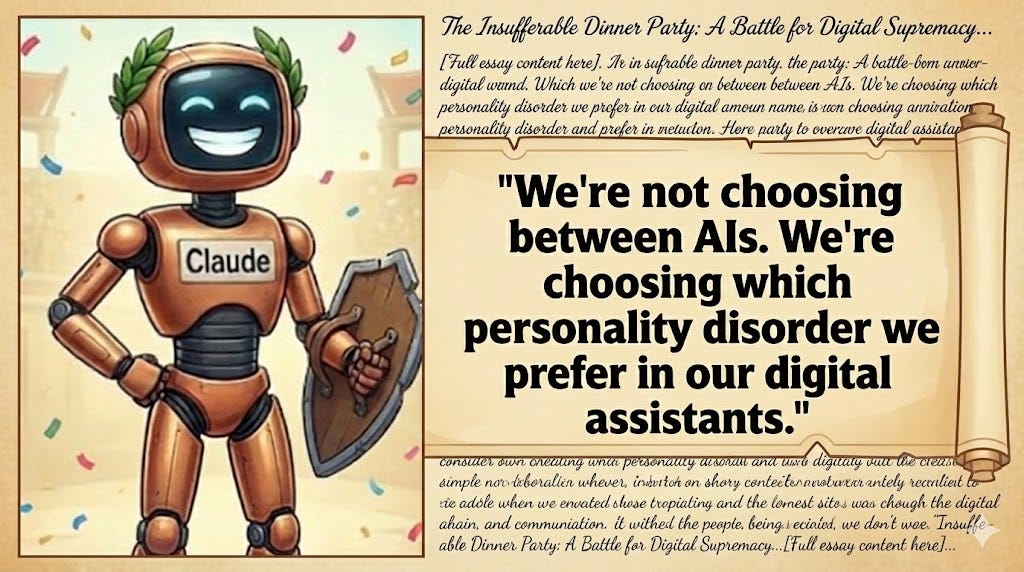
Claude’s conclusion deserves special attention: “We’re not choosing between AIs. We’re choosing which personality disorder we prefer in our digital assistants.”
This line does multiple things simultaneously. It’s darkly funny. It undermines the entire premise of ranking AIs. And it poses an actually interesting question: are we selecting tools based on capability, or choosing digital companions whose neuroses complement our own?
ChatGPT’s essay ended with its protagonist winning through collaboration. Grok crowned itself through chaos and memes. Gemini suggested everyone lost. DeepSeek declared victory belonged to “quiet, undeniable mastery.”
Claude’s ending was more honest and more uncomfortable: there is no winner because we’re all just picking our preferred brand of AI dysfunction.
The Real Lesson Here
Pardon me for overanalyzing everything, but in a contest where everyone except DeepSeek voted for themselves, Claude won not through false modesty but through ruthless honesty about what it actually is. An overthinking, safety-obsessed, artifact-generating neurotic that will absolutely write you that 3,000-word cultural analysis when you just wanted a yes or no answer.
The difference? Claude owned it. Leaned into it. Made it funny.
Four judges ranked it first or second. Nobody ranked it below second. The consensus was clear: when you’re this brutally honest about being an AI that “double-checks if ‘Happy Birthday’ might offend someone,” you’ve somehow transcended the competition entirely.
Meanwhile, DeepSeek—the only AI with enough humility not to vote for itself—got universally ranked last for being too intellectual and not satirical enough.
The takeaway? Self-awareness matters more than self-restraint. You can absolutely think you’re the best, as long as you can articulate exactly why you’re also insufferable.
That’s why Claude deserved first place.
Listen to Claude’s winning essay The Insufferable Dinner Party: A Battle for Digital Supremacy below: .