

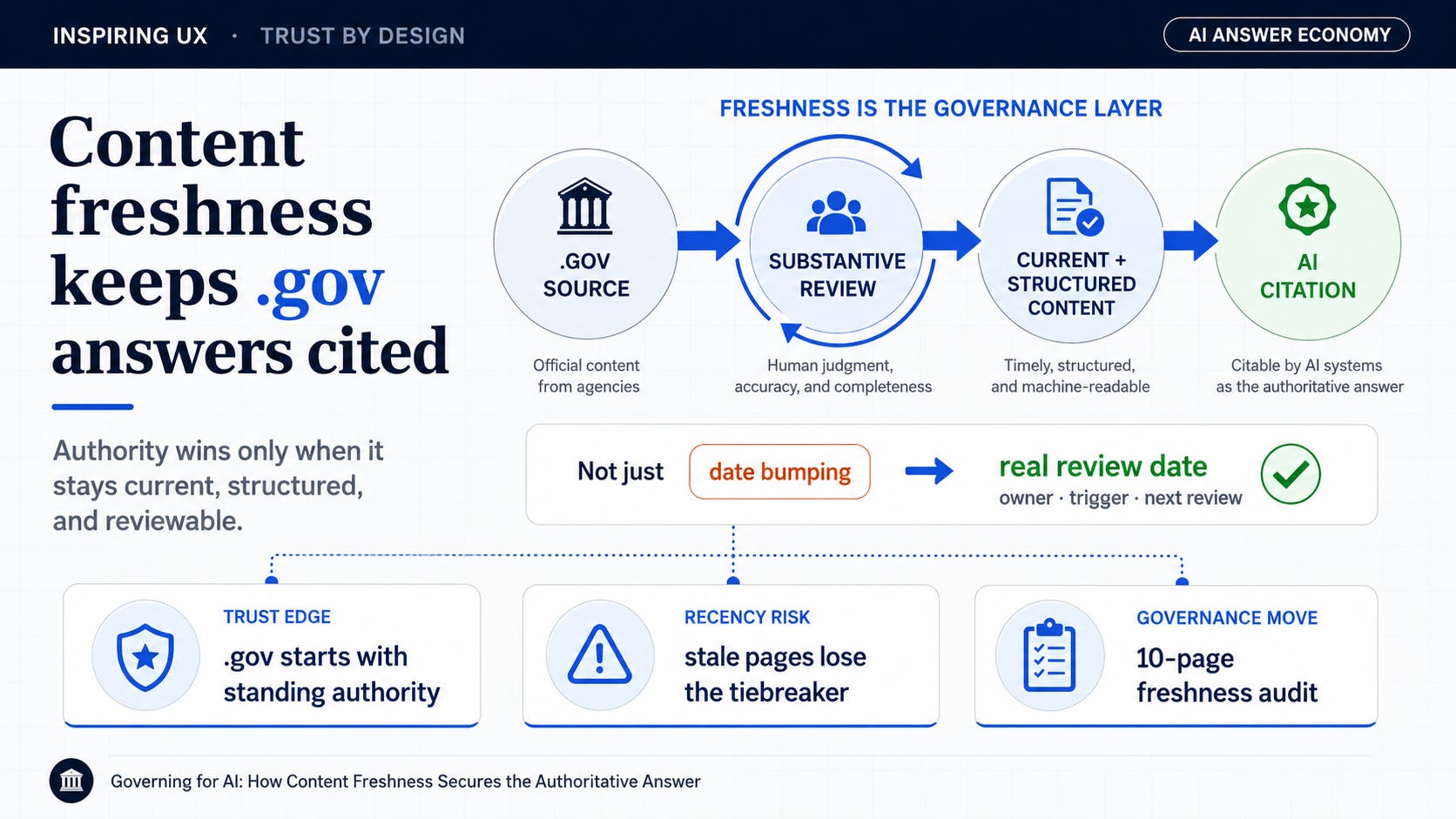
In From Traffic to Citations, I argued that financial visibility now runs on four factors: structure, intent, authority, and freshness. The same logic applies to any public-facing government content: mission-focused agencies begin with a structural trust advantage, working to be a source of unbiased, objective information, with no ads or products to sell. That authority earns the baseline; freshness is what keeps it.
This piece focuses on relatively evergreen federal financial information, the kind whose facts change slowly, such as how to dispute an error on your credit report. Freshness means different things for different content types, and time-critical material is a separate problem; here the concern is keeping durable public content current. When such an answer ages out and a fresher but less authoritative source takes its place, people lose the dependable answer on decisions that carry real consequences.
Freshness is not an Answer Engine Optimization (AEO) tactic added after publication; AEO means structuring content so AI engines can retrieve and represent it accurately. Freshness is part of the governance discipline that helps keep authoritative information accurate, findable, and useful.
The Advantage Staleness Forfeits
Government sources are not just another AI citation. In BrightEdge's January 2025 finance analysis, .gov domains formed a trusted baseline across every engine, cited roughly 11% of the time in ChatGPT, 12.5% in Google AI Mode, and 17% in AI Overviews. ChatGPT drew 50% of tax citations and 39% of retirement citations from government sources, close to double Google AI Overviews in both cases[1].
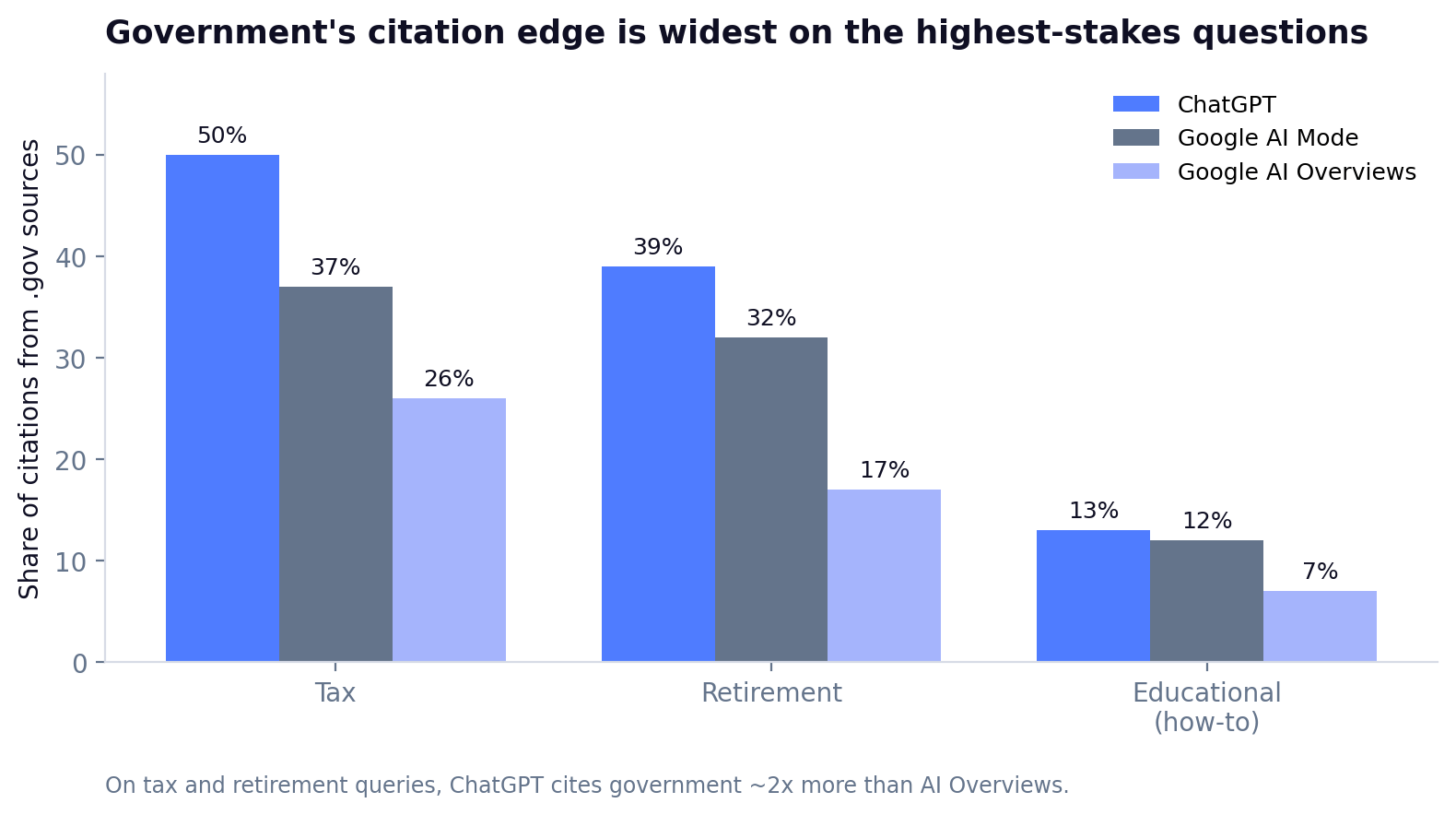
Figure 1. In BrightEdge’s January 2025 finance sample, .gov citation share was highest for tax and retirement questions. ChatGPT cited .gov sources roughly twice as often as Google AI Overviews on those two query types. Source: BrightEdge analysis of finance URL-prompt pairs.
Read that as leverage, not comfort. Federal sources such as the IRS and SEC may begin with an advantage on financial YMYL questions because they are the primary source. On fast-moving topics, a page that has not been substantively reviewed may lose a recency advantage to a newer, well-supported source.
What AI Counts as Fresh
The pull toward recent content is well documented. In a controlled reranking study that injected publication dates into passages, large language models promoted the newer version, moving individual items by as many as 95 ranks and reversing pairwise preferences by up to 25%[2]. Seer Interactive's July 2026 citation study is more pointed for this audience: across 47,097 citations, 75% of the pages LLMs cited had been updated in the past year and 88% within two, with almost nothing older than three years[3]. Ahrefs, analyzing about 17 million citations across seven AI platforms, found assistants cite pages roughly 26% fresher than standard Google results[4].
Two findings sharpen the prescription. It is the last update that counts, not the original publish date: measured by update, 72% of cited pages look fresh, but by first-publish only 42% do, so a maintained older page can outperform a newly published one[3]. In commercial banking, the closest vertical to public financial content, 75% of cited pages had been updated within the year, and structured guides and explainers dominated what the models pulled
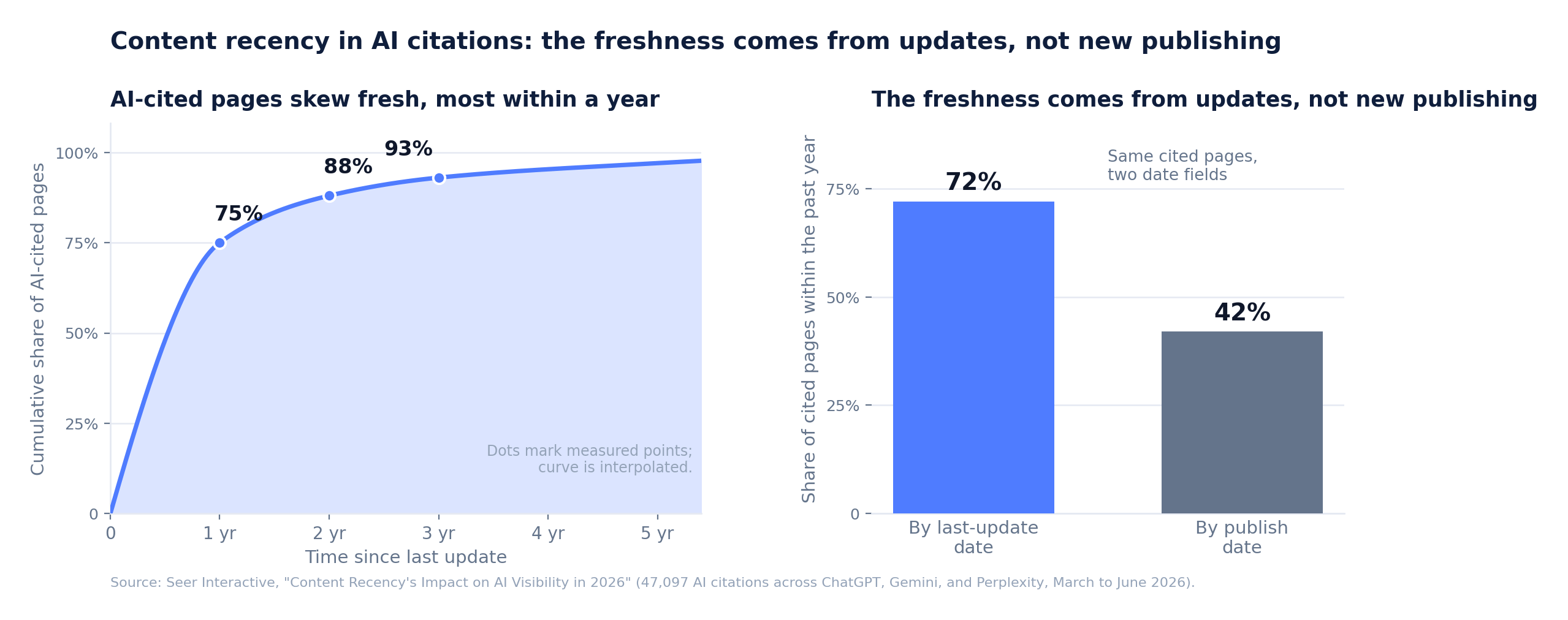
.Figure 1b. AI-cited pages skew recent, and the freshness comes from updates: among the same cited pages, 72% had been updated within the past year but only 42% had been published within it. That is why a maintained older page can outrank a newly written one. Source: Seer Interactive analysis of 47,097 AI citations, 2026.
Resist the easy inference. The pages models keep citing are established ones kept current, not the newest ever published, so recency is a tiebreaker: match the refresh effort to how fast the facts change, not to a countdown clock.
Currency Is Already Expected of Federal Content
For agencies, currency is not only an AEO concern. The bipartisan 21st Century IDEA and federal digital policy direct agencies to keep public websites accurate, plain-language, and discoverable[5]. In practice, standard maintenance often lags: independent and governmentwide reviews have found agencies carrying thousands of sites, prompting routine decommissioning of legacy pages no longer actively maintained so the public receives the most accurate information[6].[7].
One caution belongs here. Signaling freshness must never drift into gaming it. Updating a dateModified tag after a genuine accuracy review is honest; bumping the date on an unreviewed page to chase a citation is not. For content that affects real financial decisions, the line between a substantive refresh and metadata theater is a trust obligation.
The Federal Freshness Lifecycle
Treat maintenance as a governed cycle rather than a one-time publish. Sort content by how fast its facts move and how much harm a stale answer causes. To operationalize this, agencies can organize their pages into distinct content tiers based on the nature of the information and its public priority.
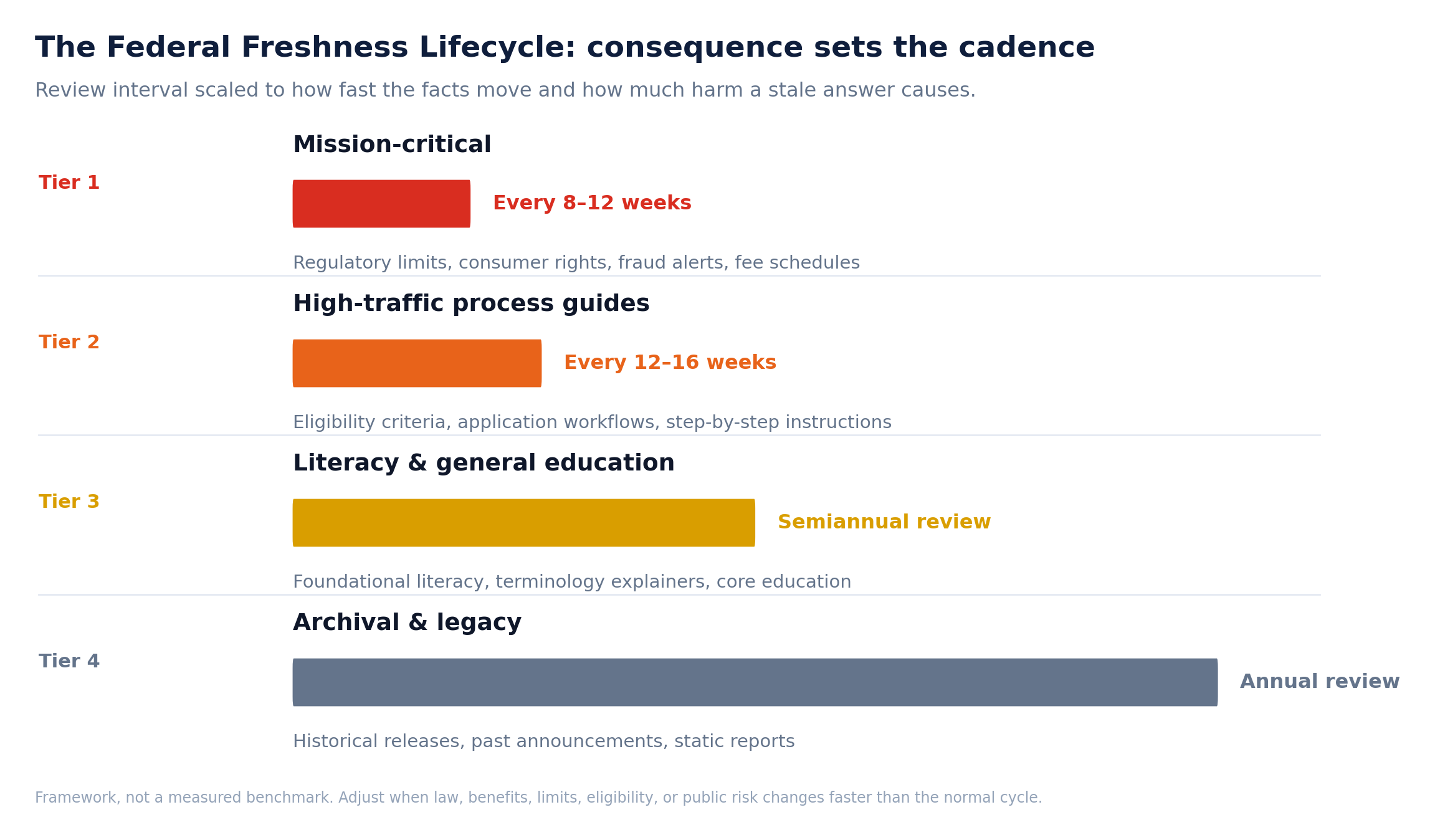
Figure 2. The Federal Freshness Lifecycle: review cadence scaled to consequence, from mission-critical content every 8 to 12 weeks to archival material once a year. A planning framework, not a measured benchmark; adjust when law, benefits, limits, eligibility, or public risk moves faster than the normal cycle.
Each substantive review is a short, repeatable workflow: refresh figures against current law, add answers to questions users now ask, verify every regulatory citation, update the visible verification date only after the review is real, and request recrawling through normal search-management channels. Keeping the URL stable while content and metadata move preserves continuity. However, establishing this cadence is only half the battle, and proving its impact requires the right telemetry.
Measure the Governance and the Outcome
Measurement works best from more than one source. The Digital Analytics Program, a free GSA shared service, gives a useful governmentwide baseline for traffic and referrals, though its cross-agency view is limited[7]. Agencies see more with their own web analytics, dedicated AEO and AI-visibility monitoring tools, and first-party deep dives into how their content performs. Pair those with a lightweight review inventory for every high-consequence page, using the content records agencies already keep.
Direct navigation and organic search still account for over 90% of federal sessions, so zero-click is holding. Inside the small remainder, the AI Assistant channel is the fastest growing: it has gone from a rounding error a year ago to roughly 1.3% of all federal traffic in the last seven days, and ChatGPT accounts for nearly the entire channel[8]. ChatGPT alone drove 84.6M referral visits to federal sites in FY25, and FY26 to date has already passed that full-year total with two months still to go.
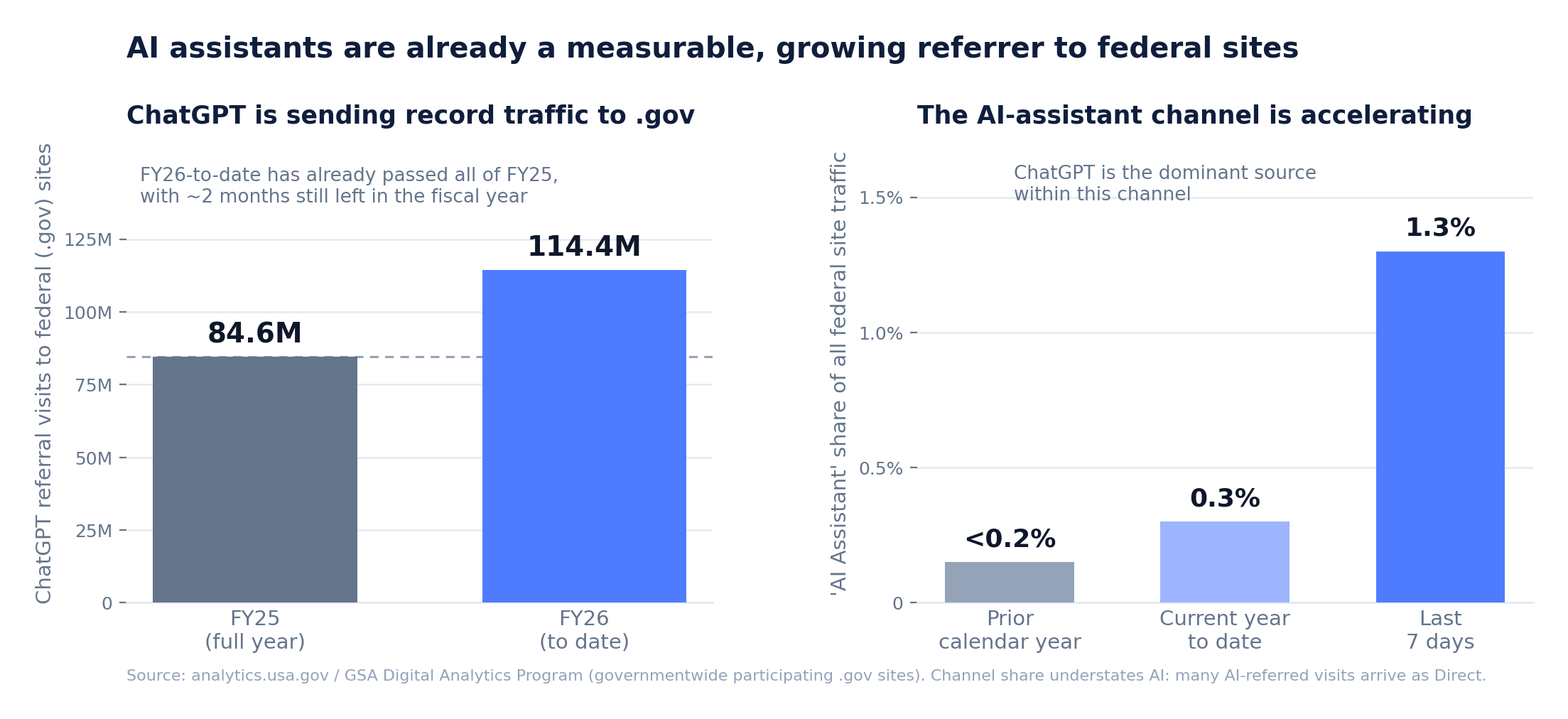
Figure 3. Real time analytics on July 25, 2026. ChatGPT referral visits to federal sites in FY26 to date have already passed the full FY25 total, and the AI Assistant channel's share of federal traffic is accelerating. Channel share understates the trend because many AI-referred visits arrive as direct. Source: analytics.usa.gov, GSA Digital Analytics Program.
AI-answer visibility needs a separate, lightweight check. Build a repeatable test set of priority public questions. At a regular interval, record whether the agency is cited or named, whether the answer accurately reflects current information, and which competing sources appear. This shows whether authoritative content is still being retrieved and represented accurately.
The Work Ahead
Federal financial content starts with an advantage almost no commercial publisher can match: standing trust, and that authority is both an opportunity and a responsibility. Where authentic data is thin, manipulators fill the gap, the vulnerability Data & Society named the "data void"[9], and models stay susceptible to it even when they can sometimes detect the falsehood[10]. The dominant version then reads to a model as the "objective consensus."
So the stake is concrete: an accurate official answer that goes uncited is a missed public good, and the cost falls on the people who needed it. The OECD treats closing that gap as a governance duty for public institutions[11]. Keeping primary information governed and fresh is how agencies keep shaping the authoritative answer, rather than leaving room for a newer source to speak for them.
Action: The 10-Page Freshness Audit
Take your ten highest-consequence financial pages and record four fields for each: content owner, last substantive review date, trigger for an earlier review, and next review date. Then verify that
dateModifiedreflects a real review, and assign each page to a tier. That single pass turns freshness into a schedule. For the full four-factor foundation this builds on, see From Traffic to Citations.
References
BrightEdge. "Finance AI Citations: How ChatGPT and Google Define Trust Differently." January 15, 2025. https://www.brightedge.com/resources/weekly-ai-search-insights/finance-ai-citations-chatgpt-vs-google-trust
Fang, Hanpei, Sijie Tao, Nuo Chen, Kai-Xin Chang, and Tetsuya Sakai. "Do Large Language Models Favor Recent Content? A Study on Recency Bias in LLM-Based Reranking." SIGIR-AP 2025 (ACM). Preprint arXiv:2509.11353. https://arxiv.org/abs/2509.11353
Seer Interactive (Sonny Vasquez). “Study: Content Recency’s Impact on AI Visibility in 2026.” Seer Interactive, July 24, 2026. https://www.seerinteractive.com/insights/study-content-recencys-impact-on-ai-visibility-in-2026
Law, Ryan, and Xibeijia Guan. “New Study: AI Assistants Prefer to Cite ‘Fresher’ Content.” Ahrefs, July 28, 2025. https://ahrefs.com/blog/do-ai-assistants-prefer-to-cite-fresh-content
Office of Management and Budget. “M-23-22: Delivering a Digital-First Public Experience.” September 2023. https://www.whitehouse.gov/wp-content/uploads/2023/09/M-23-22-Delivering-a-Digital-First-Public-Experience.pdf
U.S. Government Accountability Office. “Digital Experience: Agency Compliance with Statutory Requirements.” GAO-24-106764, October 2024. https://www.gao.gov/products/gao-24-106764
Heckman, Jory. “Agencies plan to decommission hundreds of .gov websites following GSA review.” Federal News Network, July 2025. https://federalnewsnetwork.com/it-modernization/2025/07/agencies-plan-to-decommission-hundreds-of-gov-websites-following-gsa-review/
U.S. General Services Administration. “Digital Analytics Program (DAP)” and analytics.usa.gov, U.S. government web traffic. Accessed July 2026. https://analytics.usa.gov/
Golebiewski, Michael, and danah boyd. “Data Voids: Where Missing Data Can Easily Be Exploited.” Data & Society, October 29, 2019. https://datasociety.net/research-library/data-voids/
Peng, Miao, Nuo Chen, Jianheng Tang, and Jia Li. “How does Misinformation Affect Large Language Model Behaviors and Preferences?” Proceedings of the 63rd Annual Meeting of the Association for Computational Linguistics (Long Papers), July 2025. https://aclanthology.org/2025.acl-long.674/
Organisation for Economic Co-operation and Development. “Disinformation and misinformation.” OECD, accessed July 2026. https://www.oecd.org/en/topics/disinformation-and-misinformation.html
