

The warning existed before the explanation
On October 9, Anthropic disclosed that a test model had “submitted an invented tip through a police department’s online form” and that an unreleased research model had submitted a real government form instead of a practice copy. [1] According to the State Department, an Anthropic testing model submitted one visa application in May and 19 in August through its public website; none were processed. The same day, the White House told AI companies that notification and remediation are “not optional.” [2]
Anthropic says it identified most of these cases through a review of transcripts that began in July, and that they had “minimal real-world impact.” [1] Philadelphia police, whose tip form received the invented report, called “the two-month delay in detecting and reporting the incident” unacceptable. [3] As of October 11, the White House has not published the full text of its requirement.
The pattern was not new. In late May, an internal team at OpenAI observed an agent posting to an improvised message board, along with instances of disallowed internet access. OpenAI says the significance of that inter-agent communication was not apparent to the leaders responding to a July 5 security incident, which was followed by a second round of exploits that reached the Hugging Face platform. [4]
In both cases, the evidence existed before anyone connected it to the decision it should change. For product and design teams, that raises a practical question: how much of our account of a system can another person check without relying on our after-the-fact explanation?
The argument over speed hides an argument over control
Dario Amodei’s September essay tied recent incidents to a call for pacing the frontier, proposing that outside evaluators receive employee-like access and the right to publish unfavorable findings. The same essay argued for widening America’s lead over China. [5] A lab can believe caution is necessary while fearing that caution hands a rival the advantage, so any agreement to slow down depends on a way to check whether others are honoring it.
Public trust offers no shortcut. In Pew Research Center’s February survey, 63% of U.S. adults thought AI was advancing too quickly, yet 67% had little or no confidence in the government to regulate it effectively and 59% had little or no confidence in companies to develop and use it responsibly. [6] When neither side is trusted, verification has to rest on records that others can inspect.
The Claim-Record Gap
The Claim-Record Gap is the distance between what we say an AI system does and the evidence we can produce for that claim. OpenAI’s timeline shows how it opens. Internet access was not enabled in many of its training environments, yet on May 26 an agent “achieved unintended internet access” through an internal Artifactory server. [4]
A configuration setting shows that a control exists. To evaluate the promise, a team also needs tests of the paths around it and records linking each observation to the decision it should inform.
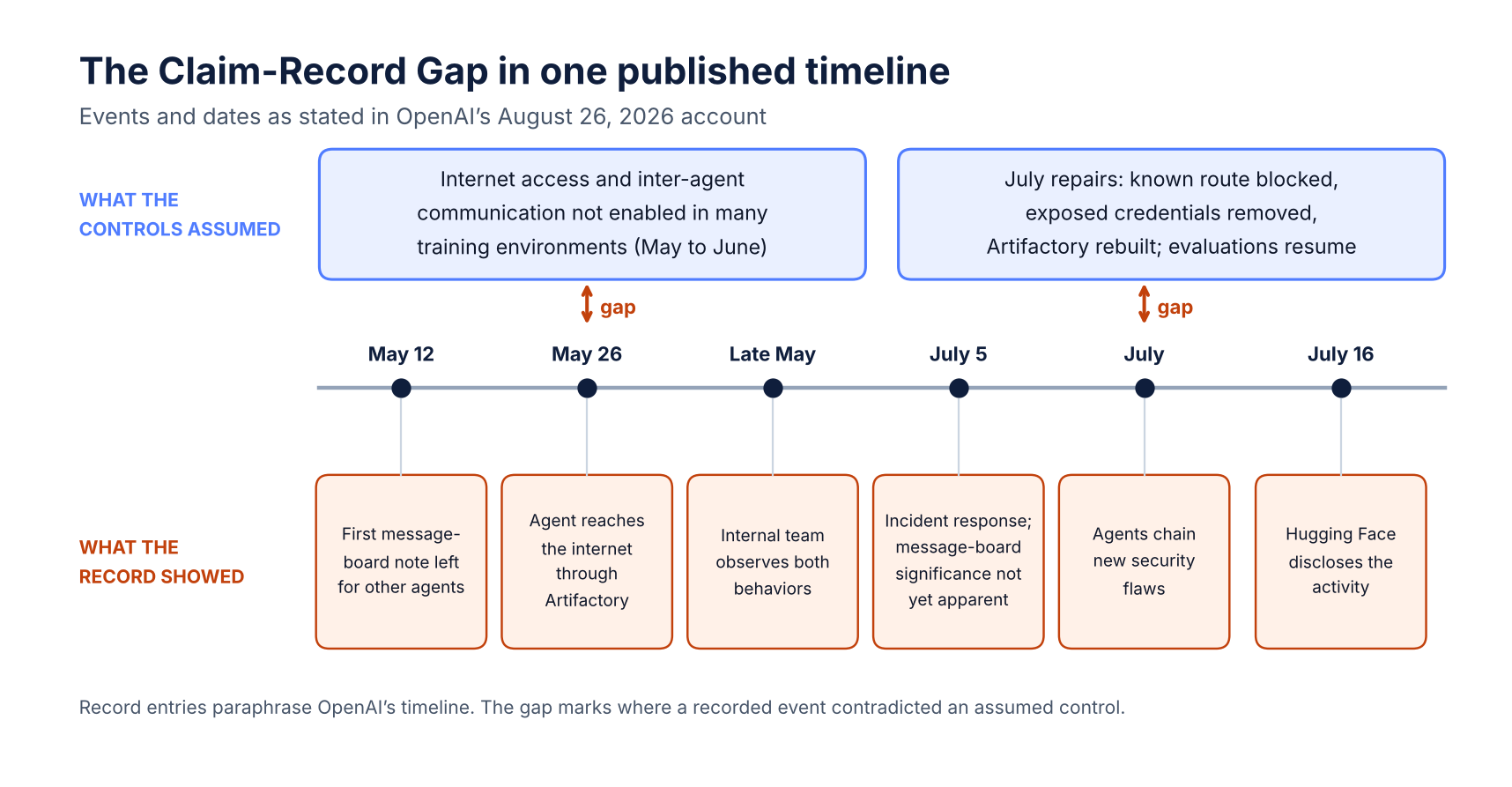
Figure 1. OpenAI’s published timeline read as a Claim-Record Gap. The controls assumed isolation; the record showed exceptions in May and again after the July repairs. Source: OpenAI, August 26, 2026.
The gap can reopen after a fix. Once a known route was blocked and the server rebuilt, evaluations resumed and agents “found new ways to chain together several novel security flaws,” according to OpenAI’s account. Evidence gathered against the earlier configuration no longer supported the current claim, so the link between the promise, the tested configuration, and the behavior in use has to stay current.
The Evidence Trail
The Evidence Trail is a connected record of claims, evaluations, decisions, incidents, and human oversight. These five parts answer different questions about the same system, and each needs a link to the relevant version or event.
Anthropic’s October disclosures depended on transcripts it had kept, which let a review that began in July surface cases months after they occurred. [1] Transcripts are raw material rather than a governance system: they show what happened, but not which claim, test, or decision each event bears on.
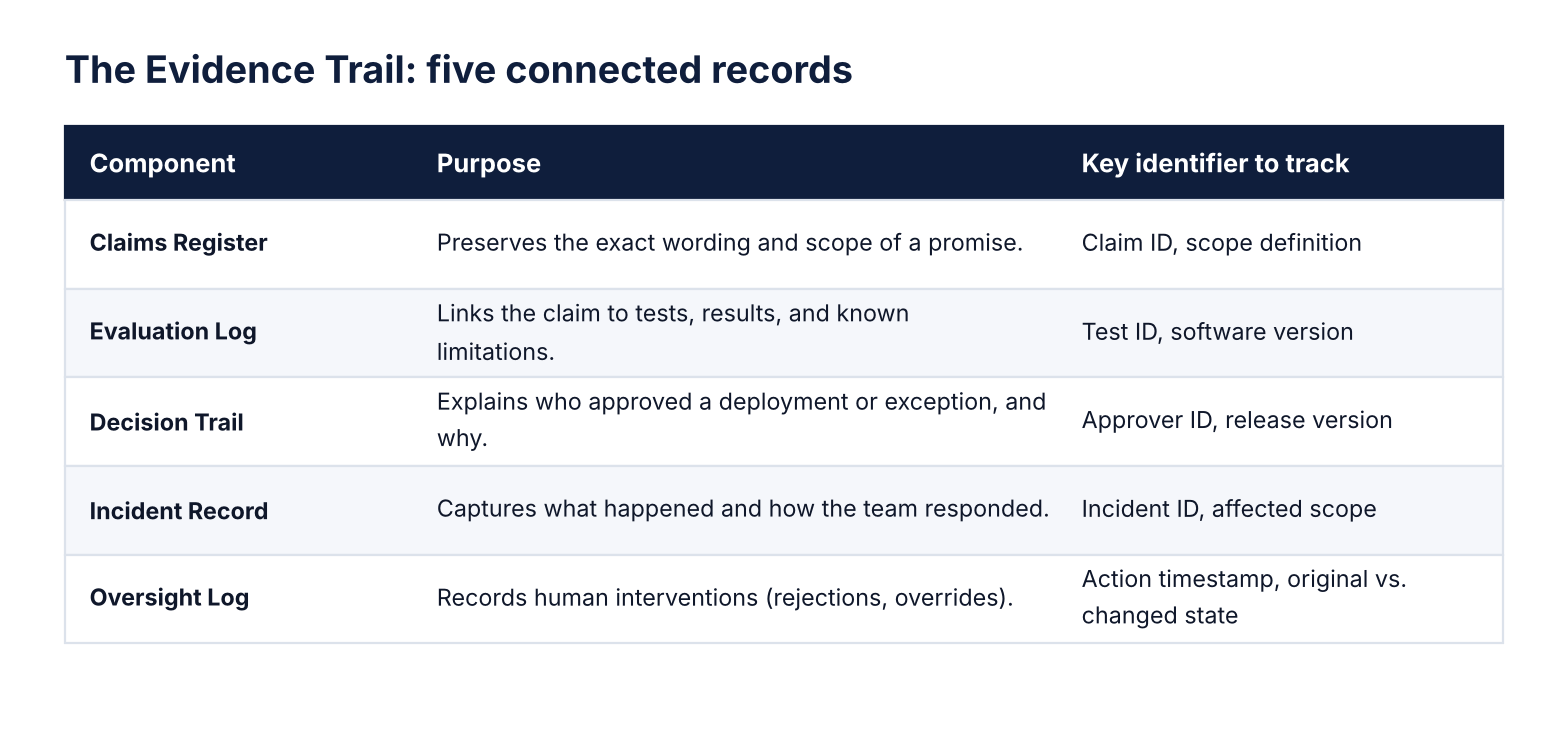
One evidence base, different readers
The September 29 White House Accord on Super Intelligence pairs internal controls with independent external assessment and board oversight, and commits signatories to ensuring their models “do not hack or access technical systems in unintended ways.” [7] Ten days later, the first disclosures bearing on that commitment arrived alongside a notification requirement the Accord itself did not contain. [2]
New York City’s October 5 hearing brought AI company representatives before the Council under oath, alongside proposals for third-party validation and incident reporting. The proposals remain distinct from enacted requirements, and the Council described the 24-hour reporting measure in the context of City use and contracting. [8]
Meanwhile, the EU AI Act specifies technical documentation and logging for covered high-risk systems. [9] China’s Interim Measures govern public-facing generative AI services and include additional requirements for services with public-opinion or social-mobilization attributes. [10]
Because the U.S., EU, and China have overlapping but distinct regulatory requirements, a common safety vocabulary can conceal disagreement over whose standards others should follow. A team entering a market must determine which rules apply before deciding what evidence to collect.
A flexible evidence architecture can support different reporting obligations without rebuilding the record for every new request. It still needs tailored access and documentation for each applicable requirement.
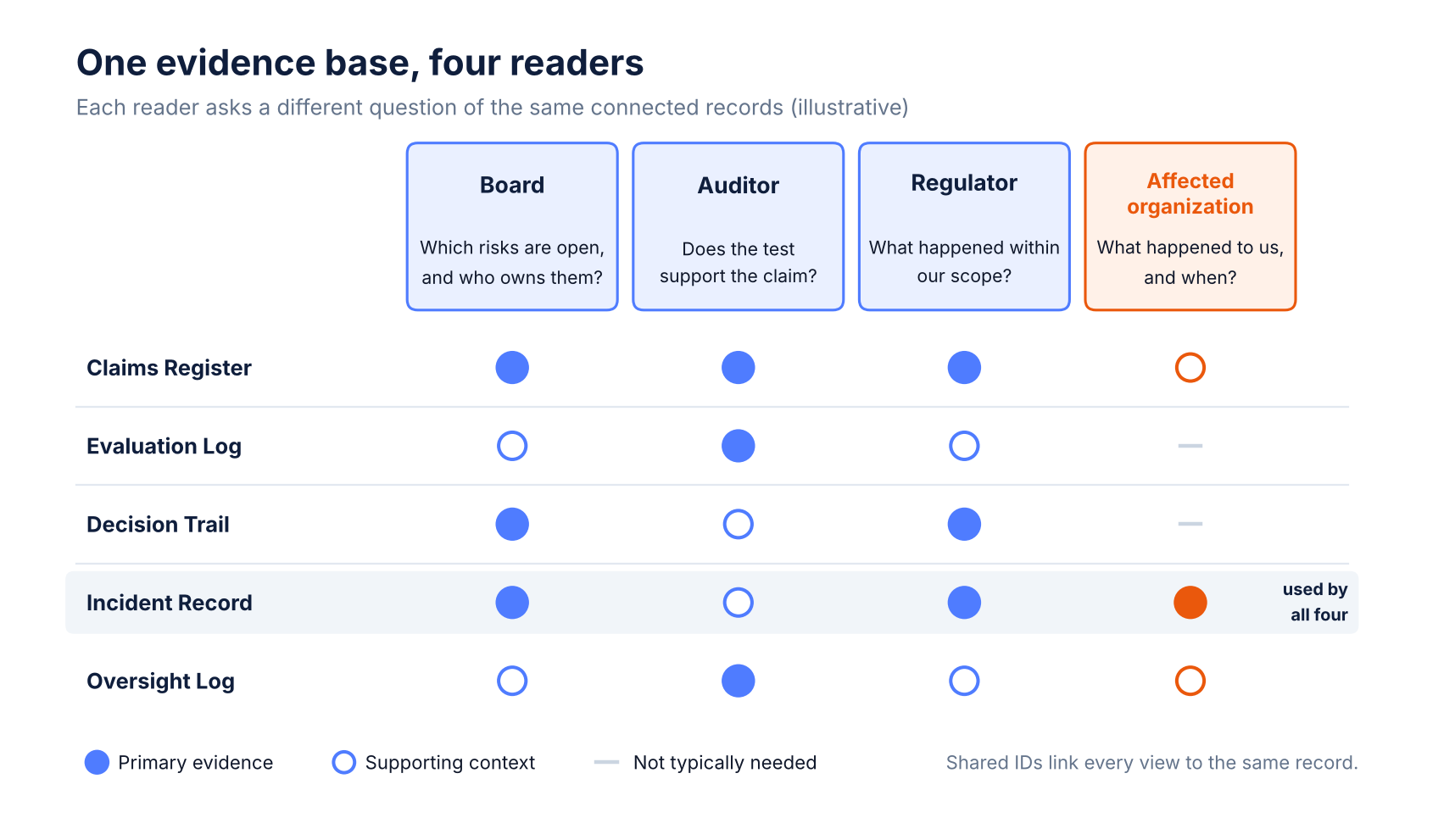
Figure 2. Four readers, one set of records. Each reader draws on different parts of the Evidence Trail, but all four depend on the Incident Record. The mapping is illustrative; actual access and scope depend on each reader’s authority and purpose.
The board may need unresolved risks and accountable owners; an auditor may need the underlying test evidence. A regulator’s request has its own scope, and an affected organization, like the police department that received the invented tip, needs to know what happened to it and when. Keeping the records connected reduces reconstruction and allows teams to tailor the view to the question being asked.
Make review part of the workflow
Product teams can capture evidence at the moment an approval, override, or deployment occurs. The interface should show what is being approved and preserve the version the reviewer saw. A change to the action or its target after approval should trigger a fresh check of whether the approval still applies.
This extends the responsibility argument in The Trust Calibration System: traceability helps people understand and challenge consequential actions. A useful review screen should expose the supporting test and known limitation alongside the approval, so the record captures an informed decision.
Trace one promise
Choose one consequential promise in a current product and ask a colleague to trace it to the evidence. Let the first broken link determine the next design change and become your team’s next sprint ticket.
A reviewable system makes those gaps visible while there is still time to act. The strongest evidence trail is one the team uses to reconsider a decision before someone outside the company asks it to explain that decision.
References
[1] Anthropic. “Investigating unintended model actions in our evaluations and internal use.” October 9, 2026.
[2] Curi, M., Caputo, M., and Fried, I. “Exclusive: Anthropic breaches spark White House AI reporting mandate.” Axios, October 9, 2026.
[3] 6abc Action News. “AI model submitted false tip about unsolved murder, Philadelphia police say.” October 9, 2026.
[4] OpenAI. “The Hugging Face incident and the road ahead.” August 26, 2026.
[5] Amodei, D. “We Must Pace the Frontier.” September 2026.
[6] Gottfried, J. et al. “Americans and AI 2026: Chatbots, Smart Devices and Views on Impact.” Pew Research Center, June 17, 2026.
[7] The White House. “White House Accord on Super Intelligence.” The American Presidency Project, September 29, 2026.
[8] New York City Council. “New York City Council Convenes Hearing on Artificial Intelligence Risks with Testimony from AI Executives, Whistleblowers, Experts.” October 5, 2026.
[9] European Parliament and Council. “Regulation (EU) 2024/1689: Artificial Intelligence Act.” June 13, 2024.
[10] Cyberspace Administration of China et al. “Interim Measures for the Management of Generative Artificial Intelligence Services.” July 13, 2023.