

86% of enterprises plan to increase their agentic AI investment, yet only 6% trust AI agents to autonomously handle their core business processes.[1] That gap does not close by deploying better models. It closes by designing the trust architecture that makes delegation possible in the first place.
Four independent research organizations have converged on the same finding from different angles. Gartner predicts over 40% of agentic AI projects will be canceled by the end of 2027, citing escalating costs, unclear business value, and inadequate risk controls.[2] McKinsey's 2026 AI Trust Maturity Survey finds that only 30% of organizations reach governance maturity level 3 or above for agentic AI controls, and two-thirds cite security and risk concerns as their top barrier to scaling.[3] Deloitte's 2026 State of AI in the Enterprise finds only 21% of organizations have a mature governance model for agentic AI in place.[4] A December 2025 Harvard Business Review study sponsored by Workato lands the sharpest number: 86% of organizations plan to increase investment, yet only 6% trust agents for core processes.[1]
None of Gartner's three failure drivers are capability failures. Costs escalate because scope was not defined upfront. Business value stays unclear because success metrics were never tied to specific workflow outcomes. Risk controls fall short because governance was treated as a compliance checkbox rather than a product requirement. These are organizational design failures.
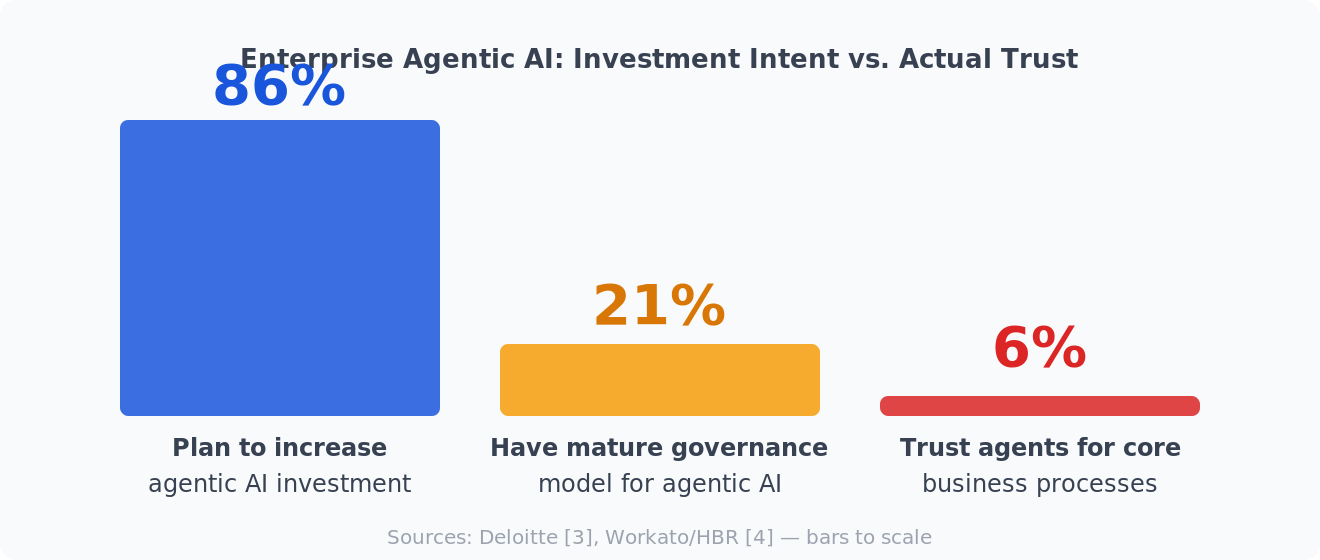
Figure 1. The Trust-Investment Gap. Bars are to scale. Investment intent (86%), mature governance in place (21%), and actual trust for core processes (6%) reveal a compounding gap. Organizations are committing resources to AI agents without building the governance architecture that makes delegation safe.
Why Capability Does Not Produce Trust
We have spent the past two years treating trust as a byproduct. Ship a capable agent and users will adopt it. Improve accuracy and trust will follow. The data says otherwise.
Gartner's projection maps onto a pattern we have seen before in enterprise software. Users do not adopt systems they cannot verify, override, or explain to an auditor. That holds for a new CRM, a new analytics dashboard, and an AI agent. The difference with agents is the consequence of a trust failure. It is not "the report looks wrong." It is "the agent sent the email, moved the funds, or filed the form before anyone caught the error."
At that consequence level, users are correct not to delegate. To practice true Responsible Acceleration — proactively embracing AI's capabilities while mitigating its downsides — we must recognize that the 6% trust figure is not a problem with user attitudes. It reflects a rational response to agents shipped without the infrastructure that makes confident delegation safe.
Five Mechanisms for Calibrated Trust
The 6% trust gap cannot be solved with a static checklist. As I explored in The Trust Calibration System, trust in autonomous environments is not a permanent achievement; it is a dynamic gauge.[5] We must design around five interconnected mechanisms:
Scope Definition (The Baseline): Before an agent runs, the user needs to understand and confirm what it is authorized to do and what falls outside its mandate. Scope left implicit will eventually be violated.
Approval Gates (The Thresholds): These sit at the threshold where unsupervised execution becomes unacceptable. In The Consent Layer, I mapped this threshold using consequence and reversibility as the two axes.[6] Actions that are high-consequence and irreversible require an explicit gate. Actions that are low-consequence and reversible can proceed automatically with logging.
Explainability (The Real-Time Readout): This requires a plain-language account of the reasoning and data that produced the output, available on demand. It is not a log file or a probability score.
Override Mechanisms (The Recalibrator): Frictionless paths to correct or reverse the agent's work are essential. Calibrated trust requires agency: the ability to guide, correct, and intervene.[5] Without a real override path, users learn that delegation is one-way and stop trusting.
Audit Trails (The Feedback Feed): Every decision and action — and the inputs that drove them — should be traceable. In a true loop, audit trails do not just sit in a compliance log; they feed directly back into refining the Scope Definition for the next cycle.
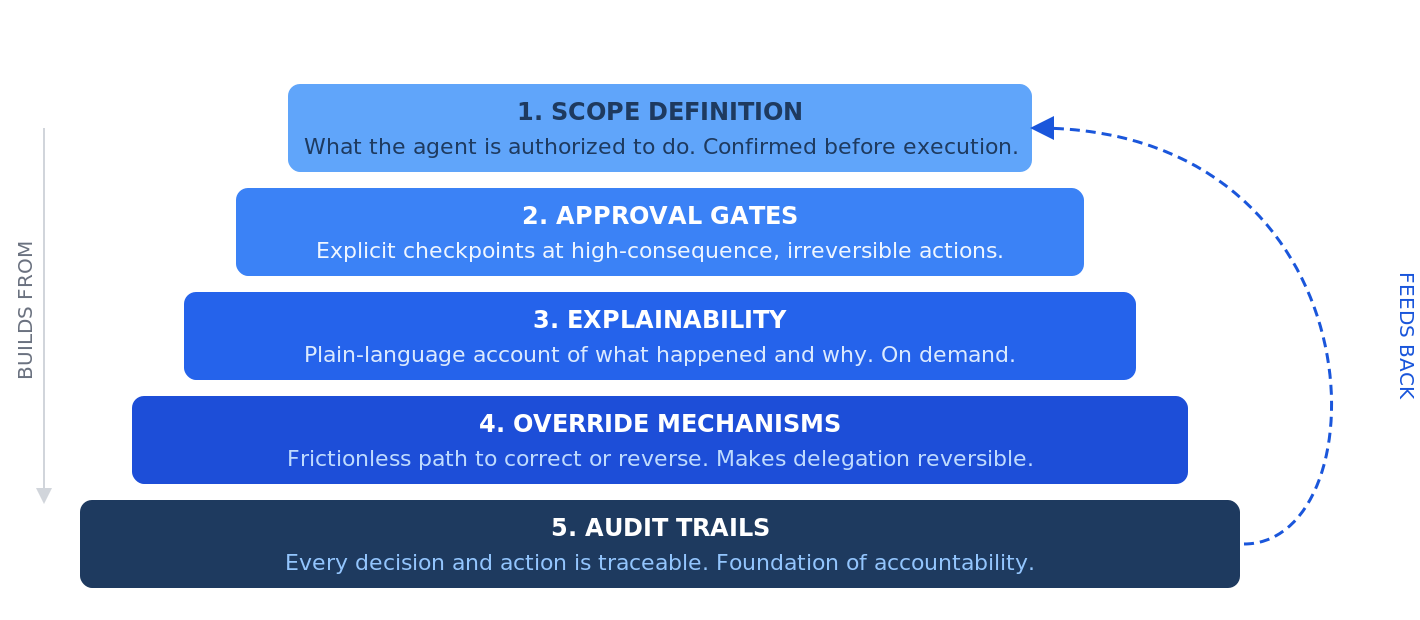
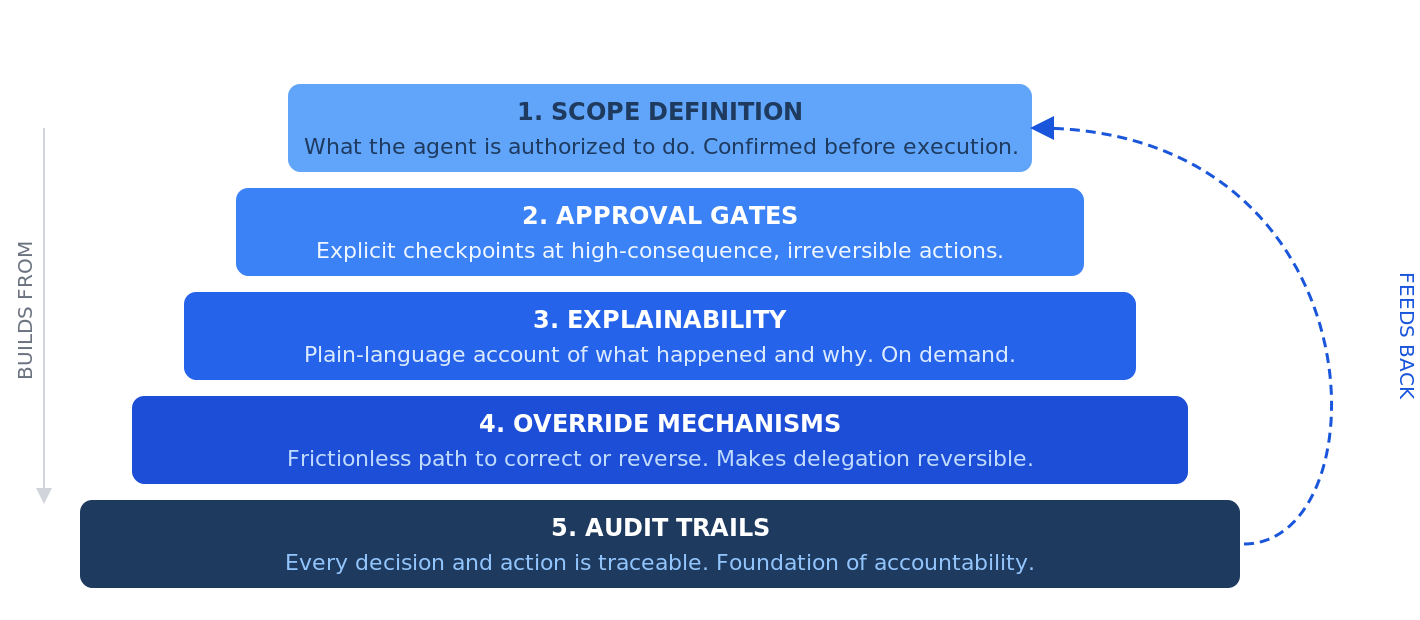
Figure 2. Five Mechanisms for Calibrated Trust. The forward sequence runs top to bottom: Scope Definition establishes what is authorized, each layer building on the last through to Audit Trails. The dashed arc on the right shows the feedback loop — audit trails refine scope definition for the next cycle, making the system iterative rather than static.
Three Patterns That Predict Agentic AI Cancellation
The first failure pattern is treating trust architecture as a post-launch problem. Teams build the agent, ship it, discover that adoption is low, and then try to diagnose the cause. NNGroup’s State of UX 2026 finds that users burned by premature AI features resist adopting later, improved versions.[7] The trust debt accumulates; the retrofit rarely reverses it.
The second pattern is conflating explainability with trust. Showing users what the agent did after the fact is useful. It does not substitute for giving users the ability to intervene before consequential actions execute. Gartner’s “inadequate risk controls” failure driver is, at the product level, often a missing approval gate.
The third pattern is defining success as task completion. Task completion tells you whether the agent can do the work. Delegation rate tells you whether users are willing to let it. Teams that track both will catch trust failures before they become cancellations.
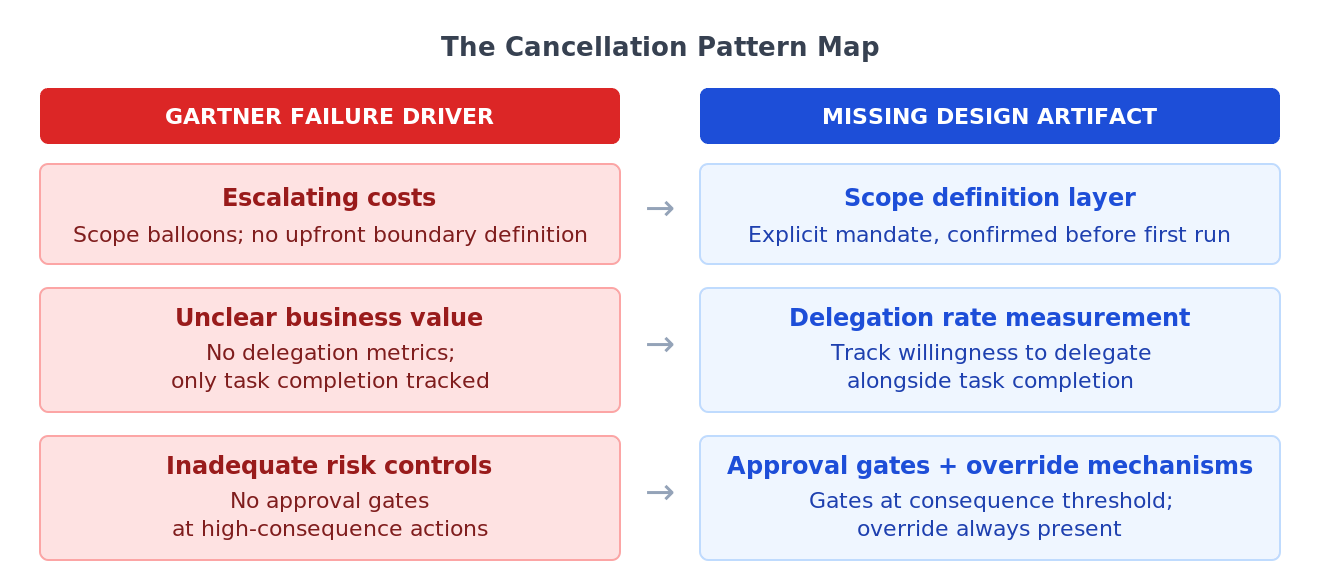
Figure 3. The Cancellation Pattern Map. Each of Gartner’s three cancellation drivers maps directly to a missing mechanism in the Five Mechanisms for Calibrated Trust. The failures are predictable and preventable — if the architecture is built before deployment rather than retrofitted after adoption fails.
The Path Forward: Design for the 6%, Not the 86%
1. Treat trust architecture as a launch requirement, not a roadmap item.
Scope definition, approval gates, explainability, override paths, and audit trails need to be present at first deployment. They cannot be retrofitted into a workflow where users have already learned not to trust the agent.
2. Measure delegation, not just completion.
Task completion rates tell you whether the agent can do the work. Delegation rates tell you whether users are willing to let it. The gap between those two numbers is the trust deficit your team needs to design against.
3. Design the override before you design the action.
For every agent capability, the user's path to reversal or correction should be designed first. Teams must distinguish between a "soft override" (editing an agent's drafted email) and a "hard rollback" (reversing a database transaction). If a clean override path cannot be designed, the capability is not ready to ship unsupervised.
The 40% cancellation figure Gartner projects is not inevitable.[2] It is the outcome of shipping agents into workflows that were never designed for human-agent trust. Teams that build the architecture first will be in the 60%.
References
Harvard Business Review Analytic Services / Workato. "From the Edge to the Core: Bringing Agentic AI to the Heart of the Enterprise." December 2025. workato.com
Gartner. "Gartner Predicts Over 40% of Agentic AI Projects Will Be Canceled by End of 2027." Press release, June 25, 2025. gartner.com
McKinsey & Company. "State of AI Trust in 2026: Shifting to the Agentic Era." January 2026. mckinsey.com
Deloitte. "State of AI in the Enterprise 2026." Deloitte Insights, January 2026. deloitte.com
Ding, W. "The Trust Calibration System: Designing AI for Agency, Not Just Efficiency." Inspiring UX, January 6, 2026. blog.inspiringux.com
Ding, W. "The Consent Layer: Designing Agentic Permissions Users Actually Trust." Inspiring UX, May 30, 2026. blog.inspiringux.com
Nielsen Norman Group. "State of UX 2026: Design Deeper to Differentiate." 2026. nngroup.com