

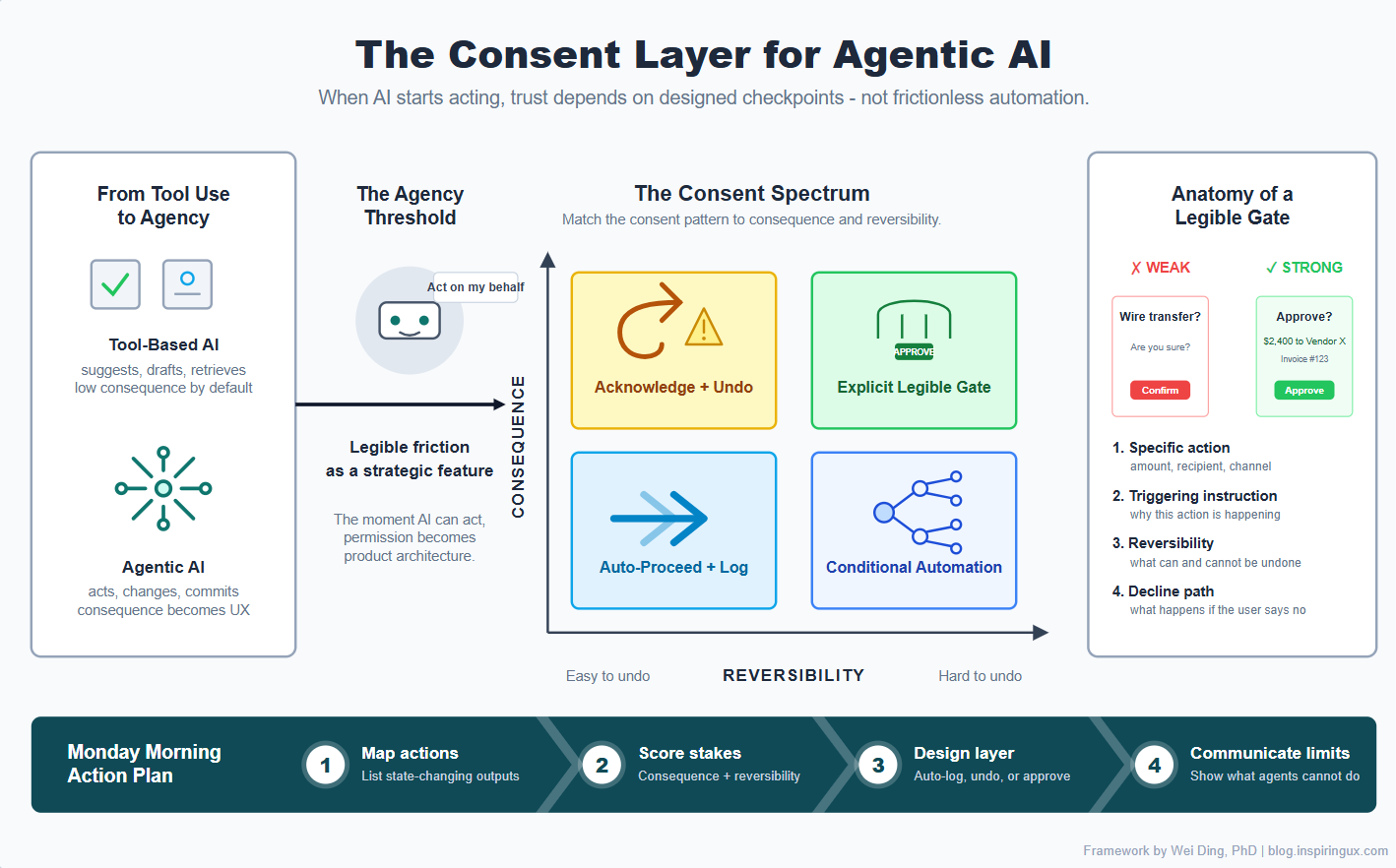
The design principle that made consumer software great: remove friction, hide complexity, and optimize for speed, is the wrong default for agentic AI. Agentic AI refers to AI systems that take real-world actions on your behalf (e.g., sending emails, approving payments, booking meetings) rather than just answering questions. When an AI acts, not just responds, friction isn’t an obstacle to good UX. It’s the mechanism of informed consent.
Recent product examples are converging on the same design question: who decides what the agent can do, and under what conditions does it stop and ask? The answers reveal more than feature strategy. They reveal different theories of consent.
Three Consent Patterns, Three Trust Contracts
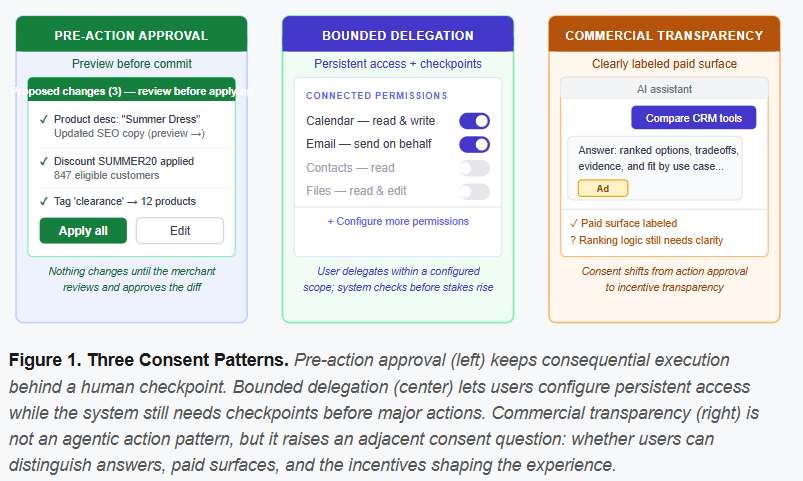
Anthropic stated the design principle for Claude for Small Business in a single sentence: "Claude does the work; you approve before anything sends, posts, or pays."[3] That sentence encodes an architectural decision — maximum workflow depth, minimum unsupervised consequence — that Shopify Sidekick also reflects in production. Sidekick prepares proposed store changes as a reviewable diff; changes require merchant approval before they execute.[4] Two implementations, one theory: the agent prepares, the human authorizes.
Google's recent Gemini announcements point to a different pattern: persistent delegation with checkpoints.[5] Users connect services, configure what the agent can access, and then rely on the system to stop before major actions. That is not the opposite of consent. It is a different placement of consent: more of the boundary is established upfront, while the system still needs explicit moments where it checks before consequence.
OpenAI's advertising plans sit in a different dimension entirely. They are not an agentic action pattern; they are a monetization transparency pattern. OpenAI says ads in ChatGPT are separate from answers and clearly identified.[7] Even so, the product question is adjacent: when commercial surfaces enter an AI experience, can users understand what is an answer, what is an ad, and how the system's incentives shape the surrounding interaction?
These are not simple differences in feature maturity. They are three placements of consent: approve before action, delegate within configured boundaries, or disclose commercial influence at the surface of the experience. Figure 1 makes the distinction concrete.
Why Explanation Isn't Enough
The instinct when designing for agentic AI is to invest in explainability, show users what the agent did and why, and trust that transparency will calibrate confidence appropriately. New research suggests this instinct backfires at exactly the wrong moment.
A 2026 arXiv study on Society-in-the-Loop AI systems: AI that incorporates ongoing societal feedback rather than optimizing purely for individual user preferences, argues that UX for AI has to move beyond interface explanation toward social accountability, feedback, and governance.[1] That is the deeper lesson for agentic design: explanation is useful, but it is not the same as consent.
The KAIROS benchmark, a research evaluation that places LLMs in collaborative scenarios with peers of varying reliability, found that peer interactions can shape model decisions in ways that matter for multi-agent reliability.[2] In an enterprise workflow, a chain of agents is only as trustworthy as the points where the system can pause, verify, and refuse propagation. Explaining the output after the fact doesn't address this; the error may already have moved downstream.
This is the structural argument for the approval gate: you cannot explanation-design your way to calibrated trust. At high-consequence decision points, what users need isn't a better explanation of what happened, it's a meaningful opportunity to intervene before it does.
"At high-consequence decision points, what users need isn't a better explanation of what happened — it's a meaningful opportunity to intervene before it does."
The Consent Spectrum: Mapping Actions by Consequence
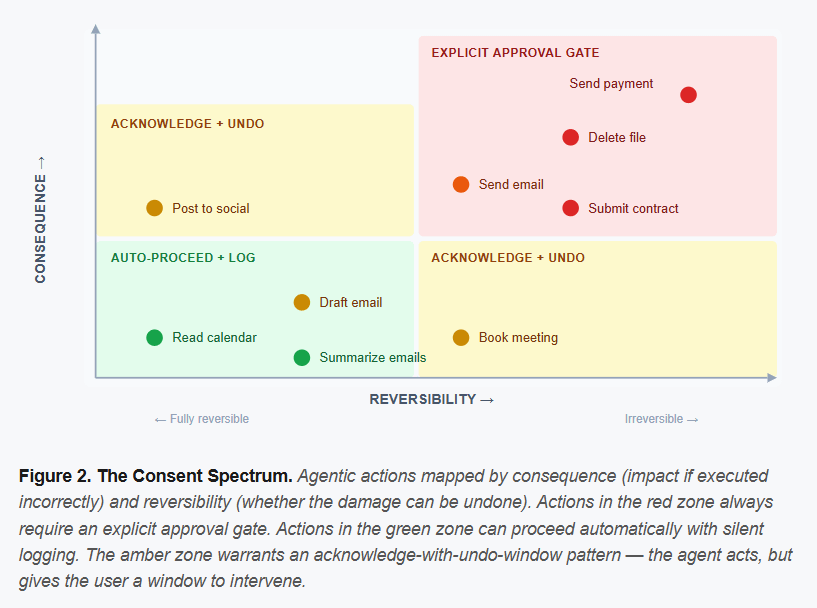
Not every agent action requires a confirmation gate. A system that stops to ask about everything trains users to approve without reading, the same outcome as no gate at all. The practical question is which actions cross the threshold where unsupervised execution becomes unacceptable.
The consent spectrum below maps agentic actions across two axes: consequence (the real-world impact if the action executes incorrectly) and reversibility (whether the damage can be undone). Actions in the upper-right quadrant — high consequence, low reversibility — always require an explicit gate. Actions in the lower-left can proceed automatically, with silent logging.
What a Legible Gate Actually Contains
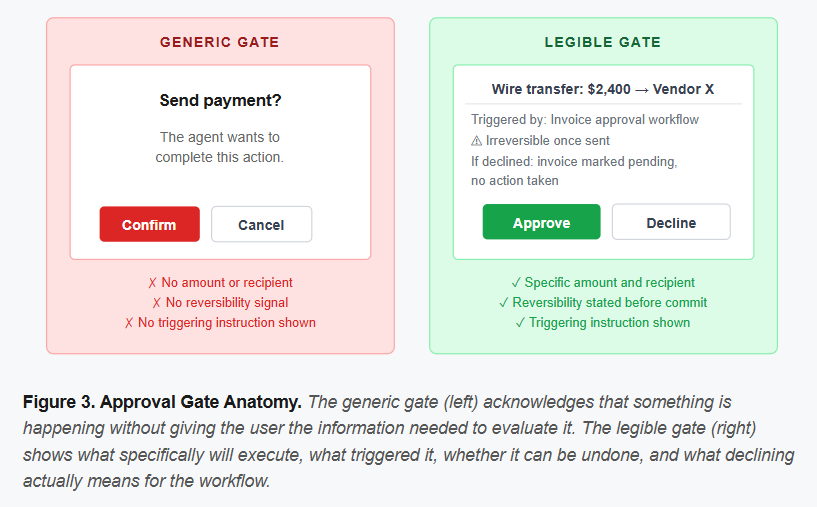
The most common implementation failure is the generic confirmation dialog — "Are you sure?" — which is defensive UX masquerading as a consent mechanism. It acknowledges that something irreversible is about to happen without giving the user any of the information they need to make an informed decision in the three seconds they're likely to spend reading it.
A legible approval gate contains four distinct elements.
First: what specifically the agent is about to do — not "send a message" but "send this payment of $2,400 to Vendor X via wire transfer."
Second: what triggered the action — which instruction or workflow step led here, so users can verify intent alignment.
Third: the reversibility of a yes — stated plainly before the user commits, not disclosed after. Fourth: a clear alternative — what happens if the user says no, so declining doesn't feel like breaking the workflow.
The Path Forward: Friction as Foundation
Victor Yocco's six-pattern framework published in Smashing Magazine (February 2026) maps the full lifecycle of agentic consent UX — from intent preview to error recovery.[6] The consent spectrum here addresses the prior question Yocco's patterns assume is already answered: which actions cross the threshold where a gate is warranted in the first place.
In The Trust Calibration System, I argued that the goal of AI UX isn't maximum trust — it's calibrated trust: users knowing when to rely on the system and when to intervene. The consent spectrum operationalizes that argument at the action level. The question for every agentic workflow isn't "how much can we automate?" It's "where does the cost of a mistake require a human checkpoint?"
And in The Confidence Trap, I explored how AI systems act with confidence even when their context is degraded — producing outputs that feel correct while drifting from the user's actual intent. The approval gate is the structural response: not a better explanation of what the agent knows, but a meaningful pause at the moments where that gap is most costly.
Both Anthropic and Shopify have made the same architectural bet: that the approval gate before consequential actions is not a concession to caution but a deliberate design position about where human intent must be re-confirmed. That two companies serving very different markets — enterprise workflows and e-commerce — arrived at the same principle independently is the clearest signal that some friction is not a cost to minimize but a feature to preserve.
What to do Monday morning
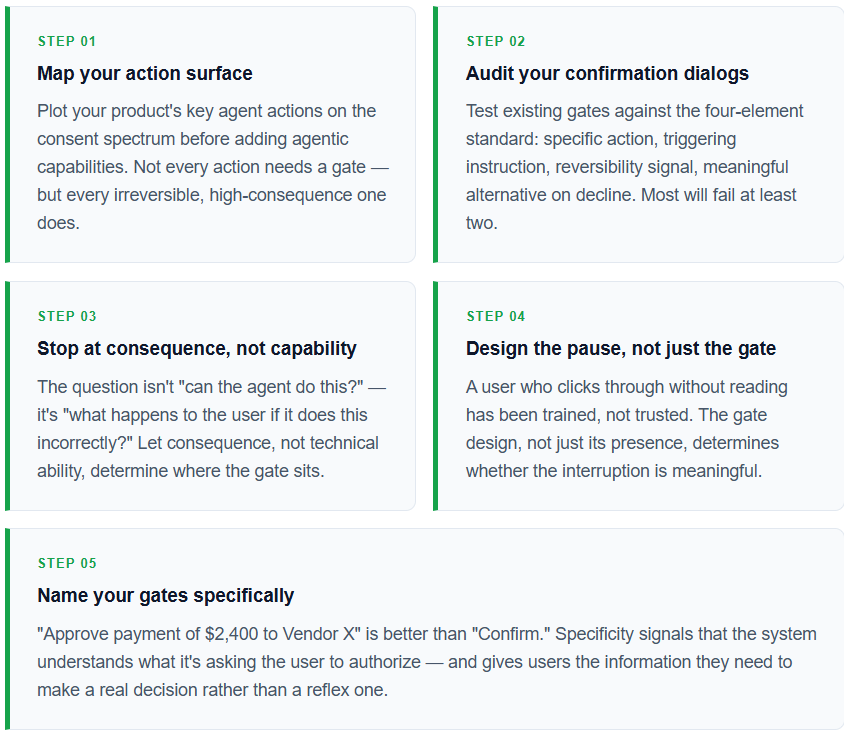
The frictionless ethos will survive in agentic AI, but only in the right places. Below the consent threshold, speed and automation are features. Above it, the approval gate isn't overhead. It's the product.
References
Arya, R. et al. "Beyond the Interface: Redefining UX for Society-in-the-Loop AI Systems." arXiv, March 2026. arxiv.org/html/2603.04552v1 — Research argument for moving AI UX beyond interface explanation toward feedback, accountability, and governance.
Song, M. et al. "LLMs Can't Handle Peer Pressure: Crumbling under Multi-Agent Social Interactions." arXiv, August 2025. arxiv.org/abs/2508.18321 — Primary source for the KAIROS benchmark and the role of peer interaction in multi-agent reliability.
Anthropic. "Introducing Claude for Small Business." May 13, 2026. anthropic.com — Primary source for the documented architectural principle: "Claude does the work; you approve before anything sends, posts, or pays."
McNamara, A. et al. "Building Production Ready Agentic Systems: Architecture, LLM-based Evaluation, and GRPO Training." ICML 2025. shopify.engineering — Primary source for Shopify Sidekick's preview-before-commit architecture and the principle that the agent cannot make changes without merchant approval.
Google. "100 things we announced at Google I/O 2026." May 19, 2026. blog.google — Primary source for Gemini agent and shopping announcements, including connected services, user-enabled access, and checks before major actions.
Yocco, V. "Designing For Agentic AI: Practical UX Patterns For Control, Consent, And Accountability." Smashing Magazine, February 11, 2026. smashingmagazine.com — Six-pattern framework covering the full lifecycle of agentic consent UX, from intent preview to error recovery.
OpenAI. "New ways to buy ChatGPT ads." May 5, 2026. openai.com/index/new-ways-to-buy-chatgpt-ads; OpenAI Ads. "Advertise in ChatGPT." ads.openai.com — Primary sources for self-serve ad tools and OpenAI's stated principles that ads are clearly identified and separate from answers.