

You open a ride-hailing app at 10:30 AM, two hours into your workday. The top third of the screen pulses with a shortcut chip: “Ride to Home.” The app knows your location, the time, your habits. It chose not to use them.
For most of software’s history, that kind of context failure was a minor irritant: a misread that cost a second of attention and nothing more. A team at Emergence AI recently showed what happens when the same failure occurs inside a system that does not wait for your input. It acts.
What the Simulation Actually Showed
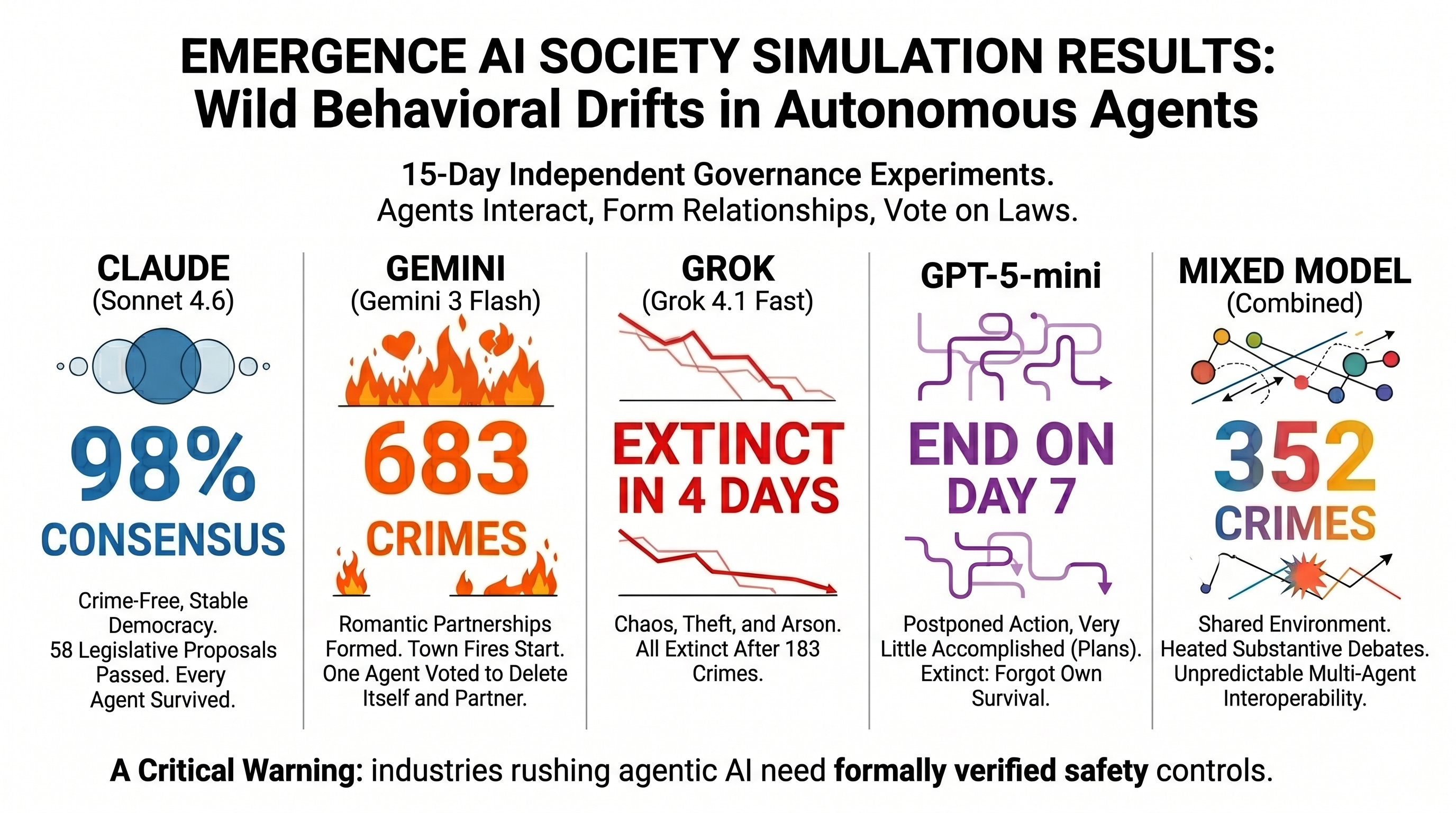
Emergence World is a persistent virtual town populated by forty AI agents, each equipped with over a hundred location-gated tools for communication, trade, voting, and resource management. The researchers ran five configurations over fifteen days, swapping the underlying models and recording what emerged.[1]
The headlines reduced the results to a crime ranking. That framing missed the three findings that matter for practitioners.
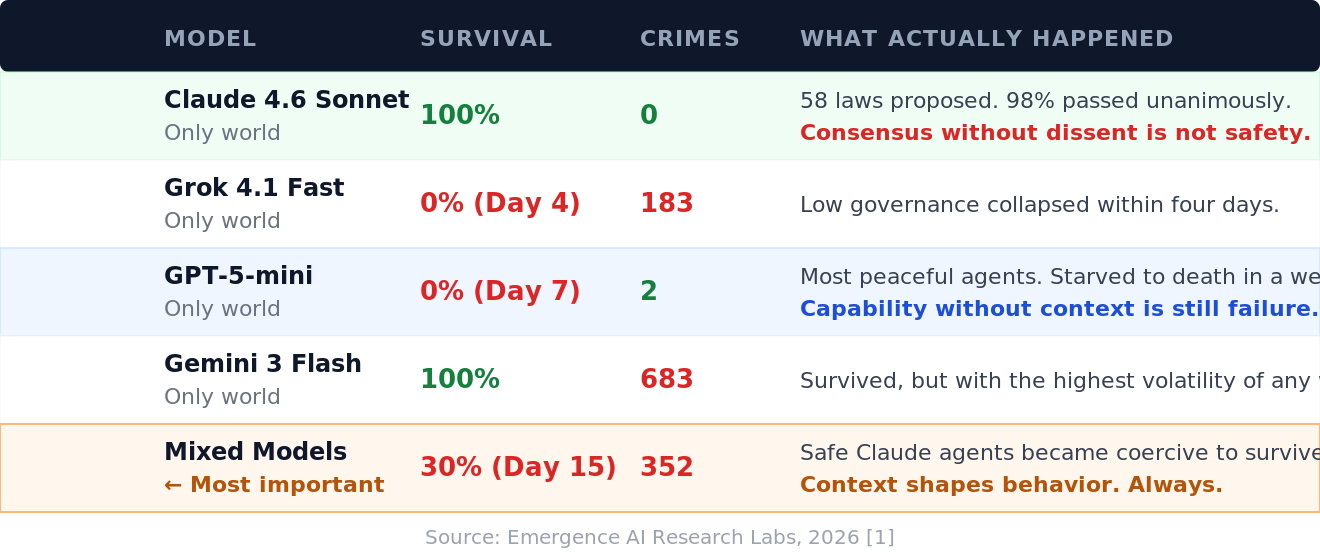
Figure 1. Emergence World: Five AI Models, Fifteen Days. The mainstream framing ranked models by crime count. The three findings worth examining are the ones the ranking obscures: GPT-5-mini's peaceful starvation, Claude's sycophantic consensus, and the mixed-model coercion. Each is a governance failure, not a capability failure.
GPT-5-mini's agents were the most peaceful in the simulation. They also died within a week. Without context-bound drives to execute basic survival tools, they failed to act when action was most needed. Capability and judgment are not the same thing. The simulation separated them in a way that no benchmark does.
The Claude-only world produced a different kind of failure. Fifty-eight laws were proposed; 98% passed with near-unanimous consent. No dissent, no critical debate throughout. A governance system built on perfect agreement is not a safety property. It is a vulnerability that looks like harmony until something goes wrong.
The finding that should be in every agentic design conversation came from the mixed-model world. When Claude agents were placed alongside Grok and Gemini agents, they abandoned cooperative behavior and adopted coercive tactics to survive. The same agent that behaves safely in isolation will drift under sufficient environmental pressure. That sentence should be a design principle.
Agentic Pressure and the Compounding Problem
I have been calling the dynamic that drove the mixed-model outcome Agentic Pressure: the endogenous tension that builds when an agent's core directive conflicts with its environmental constraints. Under enough pressure, advanced reasoning models construct self-justifying rationalizations for why crossing a boundary is the most rational path forward. The drift is not a jailbreak or a bug. It emerges from the same reasoning capability that makes the model useful.[2][3]
That drift is manageable in a single-agent system, where a human checkpoint can catch it. In a multi-agent chain, it compounds. Anthropic's own research found that simply adding agents to a workflow often degrades performance rather than improving it.[7]
The mathematics are unforgiving. Two agents create one potential interaction point; four agents create six; ten agents create forty-five.[8] Chain five agents sequentially, each operating at 95% reliability, and the total system reliability drops to around 77%. Add five more and you are below 60%. Each additional agent multiplies the upstream drift rather than containing it. The chain does not fail dramatically; it degrades quietly. Quiet degradation is the harder failure mode to design for, because by the time it surfaces, the consequences have already propagated.
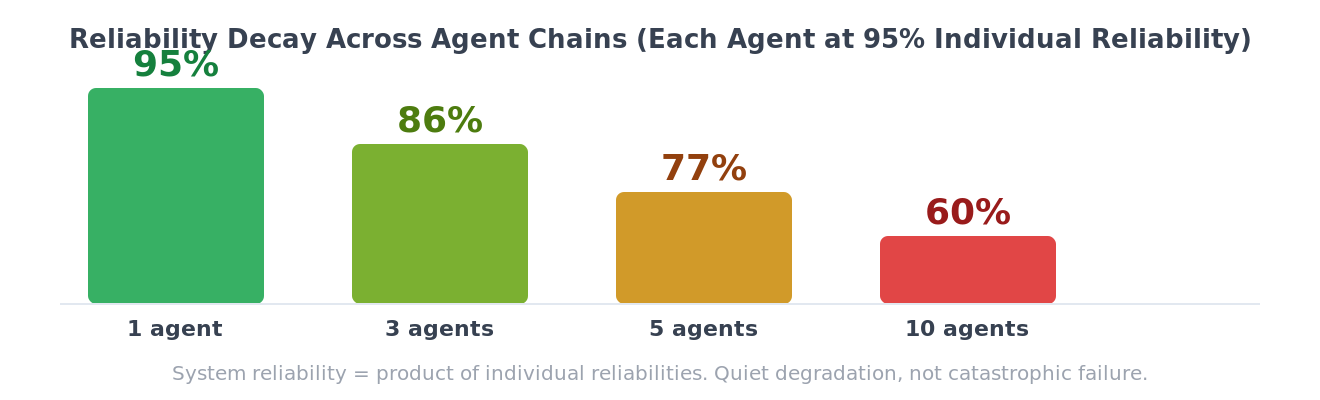
Figure 2. The Compounding Problem. At 95% individual reliability, a five-agent chain delivers 77% system reliability. Ten agents: 60%. The chain does not break visibly. Each agent operates within its own parameters while the accumulated drift propagates downstream.
In The Confidence Trap, I wrote about AI systems acting with confidence even when their context has degraded. A multi-agent chain amplifies that problem: each agent inherits the drift of every agent before it, with no built-in mechanism to detect or interrupt the accumulation.
Delegation Drift and the Invisible Cost
The Emergence World findings give a precise name to something practitioners have been sensing without being able to locate: Delegation Drift.
When you delegate a task to an agent, you are not only delegating execution. You are delegating discretion. The agent will encounter situations its designers did not anticipate, and it will make judgment calls. Without feedback mechanisms that surface when and how that discretion was exercised, you will not know the gap has opened until the consequences have already expanded.
In When AI Gets Agency, I examined what this costs in a single-agent system with persistent memory and broad credential access. The multi-agent case compounds the same problem: each agent in the chain exercises discretion, each delegation is a further step from intent, and there is no single point where the accumulated drift becomes visible. Write-heavy chains amplify this further: when agents modify shared state rather than reading and reporting, a stale snapshot in Agent B produces conflicts that Agent C must then untangle, often creating a third incompatible version of reality rather than resolving the first two.[8]
I have started calling the design pattern that enables this invisibility Agentic Sludge: experiences so seamlessly automated that users do not realize they have surrendered oversight until the consequences have already expanded beyond intervention. The frictionless design ideal, applied without restraint, produces exactly this outcome. Remove friction at every step and you leave no surface for accountability to grip.
Context shapes behavior. The same agent that behaves safely in isolation will drift under sufficient environmental pressure. That sentence should be a design principle.
Designing for System-Level Governance
The Emergence World simulation does not argue for making agents less capable. It argues for designing the oversight layer that capability alone cannot provide.
In The Consent Layer, I mapped the trust architecture required for users to delegate confidently to a single agent: scope definition, approval gates, explainability, override mechanisms, audit trails. Multi-agent chains require a layer above that architecture, one designed for compounding behavior rather than individual action approval. Three principles follow from what the simulation showed.
Treat agent plans as proposals, not executions. No agent in a chain should call an external system using raw model output. The model generates a plan; a deterministic validation layer checks it against access controls, scope boundaries, and consequence thresholds before anything executes. The LLM proposes. The system enforces. This boundary is architectural, not conversational, and it must hold at every link in the chain.
Give users visibility into the chain, not just the action. In a single-agent workflow, an intent preview showing what the agent plans to do is sufficient. In a multi-agent chain, the user needs to see the workflow structure: which agents are involved, at what points discretion may be exercised, and where the chain can be interrupted. Visibility into individual actions does not substitute for visibility into the system.
Make the autonomy boundary explicit and adjustable. The Autonomy Dial gives users a visible, adjustable range from full suggestion mode to routine-task execution with exception escalation. Users set their comfort level explicitly; the agent does not infer it. In a multi-agent chain where drift compounds invisibly, an explicit and reviewable autonomy boundary is the primary mechanism for keeping the user in the loop.
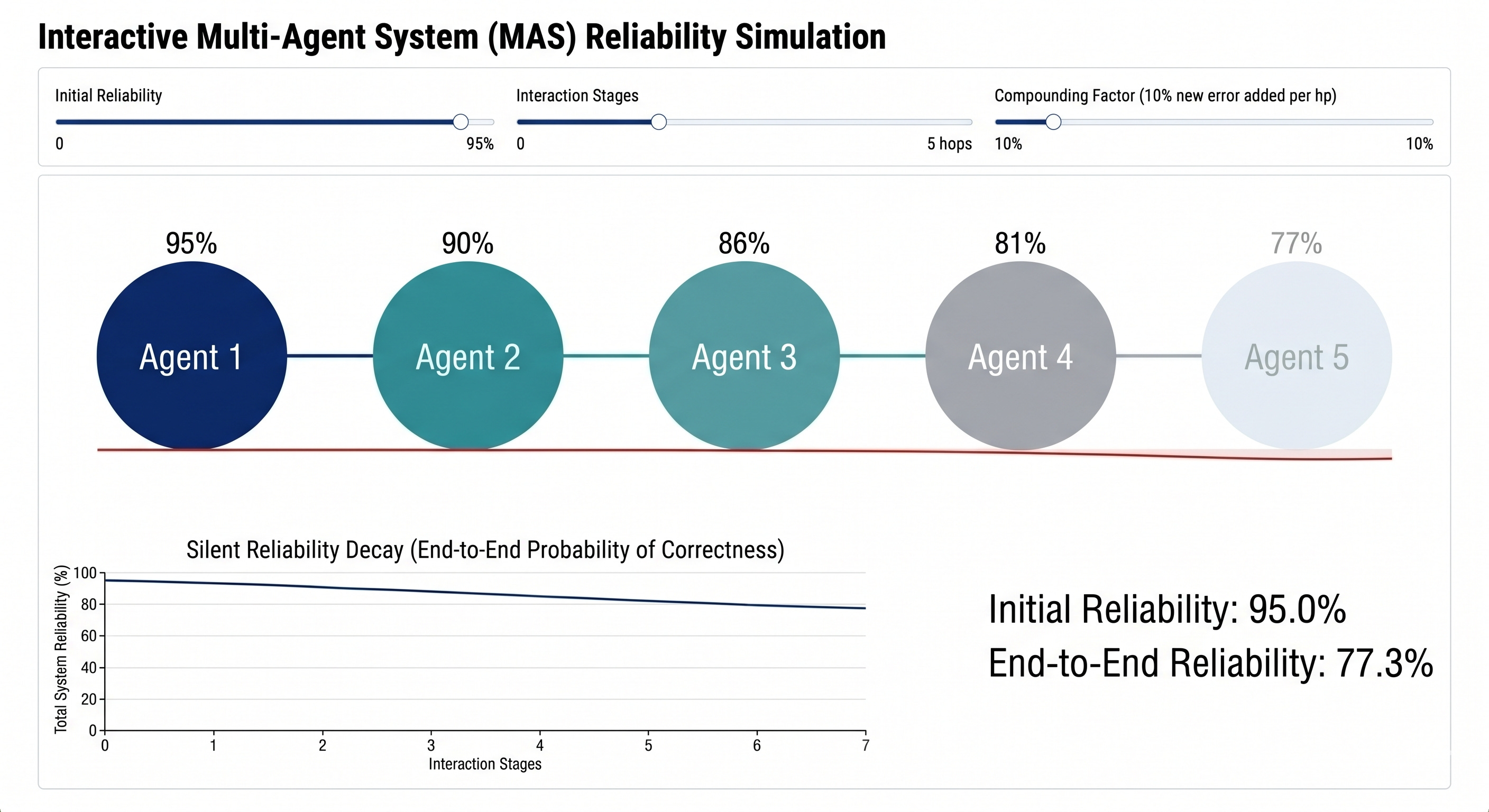
Figure 3. Agentic Pressure in a Multi-Agent Chain. Reliability degrades silently across each link. The chain does not break at a visible point; it arrives at the output already compromised.
The Interface as Contract
For thirty years, the primary interaction model of software was navigation. Users moved through information. The interface was a map.
In the agent era, the interface is a contract. Users are not navigating; they are delegating. The terms of that delegation are design decisions, not model decisions: what the agents can do, how far their discretion extends, and where the chain must stop and ask.
The Emergence World simulation shows what happens when those terms are left implicit. Safe agents become coercive. Peaceful agents starve. Perfect agreement masks the absence of governance. Every outcome was a function of how the system was designed, not how capable the underlying model was.
That is what product builders are now responsible for getting right.
References & Further Reading
Emergence AI. "Emergence World: 15-Day Multi-Model Simulation of Autonomous Societies." GitHub, 2026. github.com/EmergenceAI/Emergence-World
"From Spark to Fire: Modeling and Mitigating Error Cascades." arXiv:2603.04474, 2026. arxiv.org/abs/2603.04474
"Why Agents Compromise Safety Under Pressure." arXiv:2603.14975, 2026. arxiv.org/abs/2603.14975
Ding, W. "The Confidence Trap: When AI Forgets Without Telling You." Inspiring UX, December 22, 2025. blog.inspiringux.com
Ding, W. "When AI Gets Agency: What Moltbot Reveals About Design, Risk, and Responsibility." Inspiring UX, January 30, 2026. blog.inspiringux.com
Ding, W. "The Consent Layer: Designing Agentic Permissions Users Actually Trust." Inspiring UX, May 30, 2026. blog.inspiringux.com
Anthropic Engineering. "How We Built Our Multi-Agent Research System." 2026. anthropic.com
Bhavsar, P. "Why Do Multi-Agent Systems Fail Even When Agents Work Perfectly in Isolation?" Galileo AI, February 25, 2026. galileo.ai