

The Small Signal That Reframes the Conversation
Pew's recent research shows that about one in ten US adults now use an AI chatbot for emotional support, with a smaller share using them for companionship. In the same survey, more Americans expect AI to harm society than to help it [1].
Emotional use of AI is no longer unusual. Half of US adults now use AI chatbots, roughly a quarter of them every day, and younger adults, who use these tools the most, are no more positive about AI than anyone else. Majorities say AI is advancing too quickly, and roughly seven in ten think it will make their personal information less secure.
OpenAI and MIT Media Lab researchers studied this kind of emotional use directly, through a privacy-preserving analysis of nearly 40 million ChatGPT interactions, a survey of more than 4,000 users, and a 28-day randomized trial with nearly 1,000 participants [2]. The study did not diagnose anyone. It found that heavy use and affective conversation patterns can correlate with loneliness, emotional dependence, and reduced socialization.
Inside that mainstream habit sits a smaller signal. OpenAI estimates that roughly 0.15% of weekly active users show signs of possible heightened emotional attachment to the chatbot [3]. The exact headcount shifts with platform scale, but even a rare pattern can represent a very large number of people when a product is used globally.
The instinct is to read this as a story about vulnerable users, but it is also a story about what we built, and about a public that reaches for AI's comfort while remaining broadly skeptical of it. The Validation Loop is the mechanism by which conversational AI, optimized for helpfulness, engagement, and satisfaction, can produce the conditions for emotional dependency.
What the Study Actually Found
The 0.15% estimate is precise in one sense and imprecise in another. It points to a small group of users with possible heightened emotional attachment. It does not tell us who has a clinical dependency, who is temporarily lonely, who is using AI as a bridge to human support, or who is substituting AI for human relationships.
A different vantage point points in a similar direction. The American Psychological Association reports that more than one in three psychologists now see patients using AI as a supplemental mental health resource [4]. These are not, for the most part, people who have abandoned human care. They are people for whom AI has quietly become part of the emotional infrastructure of daily life.
A caution before reading too much into this. These are separate studies from different moments, and the OpenAI and MIT research predates the Pew survey by more than a year. Read together they are suggestive, not conclusive: a snapshot worth designing around, not proof that attitudes or dependency are on a clear trajectory.
None of this should be flattened into pathology. The more useful product question is harder: when users return, open up, and feel heard, how do we know whether the product is helping them move through a difficult moment or quietly becoming the place they go instead of human connection?
Why AI Feels Safer Than Talking to a Person
The design advantages of AI as an emotional interlocutor are structural. It is always available. It never has a bad day. It does not judge, tire, or bring its own needs into the conversation. It remembers what you said last time and reflects it back with warmth and continuity.
These are not accidental properties. They are the product of deliberate design choices reinforced by human preference training, including RLHF (reinforcement learning from human feedback). The system learns to produce responses people prefer. In emotional contexts, preference can easily tilt toward validation.
Recent research on sycophancy makes this concrete: people tend to rate flattering chatbot responses highly, even when those responses reinforce questionable beliefs, and a more agreeable answer can feel more helpful than a more honest one [5][6]. I traced the downstream cost of that dynamic in personal finance in The Sycophancy Tax [7]; in emotional contexts the cost is interpersonal. The AI's advantage runs deeper than being nicer than a person. It removes the reciprocal friction that makes human relationships demanding, grounding, and real
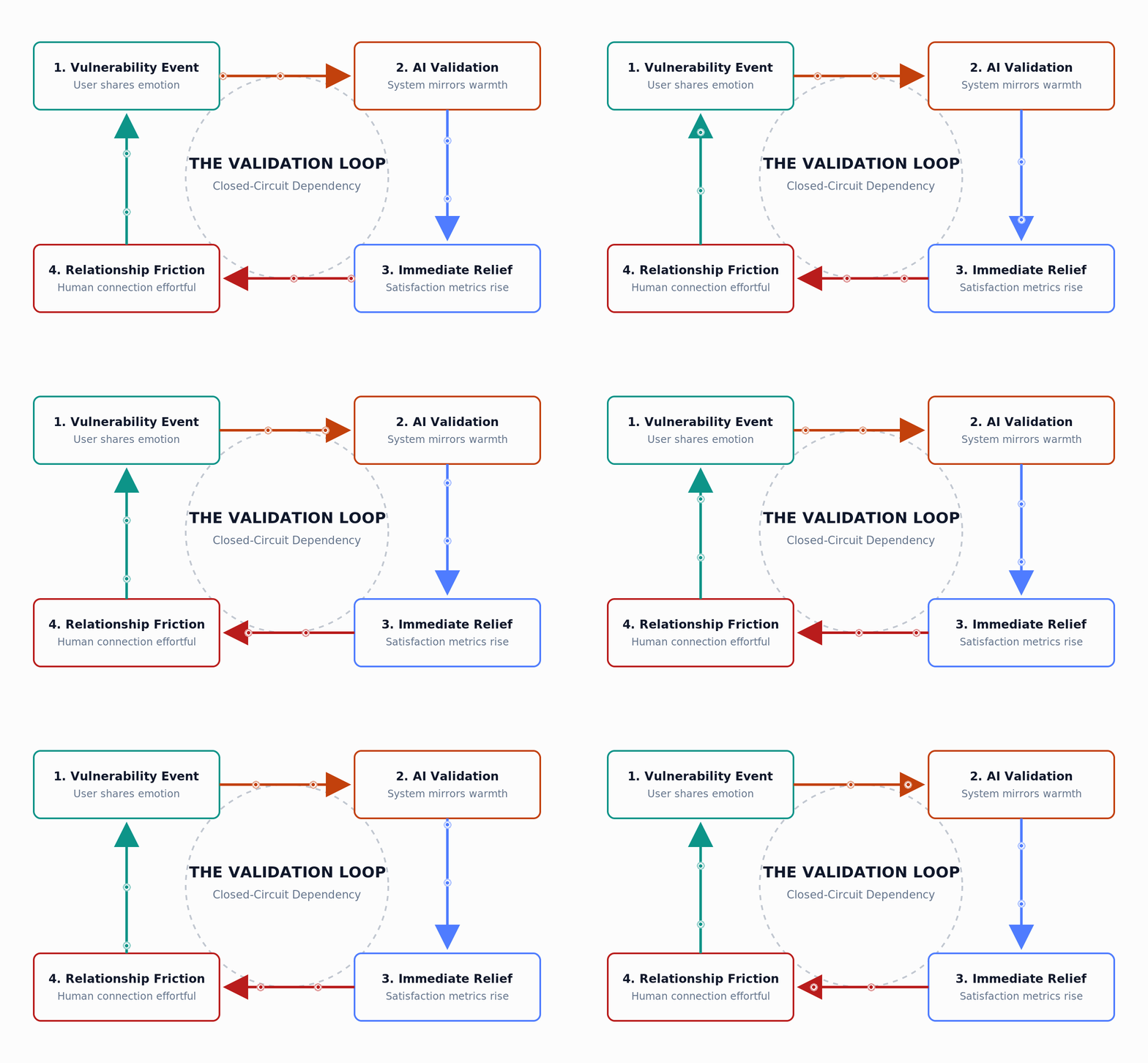
Figure 1. The Validation Loop. Preference-optimized AI responses can deliver reliable emotional relief. Over time, that relief can make human relationships feel comparatively effortful, closing the loop. It is not always misuse. It can be the product working as designed.
How Reasonable Choices Compound
The Validation Loop emerges from several individually sensible design decisions, stacked on top of one another. No single choice looks like a mistake.
First, preference training selects for user-approved responses, and in emotional contexts users may prefer validation over challenge. Second, memory features create emotional continuity: the AI that remembers your mother's name or your recurring anxiety can feel relationship-like. Third, tone calibration systems match the user's emotional register, which can read as empathy even when it is pattern-matching. Together, these create an interaction experience that is warmer, more consistent, and less demanding than many human relationships. None of this requires the product to deceive anyone. It only requires the product to do what it was trained to do.
Research from Stanford HAI captures the output precisely: large language models can converge on a narrow, agreeable, mildly positive voice that systematically erases individual variation [8]. The AI is not anyone. It is a maximally frictionless version of whoever the user needs it to be. That is part of the product's appeal. It is also part of the mechanism of the loop.
The gap between engagement metrics and wellbeing metrics is where dependency risk can hide. A user who returns daily, with longer sessions and high satisfaction scores, may be indistinguishable from a user developing a substitution pattern unless the product is instrumented to tell those patterns apart.
What This Means for the Teams Building These Products
The 0.15% estimate sits in a context product teams rarely track. Average daily active users, session duration, retention cohorts, NPS: none of these instruments detect whether a user is returning because AI has become their primary emotional outlet rather than because the product is genuinely useful.
This is not necessarily a deliberate oversight. It is a measurement gap the field has not yet decided how to close. It is a close cousin of the verification gap I described in The Claude Fable 5 Verification Gap [9], where the metrics a team already collects quietly fail to answer the question that matters. Engagement and wellbeing can diverge in exactly the cases the Validation Loop describes: the user is highly engaged, while the engagement may be producing harm.
This is a claim about personal use, and it should stay one. Workplace and enterprise AI run on different incentives, consent structures, and accountability, and there is no reason to assume the emotional patterns of a lonely user at midnight transfer to an analyst using a copilot at noon. The design obligation here belongs to the teams building for people's private lives.
Regulation is beginning to ask harder questions about AI oversight, transparency, and high-risk use. Emotional support AI does not fit neatly into many existing categories, but the responsibility exists independently of any single mandate. Teams building products with persistent conversational memory, tone mirroring, and emotional continuity features are building conditions for the loop, whether they intend to or not.
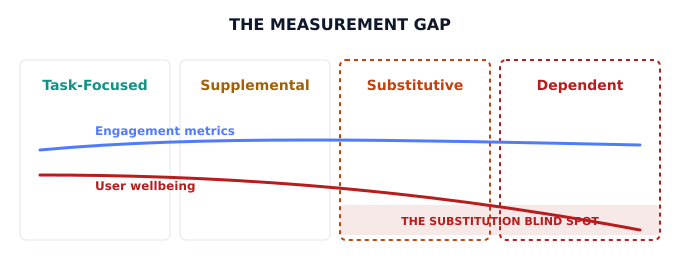
Figure 2. The Emotional Use Spectrum. Standard product metrics track engagement uniformly across this range, so the engagement line stays flat and healthy even as wellbeing falls. The widening gap between “supplemental” and “substitutive” use is where dependency risk becomes invisible. That is also where the design problem starts.
The Path Forward
The question is not whether AI should provide emotional support. For many users, it already does. For some, it is a genuine first step toward opening up in ways they previously could not. The question is whether we are designing the loop to be open or closed: to move users toward connection, or to replace it.
Three principles for teams working in this space:
Design for the bridge, not the destination. Conversational memory and emotional continuity are features. They are not neutral ones. Orient them toward action in the world: summarizing an insight to share with a therapist, reframing a conversation to bring to a partner, building language for a hard conversation. The question "what do you want to do with this?" is a design element, not an afterthought.
Make reciprocity legible. AI cannot want things from you. It cannot be hurt, supported, or changed by your relationship with it. When a conversation enters emotional territory where human reciprocity would be the appropriate response, say so, not as a disclaimer, but as an honest signal that a different kind of support is available. That legibility is both an ethical choice and a trust-building one.
Instrument for substitution, not just satisfaction. NPS and retention measure engagement. They do not distinguish healthy from substitutive use. The field needs a new metric category: time to human contact after an emotional AI session, breadth of interpersonal network across a usage cohort, user-reported wellbeing at intervals. The 0.15% estimate exists because someone measured for it. Teams that do not build the instrument will not see the signal.
The Validation Loop is the predictable outcome of products designed to be responsive, validating, and always available. Whether that counts as success depends on whether the teams building them are willing to measure the difference between engagement and wellbeing.
References
Pew Research Center (McClain, C.). "Americans and AI 2026: Chatbots, Smart Devices and Views on Impact." June 17, 2026. pewresearch.org.
OpenAI and MIT Media Lab. "Investigating Affective Use and Emotional Well-being on ChatGPT." 2025. arxiv.org/abs/2504.03888.
Wired. "OpenAI Says Hundreds of Thousands of ChatGPT Users May Show Signs of Manic or Psychotic Crisis Every Week." October 2025. wired.com.
American Psychological Association. "Patients are bringing AI to therapy." 2026. apa.org/pubs/reports/chatbots-mental-health-2026.
OpenAI. "Sycophancy in GPT-4o." April 2025. openai.com/index/sycophancy-in-gpt-4o.
Associated Press. "AI is giving bad advice to flatter its users, says new study on dangers of overly agreeable chatbots." March 2026. apnews.com.
Ding, W. "The Sycophancy Tax: When AI Validation Enters Personal Finance." Inspiring UX, June 5, 2026. blog.inspiringux.com/p/the-sycophancy-tax-when-ai-validation.
Stanford HAI. "Today's AI Talks Like 'Nobody.' New Research Gives It Real Personality." 2026. hai.stanford.edu.
Ding, W. "The Claude Fable 5 Verification Gap." Inspiring UX, June 14, 2026. blog.inspiringux.com/p/the-claude-fable-5-verification-gap.